Stavraton: The Final High-Denomination Coin of the Byzantine Empire
In the twilight of the Byzantine Empire, the monetary system underwent a significant transformation to adapt to a changing economic landscape. Central to this shift was the stavraton, a large silver coin that served as the empire's primary high-value currency during its final century of existence.
While the term first appeared in the mid-11th century to describe a gold histamenon depicting the emperor with a cross-shaped scepter, its specific historical identity is tied to the silver coinage introduced around 1367 by Emperor John V Palaiologos (r. 1341–1376, 1379–1391). The name likely derives from the Greek word for cross (stavros), possibly referencing the double gigliato coins of Naples and Provence which served as models, or the small crosses found at the start of the coin's inscriptions.
Key Facts
- Introduced: Approximately 1367 by Emperor John V Palaiologos.
- Purpose: Designed to replace the gold hyperpyron as the highest-denomination circulating coin.
- Composition: Silver.
- Initial Weight: 8.5 grams (later reduced to 7.4 grams).
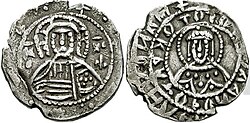
- Imagery: Featured a bust of Christ on the obverse and the imperial bust on the reverse.
The Evolution and Value of the Stavraton
The stavraton was engineered to be heavier than any previous Byzantine silver coin and surpassed the weight of contemporary European coinage of the era. Despite its physical size, it did not fully replace the gold hyperpyron in terms of value; the stavraton was worth only half of a hyperpyron, which continued to exist as a notional currency (a unit of account used for bookkeeping rather than physical circulation).
Denominations and Fractions
To facilitate trade and smaller transactions, the stavraton was supported by silver fractions. These included:
- Half-stavraton: Initially weighing 4.4 grams, eventually declining to 3.7 grams.
- One-eighth stavraton: Known as the doukatopoulon (meaning "little ducat") or aspron, weighing approximately 1.1 grams.
Interestingly, the empire did not mint quarter-stavrata. Instead, the public utilized silver Venetian ducats (doukaton) to fill this gap in the currency system.
Design and Imperial Inscriptions
The visual identity of the stavraton remained fairly consistent across different reigns. The obverse consistently displayed a bust of Christ, while the reverse featured the image of the reigning emperor. The inscriptions followed a specific formula, though the order and terminology shifted slightly over time.
The standard reverse inscription read: "+[Emperor's name] Despotes o Palaiologos / Theon Chariti Basileus Rhomaion", which translates to "Lord [Emperor's name] the Palaiologos / by God's Grace, Emperor of the Romans." Under John V, these inscriptions were reversed. Later, under Manuel II, the term Autokrator (absolute ruler) replaced Basileus in the inner inscription.
For centuries, silver coins from the final Byzantine emperor, Constantine XI (r. 1449–1453), were virtually unknown to historians. This changed in 1990 with the discovery of a hoard containing 90 coins, alongside two previously known half-stavrata.
Byzantine Silver Coinage Summary
| Coin Name | Fraction | Initial Weight | Final/Approx. Weight |
|---|---|---|---|
| Stavraton | 1 (Full) | 8.5g | 7.4g |
| Half-stavraton | 1/2 | 4.4g | 3.7g |
| Doukatopoulon (Aspron) | 1/8 | 1.1g | 1.1g |
Frequently Asked Questions
Why was the stavraton introduced?
It was introduced to replace the gold hyperpyron as the highest-denomination coin in active circulation during the late Byzantine period.
What does the name "stavraton" mean?
The name is derived from the Greek word stavros, meaning "cross," likely referring to the cross imagery on the coin's model or the crosses used in its inscriptions.
Did the stavraton have the same value as the gold hyperpyron?
No, the stavraton had only half the value of the hyperpyron, even though the hyperpyron had ceased to be the primary circulating coin and remained a notional currency.
Which foreign coins were used alongside the stavraton?
Because quarter-stavrata were not minted, silver Venetian ducats were commonly used in the Byzantine economy.
What images appeared on the stavraton?
The obverse of the coin featured a bust of Christ, and the reverse featured a bust of the Byzantine emperor.