Ploidy and Chromosome Sets in Biological Organisms
In the study of genetics, ploidy refers to the number of complete sets of chromosomes present in a cell. This numerical value determines how many possible alleles—alternative versions of a gene—exist for autosomal and pseudoautosomal genes. Chromosome sets are defined by the number of maternal and paternal copies within each homologous chromosome pair, which is the natural state in which chromosomes exist.
Organisms, tissues, and individual somatic cells (non-reproductive cells) are categorized by their ploidy level. While many animals are uniformly diploid, ploidy can vary significantly between different species, different tissues within a single organism, or at various stages of a life cycle.
Key Facts
- Monoploid refers to a single set of chromosomes.
- Diploid organisms possess two complete sets of chromosomes.
- Polyploid is a general term for cells with three or more sets of chromosomes.
- Euploidy occurs when the chromosome number is an exact multiple of the species' typical gamete number.
- Aneuploidy occurs when a cell has an abnormal number of chromosomes that is not an exact multiple of a set.
- Polyploidy is highly common in plants, particularly grasses, and in some invertebrates, reptiles, and amphibians.
Foundational Concepts of Ploidy
Monoploid vs. Haploid
While often used interchangeably in diploid organisms, there is a technical distinction between these terms. The monoploid number (x) is the number of chromosomes found in a single complete set. The haploid number (n) refers specifically to the total number of chromosomes found in a gamete (sperm or egg cell) produced via meiosis.
In diploid species, the monoploid and haploid numbers are equal. However, in polyploid species, they differ. For example, in the common potato (Solanum tuberosum), which is tetraploid, the monoploid number is 12, but the haploid number is 24.
![A haploid set that consists of a single complete set of chromosomes (equal to the monoploid set), as shown in the picture above, must belong to a diploid species. If a haploid set consists of two sets, it must be of a tetraploid (four sets) species.[1]](/images/be/6c/be6cdf52a11e3da564514c7e0d66192c402603b7759ccbec1765ec0554abdbe5.webp)
Diploidy in Humans
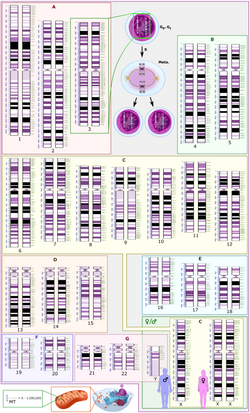
Humans are diploid organisms. Our somatic cells normally contain two complete sets of chromosomes—one paternal and one maternal—forming 23 homologous pairs for a total chromosome complement of 46. During meiosis, this number is halved to create haploid gametes with 23 chromosomes each. Upon fertilization, the fusion of these gametes restores the diploid number of 46 in the resulting zygote.
Types of Ploidy and Variations
Polyploidy
Polyploidy occurs when cells contain three or more sets of chromosomes. This state is a major driver of speciation in plants and fungi. Specific levels include:
- Triploid: 3 sets
- Tetraploid: 4 sets
- Pentaploid: 5 sets
- Hexaploid: 6 sets
Some organisms exhibit extreme ploidy. Polytene chromosomes in fruit flies can be 1024-ploid, and the silk glands of the commercial silkworm (Bombyx mori) can reach 1,048,576-ploid.
Aneuploidy and Euploidy
An organism is euploid if its chromosome count is an exact multiple of the monoploid set. Conversely, aneuploidy describes a condition where the chromosome number is irregular. An example in humans is Turner syndrome, where an individual may be missing a sex chromosome, resulting in a (45,X) karyotype instead of the usual 46.
Biological Distribution and Significance
Ploidy Across Species
Ploidy levels vary widely across the tree of life. In the genus Xenopus (African toads), species range from diploid (X. tropicalis) to dodecaploid (X. ruwenzoriensis, 12 sets). While polyploidy is common in plants—with half of all known plant genera containing polyploid species—it is typically fatal in mammals and birds.
Tissue-Specific Polyploidy
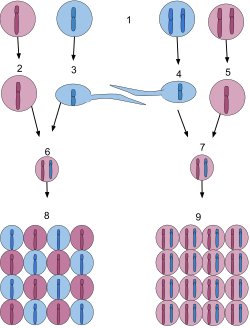
Ploidy is not always uniform across an entire organism. Some species exhibit mixoploidy, where different tissues have different ploidy levels. In mammals, the liver is a notable example where entire tissues may be polyploid even though the rest of the body remains diploid.
Summary of Ploidy Terminology
| Term | Description |
|---|---|
| Ploidy Number | The total number of chromosome sets in a cell. |
| Monoploid Number (x) | Number of chromosomes in a single complete set. |
| Haploid Number (n) | Number of chromosomes found in gametes. |
| Chromosome Number | Total number of individual chromosomes across all sets. |
| Euploid | An organism with a chromosome number that is an exact multiple of a set. |
| Aneuploid | An organism with an abnormal number of chromosomes (not a multiple of a set). |
Frequently Asked Questions
What is the difference between haploid and diploid?
A haploid cell contains one single set of chromosomes (n), typically found in gametes like sperm and eggs. A diploid cell contains two complete sets of chromosomes (2n), one from each parent, typically found in somatic cells.
Can an organism have more than two sets of chromosomes?
Yes, this is called polyploidy. It is very common in plants (such as wheat and potatoes) and some animals like amphibians and reptiles. Some specialized tissues can even have thousands of sets of chromosomes.
What happens if a human has an incorrect number of chromosomes?
This is known as aneuploidy. Depending on which chromosome is affected, it can lead to genetic syndromes, such as Turner syndrome (45 chromosomes), or it can be fatal to the developing embryo.
Why is polyploidy more common in plants than in mammals?
Polyploidy is a significant driver of evolution and speciation in plants and fungi. In contrast, changes in ploidy levels in mammals and birds are typically fatal, though some evidence suggests ancient polyploidization events contributed to early evolutionary diversification.