Plaza de Mayo: The Historic Heart of Buenos Aires
Located in the vibrant microcentro (financial district) within the neighborhood of Monserrat, the Plaza de Mayo is far more than just a city square; it is the symbolic epicenter of Argentine political and social life. From the dawn of the city's foundation to the modern era, this space has witnessed the most pivotal moments in the nation's history, serving as the stage for both triumphant celebrations and poignant protests.
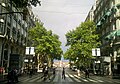
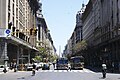
The square is bounded by Bolívar, Hipólito Yrigoyen, Balcarce, and Avenida Rivadavia streets. It serves as a major urban hub where three significant thoroughfares originate from its western side: Avenida Presidente Julio Argentino Roca, Avenida Roque Sáenz Peña, and Avenida de Mayo.
Key Facts
- Location: Monserrat, Buenos Aires, Argentina.
- Established: Originally founded in 1580; unified into its current form in 1884.
- Primary Landmark: The May Pyramid, the city's first national monument.
- Political Significance: Site of the May Revolution and the focal point for national demonstrations.
- Transport: Served by Underground stations Plaza de Mayo (Line A), Catedral (Line D), and Bolívar (Line E).
The Evolution of the Plaza
The origins of the plaza date back to 1580, coinciding with Juan de Garay's foundation of Buenos Aires. In 1608, Jesuit clergymen secured a title to the 2-hectare lot. By 1661, the local governor acquired the eastern half for the city's new fort, creating the Plaza de Armas.
By the early 19th century, the area had fallen into neglect. To restore order, a Romanesque colonnade was constructed from north to south in 1804. This structure functioned as a market and split the area into two distinct sections: the Plaza de la Victoria to the west and the Plaza de Armas to the east.
The unification of these spaces occurred in 1884 under the direction of Mayor Torcuato de Alvear, who ordered the demolition of the colonnade to modernize the area, resulting in the singular Plaza de Mayo we recognize today.
Architectural and Cultural Landmarks
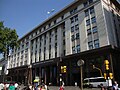
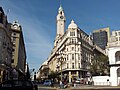
The square is surrounded by some of Argentina's most significant government and religious buildings, making it a primary destination for tourists and historians alike.
Central Monuments and Government Seats
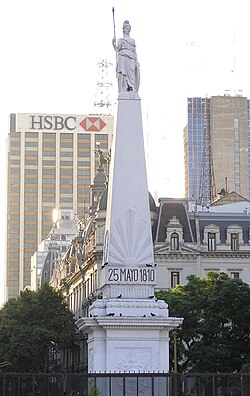
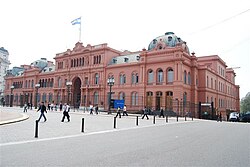
At the center of the square stands the Pirámide de Mayo (May Pyramid), inaugurated in 1811 to commemorate the first anniversary of the May Revolution. The eastern side is dominated by the Casa Rosada, the official seat of the President of Argentina.
Civic and Religious Institutions
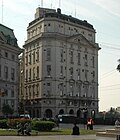
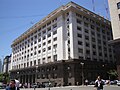
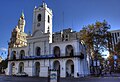
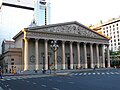
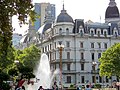
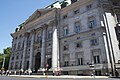
The perimeter also features the Cabildo, which served as the city council during the colonial era, and the Metropolitan Cathedral of Buenos Aires. Other notable structures include the Buenos Aires City Hall and the headquarters of the Bank of the Argentine Nation.
A Legacy of Political Struggle
The Plaza de Mayo is named in honor of the May Revolution of 1810, the catalyst for Argentina's eventual independence from Spain in 1816. Since then, it has remained the primary site for popular demonstrations.
The Peronist Era and Conflict
On October 17, 1945, mass demonstrations organized by the CGT trade union federation led to the release of Juan Domingo Perón. This date became known as "Loyalty Day" for Peronists. However, the plaza also saw tragedy on June 16, 1955, when a bombing during a rally killed 364 people in an attempt to overthrow Perón.
Human Rights and the Mothers of the Plaza de Mayo
Since 1977, the square has been the gathering place for the Mothers of the Plaza de Mayo. These women congregated to demand answers regarding their children, the desaparecidos (disappeared), who were victims of forced disappearance, torture, and murder by the military regime during the "Dirty War" of the National Reorganization Process.
The plaza continued to be a site of unrest into the 21st century, most notably during the December 2001 riots, which resulted in five deaths and several injuries.
Summary of Plaza de Mayo Landmarks
| Landmark | Significance | Location/Position |
|---|---|---|
| May Pyramid | First national monument; commemorates May Revolution | Center of the square |
| Casa Rosada | Executive office of the President of Argentina | Eastern side |
| Cabildo | Former colonial city council | Surrounding area |
| Metropolitan Cathedral | Main cathedral of Buenos Aires | Surrounding area |
| Bank of the Argentine Nation | National financial headquarters | Surrounding area |
Frequently Asked Questions
What is the significance of the May Pyramid?
The May Pyramid, inaugurated in 1811, is Buenos Aires' first national monument. It was built to commemorate the first anniversary of the May Revolution, which began Argentina's journey toward independence from Spain.
Who are the Mothers of the Plaza de Mayo?
They are a group of mothers who have gathered in the square since 1977 to protest the forced disappearance of their children during the military dictatorship's "Dirty War," bringing international attention to human rights abuses in Argentina.
How was the current Plaza de Mayo formed?
The modern plaza was created in 1884 when Mayor Torcuato de Alvear ordered the demolition of a Romanesque colonnade (the Recova) that had previously divided the space into the Plaza de la Victoria and the Plaza de Armas.
Which government buildings are located around the square?
The most prominent government buildings include the Casa Rosada (the presidential palace), the Cabildo (former colonial council), and the Buenos Aires City Hall.
How can visitors access the Plaza de Mayo via public transport?
The square is highly accessible via the Buenos Aires Underground (Subte), with three nearby stations: Plaza de Mayo (Line A), Catedral (Line D), and Bolívar (Line E).