Plankton: The Drifters Driving Global Ocean Ecosystems
Derived from the Greek word planktos, meaning "drifter" or "wanderer," plankton are organisms that inhabit water or air but lack the ability to propel themselves against currents or wind. While often associated with the saltwater of the oceans and brackish estuaries, plankton are also found in freshwater lakes and rivers. An individual organism within this group is referred to as a plankter.
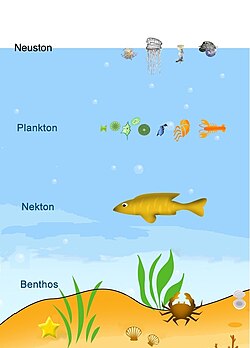
Plankton are not defined by a single taxonomic group or biological kingdom. Instead, they are categorized by their ecological niche and motility. This diverse group ranges from microscopic bacteria and archaea to larger animals like jellyfish. By definition, plankton are distinct from nekton (organisms that can swim against currents) and benthos (organisms living on the ocean floor). Additionally, neuston are organisms that float at the water's surface; those that cannot swim against the wind or current are considered a specialized subset of plankton.
Key Facts
- Diverse Scale: Plankton range from femtoplankton (viruses) to megaplankton (jellyfish).
- Trophic Roles: They are divided into producers (phytoplankton), consumers (zooplankton), and decomposers.
- Global Impact: They form the base of the marine food web and play a critical role in the global carbon cycle.
- Life Cycles: Some spend their entire lives as plankton (holoplankton), while others are only planktonic during larval stages (meroplankton).
- Atmospheric Reach: Some microorganisms can be swept into the atmosphere as aeroplankton.
Classification by Trophic Mode
![Jellyfish are gelatinous zooplankton.[77]](/images/de/28/de28d1c7a8f77b9e9d4a5bdd738dac4c262ce2ac08accf3df45b56dc1142cecd.jpg)
Traditionally, plankton were divided into two primary feeding groups, though modern research has identified more complex roles.
Phytoplankton
These are autotrophic, plant-like producers, such as diatoms and cyanobacteria. They synthesize their own food via photosynthesis and form the foundational base of the marine food web.
![Ocean chlorophyll concentration is a proxy for, or an indicator of, the distribution and abundance of phytoplankton. The intensity of green indicates how abundant the phytoplankton are, while blue indicates where there are few phytoplankton. – NASA Earth Observatory, October 2019.[6]](/images/27/2c/272c0401e3a007308732c6b2c4d7286f48d80b0a3d9a08182271f8e81fb31e5b.png)
Zooplankton
Zooplankton are heterotrophic consumers, such as copepods and radiolarians, which obtain energy by predating on other life forms, typically smaller phytoplankton.
Mixoplankton
Recent scientific findings have introduced the category of mixoplankton. These unicellular organisms, including many dinoflagellates, can combine photosynthesis and ingestion within a single cell, allowing them to act as both producers and consumers.
Planktonic Decomposers
This group includes bacterioplankton, aquatic viruses, and microscopic fungi (mycoplankton). These organisms recycle organic nutrients through processes like the mycoloop, microbial loop, and viral shunt, making nutrients available for other plankton.
![The central role played by pelagic fungi, both parasitic and saprotrophic in the mycoloop, and saprotrophic fungi as active contributors to the microbial loop. The activity of heterotrophic microbes, including pelagic fungi, has far-reaching global implications for fisheries (i.e., the amount of carbon that will ultimately flow to higher trophic levels) and climate change (i.e., the amount of carbon that will be sequestered in the ocean or respired back to CO2 and the release of other greenhouse gases; e.g., N2O.[99]](/images/de/06/de06384506b662a39d9456cbb134edd29ae59844a8bd474b23944dc55f41b79a.jpg)
Size Categories of Plankton
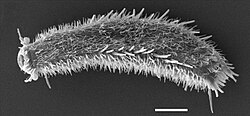
![Tomopteris, a holoplanktic bioluminescence polychaete worm[87]](/images/1a/9a/1a9adce469621a01beb2fbd4b0a9cf8c995cebcadcd9a05655b669e70f4841fb.jpg)
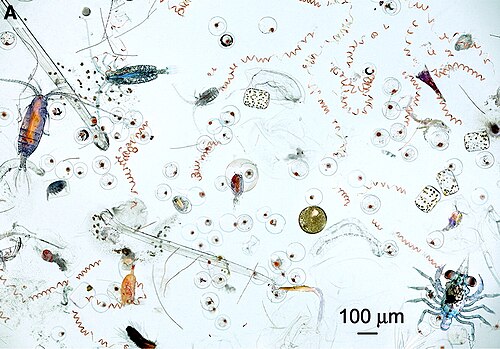
Scientists categorize plankton based on their Effective Size Diameter (ESD) to better understand their ecological roles.
| Group | Size Range (ESD) | Examples |
|---|---|---|
| Megaplankton | > 20 cm | Jellyfish, ctenophores, salps, cephalopods |
| Macroplankton | 2 – 20 cm | Sargassum seaweed, larger metazoans |
| Mesoplankton | 0.2 – 20 mm | Copepods, medusae, chaetognaths |
| Microplankton | 20 – 200 μm | Larger eukaryotic protists, some diatoms |
| Nanoplankton | 2 – 20 μm | Small diatoms, small flagellates |
| Picoplankton | 0.2 – 2 μm | Bacteria, small eukaryotic protists |
| Femtoplankton | < 0.2 μm | Marine viruses |
![Plankton species diversity Diverse assemblages of unicellular and multicellular organisms with different sizes, shapes, feeding strategies, ecological functions, life cycle characteristics, and environmental sensitivities.[16]](/images/0b/5f/0b5f484cacc5ce8047ccf266660b911a5a57d2d61ac1f0db5798009a075cbb4b.jpg)
Life Cycles and Habitats
Holoplankton vs. Meroplankton
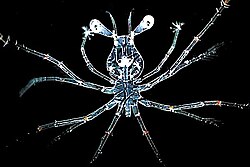
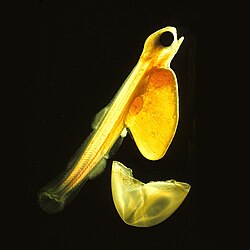
Plankton are further distinguished by the duration of their drifting phase. Holoplankton spend their entire life cycle as plankton, such as copepods. In contrast, meroplankton are temporary residents; for example, fish eggs and crab larvae drift as plankton before developing into nekton or benthos.
Diverse Habitats
- Aeroplankton: Microorganisms swept into the atmosphere via sea spray.
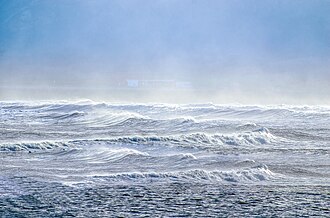
Sea spray containing microorganisms in marine plankton can be swept high into the atmosphere and may travel the globe as aeroplankton before falling back to earth. - Deep Ocean: Diverse microbial ecosystems found within the "ocean conveyor belt" of deep currents.
![The ocean conveyor belt carries warm surface waters (red) northward near the surface and cold deep waters (blue) southward. Diverse and flourishing microbial ecosystems have been found deep in the belt.[43][44]](/images/b2/bf/b2bf5912f665b6b29f0bf2b1342a0f6637f6cf0177497842bfe136e83b5418ca.jpg)
The ocean conveyor belt carries warm surface waters (red) northward near the surface and cold deep waters (blue) southward. Diverse and flourishing microbial ecosystems have been found deep in the belt.[43][44] - Surface Waters: The neuston layer, where organisms interact with the air-water interface.
Ecological Importance
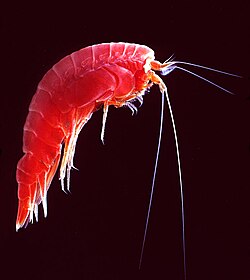
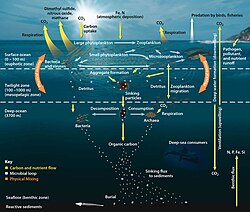
Plankton are central to the Earth's survival. They drive the marine food web, importing nutrients from the atmosphere and exporting them to the ocean floor. This process is vital for the global carbon cycle, as plankton sequester carbon or respire it back as CO2. Furthermore, the activity of heterotrophic microbes and pelagic fungi has significant implications for global fisheries and climate change.
Frequently Asked Questions
What is the difference between plankton and nekton?
Plankton are organisms that drift with water currents and cannot swim against them, whereas nekton are organisms capable of swimming actively against currents.
Can an organism be both a plant and an animal in the plankton?
Yes, these are called mixoplankton. They can perform photosynthesis like plants and ingest food like animals.
What are meroplankton?
Meroplankton are organisms that spend only a portion of their life cycle—usually the larval or egg stage—as plankton before transitioning to another lifestyle.
How do plankton affect climate change?
Plankton influence the carbon cycle by sequestering carbon in the deep ocean or releasing greenhouse gases like CO2 and N2O through microbial respiration.
What is the smallest type of plankton?
The smallest are femtoplankton, which consist of marine viruses measuring less than 0.2 micrometers.