Salps: The Jet-Propelled Architects of the Ocean's Carbon Cycle
In the vast expanses of the world's oceans, there exists a creature that looks like a translucent gummy bear but functions as a sophisticated biological pump. The salp (family Salpidae) is a barrel-shaped, planktonic tunicate—a marine invertebrate—that plays a disproportionately large role in the health and chemistry of our seas. From the freezing waters of the Southern Ocean to equatorial currents, these gelatinous animals are masters of efficiency and rapid adaptation.
Unlike many other plankton that drift aimlessly, salps are active swimmers. They move using a highly efficient form of jet propulsion, contracting their gelatinous bodies to pump water through their centers. As water flows through them, salps use internal feeding filters to strain out phytoplankton, the microscopic plants that form the base of the marine food web.
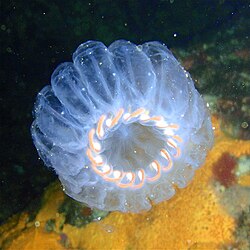
Key Facts
- Classification: They are chordates, meaning they possess a dorsal nerve cord and are more closely related to vertebrates than to jellyfish.
- Movement: They utilize one of the most efficient jet propulsion systems in the animal kingdom.
- Diet: They feed exclusively on phytoplankton via internal filtration.
- Environmental Impact: They contribute significantly to the ocean's biological pump by transporting carbon to the seafloor.
- Distribution: Found globally in equatorial, temperate, and cold seas, with massive concentrations near Antarctica.
A Complex Life Cycle: Two Generations in One
Salps possess a fascinating and obligatory alternation of generations, meaning they switch between two distinct life forms to survive and propagate.
The Solitary Phase (Oozooid)
The life cycle begins with the oozooid, a single, barrel-shaped animal. This phase is asexual; the oozooid reproduces by budding off a chain of tens to hundreds of smaller individuals, which are eventually released into the open water.
The Aggregate Phase (Blastozooid)
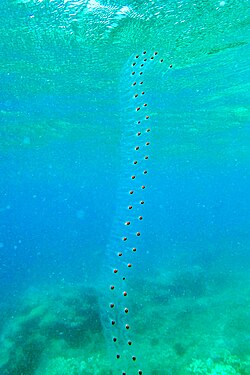
These offspring, known as blastozooids, form long, stringy colonies. They swim and feed together as a chain, growing in size as they go. Unlike their parent, blastozooids reproduce sexually. They are sequential hermaphrodites, maturing first as females and being fertilized by male gametes from older chains. Each blastozooid produces a growing embryo oozooid attached to its body wall.
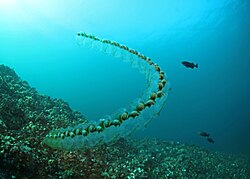
Once these embryos are released, they grow into solitary oozooids, completing the cycle. This dual-strategy allows salps to respond with incredible speed to phytoplankton blooms. When food is abundant, they can clone themselves and grow faster than almost any other multicellular animal.
Oceanographic Importance and Climate Impact
The ability of salps to rapidly multiply makes them a critical component of the ocean's biological pump. This process involves the transport of carbon from the surface to the deep ocean. As salps consume phytoplankton, they produce heavy fecal pellets and eventually die; both the pellets and their bodies sink rapidly to the seafloor, sequestering carbon away from the atmosphere.
However, their success can be disruptive. In 1920, a massive incursion of Salpa fusiformis into the North Sea caused the Scottish herring fishery to fail. Furthermore, if phytoplankton becomes too dense, salps can become clogged and sink, occasionally leaving beaches covered in slimy mats of gelatinous bodies.
Biological Relationships and Classification
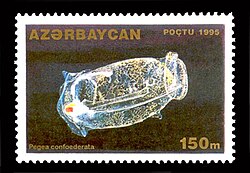
Despite their resemblance to jellyfish, salps are chordates. This means they share a common ancestor with vertebrates (animals with backbones). They are closely related to other pelagic tunicates, such as Doliolida and Pyrosoma, as well as benthic (bottom-living) tunicates.
Their transparent bodies also provide a unique ecosystem; small fish are often seen swimming inside salps to seek protection from predators.
| Feature | Description |
|---|---|
| Phylum | Chordata |
| Body Type | Barrel-shaped, gelatinous, transparent |
| Size | Typically 1 to 10 cm (0.4 to 3.9 in) |
| Locomotion | Jet propulsion via body contraction |
| Primary Diet | Phytoplankton |
| Key Habitats | Equatorial, temperate, and polar seas (especially Southern Ocean) |
Frequently Asked Questions
Are salps the same as jellyfish?
No. While they look similar and are both planktonic and gelatinous, salps are chordates (related to vertebrates), whereas jellyfish are cnidarians.
How do salps affect climate change?
By consuming phytoplankton and sinking to the ocean floor as waste or dead bodies, salps transport carbon from the surface to the deep sea, potentially altering the ocean's carbon cycle and damping global warming.
What is the difference between an oozooid and a blastozooid?
An oozooid is the solitary, asexual phase of the life cycle that produces chains of clones. A blastozooid is an individual within those aggregate chains that reproduces sexually.
Where are salps most abundant?
They are most concentrated in the Southern Ocean near Antarctica, where they sometimes form enormous swarms that can outnumber krill.
Can salps be harmful to other marine life?
While not predatory, they can compete with other planktonic species for food. Their rapid blooms can strip phytoplankton from the water, which may negatively impact other species that rely on the same food source.