Photometry History: The Evolution of Early Light Measurement
Before the invention of electronic light-sensitive elements, scientists relied on the human eye to measure light. This process, known as photometry, involved estimating the relative luminous flux—the total amount of visible light emitted by a source—by comparing an unknown light source against a known standard.
The fundamental principle behind these early measurements was the human eye's ability to judge equal illuminance (the amount of light falling on a surface). By arranging sources so that their illuminance was equal, researchers could calculate relative fluxes using the inverse square law, which states that illuminance decreases proportionally to the square of the distance from the source.
A simple example of this method involved a piece of paper with an oil spot to increase transparency. When the spot became invisible from either side, it indicated that the illuminance from both sides was equal.
Key Facts
- Early photometry relied on visual estimation rather than electronic sensors.
- Calculations were based on the inverse square law of distance.
- By 1861, three primary photometer types were in common use: Rumford's, Ritchie's, and the extinction of shadows method.
- The extinction of shadows was regarded as the most precise method of the era.
Common Types of Early Photometers
Rumford's Photometer
Also known as a shadow photometer, Rumford's device operated on the principle that a brighter light source casts a deeper shadow. Two lights were used to cast shadows onto paper; if the shadows appeared to be of the same depth, the difference in the distance of the lights revealed the difference in their intensity. For instance, a light placed twice as far away would need to be four times as intense to produce the same shadow depth.
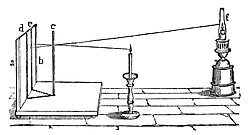
Ritchie's Photometer
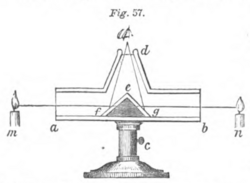
Ritchie's photometer focused on the equal illumination of surfaces. The apparatus consisted of a box approximately six to eight inches long and one inch in width and depth. Inside, a wedge of wood angled upwards and covered in white paper served as the target. The observer looked through a tube at the top of the box, while the height of the device was adjustable via a stand.
The light sources were placed at the sides of the box to illuminate the paper surfaces. By adjusting the position of the lights until both surfaces appeared equally illuminated, the user could determine the intensity difference based on the square of the distance difference.
Method of Extinction of Shadows
Considered the most precise of the three methods, this technique relied on the total removal of a shadow. When an opaque object casts a shadow onto a white screen from one light source, a second light source can be positioned at a specific distance where it completely obliterates all traces of that shadow.
Comparison of Early Photometry Methods
| Method | Primary Principle | Key Characteristic |
|---|---|---|
| Rumford's | Shadow Depth | Brighter lights cast deeper shadows |
| Ritchie's | Surface Illumination | Comparison of light on a white paper wedge |
| Extinction of Shadows | Shadow Obliteration | Most precise; second light removes the first light's shadow |
Frequently Asked Questions
How did early scientists measure light without electronics?
They used visual estimation, comparing the illuminance of an unknown light source to a standard source using the human eye's ability to detect equal brightness.
What is the inverse square law in photometry?
It is the principle that the illuminance of a light source decreases proportionally to the square of the distance from that source.
Which early photometer was the most accurate?
The method based on the extinction of shadows was considered the most precise of the common types used by 1861.
How did Rumford's photometer determine light intensity?
It compared the depth of shadows cast by two different lights; the distance required to make the shadows appear equal indicated the relative intensity of the sources.
What was the purpose of the white paper wedge in Ritchie's photometer?
The wedge provided a surface that could be illuminated by two different light sources simultaneously, allowing the observer to adjust the lights until the surfaces appeared equally bright.