Understanding the Phoneme: The Building Blocks of Language
Have you ever wondered how we distinguish the word "pat" from "bat" or "pit"? While these words look different on paper, the magic happens in the subtle shifts of sound produced by our vocal organs. In the scientific study of language, these fundamental units of sound are known as phonemes.
A phoneme is the smallest possible phonetic unit that can change the meaning of a word. While a single language may use hundreds of different physical sounds, it uses a much smaller, organized set of phonemes to build its vocabulary. This article explores the mechanics of phonemes, how they vary across the globe, and the linguistic theories used to define them.
Key Facts
- Definition: A phoneme is a set of similar speech sounds perceived as a single basic sound that distinguishes one word from another.
- Scope: All spoken languages contain both consonant and vowel phonemes.
- Diversity: Phonemic inventories vary wildly, from as few as 9–11 in Pirahã to as many as 141 in ǃXũ.
- Averages: Across all languages, the average number of consonant phonemes is approximately 22, while the average for vowels is about 8.
- Representation: In writing, phonemes are traditionally enclosed in forward-sloping slashes, such as /ɒ/.
The Conceptual Basis of Phonemes
The term phoneme (derived from the Ancient Greek phōnēma, meaning "sound made" or "utterance") has a rich history. While the word was used as early as 1873 to refer to simple speech sounds, the concept of the phoneme as an abstract linguistic unit was developed between 1875 and 1895 by Polish linguist Jan Baudouin de Courtenay and his student Mikołaj Kruszewski.
Later, Daniel Jones introduced the term in its modern sense to the Western world. The concept was further refined by the Prague School (including Nikolai Trubetzkoy) and various structuralists like Ferdinand de Saussure, Edward Sapir, and Leonard Bloomfield. These scholars debated whether phonemes were purely physical sounds or cognitive tools used by the human mind to organize speech.
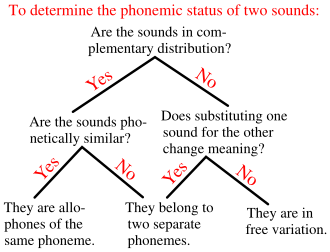
Phonemes vs. Allophones
It is important to distinguish between a phoneme and its allophones. A phoneme is the abstract category, while allophones are the actual physical variations of that sound. For example, the English phoneme /ɒ/ (as in "pot") is one single unit to a speaker, even though its actual pronunciation varies significantly between British, American, and Australian accents. Despite these different physical realizations, it remains one phoneme because it serves to contrast with other sounds, like the /ʊ/ in "put."
Rules and Restrictions in Phonology
Phonology—the branch of linguistics studying speech patterns—identifies several rules that govern how phonemes behave within a language.
Biuniqueness
In classic structuralist theory, biuniqueness was a requirement stating that every specific sound (phone) must be assigned to one, and only one, phoneme. This creates a "many-to-one" mapping, ensuring that sounds are not ambiguous. However, this concept was famously challenged by linguists Noam Chomsky and Morris Halle in the mid-20th century.
Neutralization and Archiphonemes
Sometimes, the distinction between two phonemes disappears in certain environments. This is called neutralization. For instance, if two sounds that usually distinguish words become identical in a specific position, the contrast is neutralized. To handle these cases, linguists sometimes use an archiphoneme—a symbol representing an underspecified sound that covers multiple possible phonemes.
Morphophonemes
In some linguistic systems, phonemes interact with morphemes (the smallest units of meaning, like prefixes or suffixes) to create new sounds, a process known as morphophonemics.
Global Variation in Phonemic Inventories
Not all languages are created equal when it comes to their "sound toolkit." Some languages rely heavily on tone—where the pitch of a syllable changes the word's meaning—while others, like French, have no phonemic tone at all.
The following table illustrates the extreme diversity found in linguistic inventories:
| Language Category | Vowel Characteristics | Consonant Characteristics | Notable Feature |
|---|---|---|---|
| Low Inventory (e.g., Rotokas, Pirahã) | Very few (as low as 2) | Very few (as low as 6) | Minimalist sound systems |
| High Inventory (e.g., ǃXũ, Ubykh) | High variety | Extremely high (up to 81) | Massive range of distinct sounds |
| English | 13 to 21 (including diphthongs) | 22 to 26 | Average consonant count |
| Tonal Languages (e.g., Cantonese, Wobé) | Varies | Varies | Pitch determines meaning |
The Debate Over "Correct" Analysis
One of the most enduring debates in linguistics is whether there is a single "true" way to map sounds to phonemes. This is often described as the tension between "God's Truth" (the idea that a language has one intrinsic, discoverable structure) and "hocus-pocus" (the idea that any coherent, functional analysis is valid).
For example, when analyzing English vowels, some linguists count 20 distinct vowel phonemes. However, an alternative analysis suggests that long vowels and diphthongs (like the /aɪ/ in "eye") are actually combinations of a short vowel and a semi-vowel like /j/ or /w/. Under this view, English might only have around seven vowel phonemes. Both analyses are mathematically coherent, leading to the conclusion by linguist Yuen Ren Chao that different systems are not necessarily "correct" or "incorrect," but rather "good" or "bad" for specific analytical purposes.
Frequently Asked Questions
What is the difference between a phoneme and a phone?
A phone is the actual, physical sound produced by a speaker. A phoneme is the abstract mental category that the speaker uses to organize those sounds to distinguish meaning.
Do sign languages have phonemes?
Yes. While sign languages do not use sound, they possess a phonological structure. Instead of vocal sounds, they use spatial-gestural equivalents to distinguish meaning.
What is a minimal pair?
A minimal pair consists of two words that differ by only one single sound in the same position, which changes the meaning of the word (for example, "pin" and "bin"). This is a primary method used to identify phonemes.
Why do different accents have different pronunciations of the same phoneme?
Because a phoneme is a category, not a single rigid sound. Different accents use different allophones (physical variations) to represent the same underlying phoneme.
What is a suprasegmental phoneme?
These are features that extend over more than one individual sound segment, such as tone (pitch) or stress (emphasis), which can change the meaning of a word or sentence.