Penguins: Evolution, Diversity, and Conservation of the World's Flightless Divers
Penguins are highly specialized marine birds belonging to the order Sphenisciformes. While they are often associated exclusively with the frozen landscapes of Antarctica, these flightless birds have adapted to a variety of environments across the Southern Hemisphere. From the towering Emperor penguin to the diminutive Little penguin, their unique physiology allows them to thrive in the ocean, where they have traded the ability to fly through the air for the ability to "fly" through the water.
Historically, the term "penguin" was first applied to the Great Auk, a now-extinct bird. However, in modern scientific classification, it refers specifically to the family Spheniscidae.
Key Facts
- Temporal Range: Penguins have existed from the Late Danian to the present (approximately 62 to 0 million years ago).
- Sister Group: Genomic analysis suggests penguins diverged from the Procellariiformes (tubenoses) about 60 million years ago.
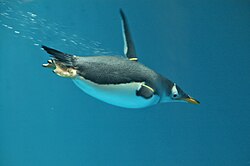
- Anatomy: Their wings have evolved into stiff, flat flippers for swimming, though they retain the basic bone structure of flighted birds.
- Diversity: Modern penguins are divided into six living genera: Aptenodytes, Eudyptes, Eudyptula, Megadyptes, Pygoscelis, and Spheniscus.
- Giant Ancestors: Fossil records show that during the Late Eocene and Early Oligocene, some species grew up to 1.80 meters tall.
Evolution and Systematics
The evolutionary journey of the penguin is marked by a transition from flight to deep-sea diving. A 2014 whole-genome analysis of 48 bird species confirmed that penguins are the sister group to the Procellariiformes, with a divergence occurring roughly 60 million years ago.
Ancient Giants
The fossil record reveals that penguins were once far larger than they are today. Between 40 and 30 million years ago (Late Eocene to Early Oligocene), gigantic lineages existed. Nordenskjoeld's giant penguin was among the tallest, reaching nearly 1.80 meters (5.9 feet). Meanwhile, the New Zealand giant penguin was likely the heaviest, with estimated weights of 80 kilograms (180 lb) or more.
Anatomy and Physiology
To survive in harsh marine environments, penguins have undergone significant anatomical changes. Their most striking adaptation is the transformation of the wing into a flipper. Unlike the flexible wings of flighted birds, penguin flippers are shorter and stouter, providing the rigidity necessary to push through dense seawater.
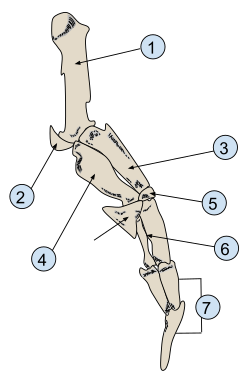
Other physiological adaptations include specialized feathers for insulation and a bone structure that supports diving. While they are clumsy on land, their efficiency underwater is unmatched among birds.
Diversity of Modern Species
Modern penguins are categorized into several distinct groups based on their physical characteristics and genetic lineage.
- Great Penguins (Aptenodytes): Includes the Emperor and King penguins.
- Crested Penguins (Eudyptes): Includes the Macaroni, Royal, Northern and Southern Rockhopper, Fiordland, Snares, and Erect-crested penguins.
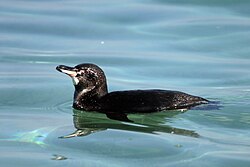
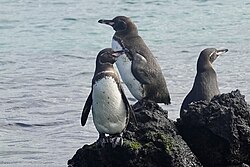
- Banded Penguins (Spheniscus): Includes the Galapagos, Humboldt, Magellanic, and African penguins.
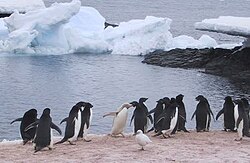
- Brush-tailed Penguins (Pygoscelis): Includes the Adélie, Chinstrap, and Gentoo penguins.
- Little Penguin (Eudyptula): The smallest of the penguin species.
- Yellow-eyed Penguin (Megadyptes): A distinct lineage found in New Zealand.
Conservation Status
Penguins face various threats, ranging from climate change to habitat loss. The IUCN Red List tracks the status of these species to guide conservation efforts. While some species like the Adélie and King penguins are currently listed as Least Concern, others are in critical danger.
| Species | IUCN Status | Trend | Mature Population |
|---|---|---|---|
| African penguin | Critically Endangered | Decreasing | 19,800 |
| Galápagos penguin | Endangered | Decreasing | 1,200 |
| Yellow-eyed penguin | Endangered | Decreasing | 2,600–3,000 |
| Emperor penguin | Endangered | Decreasing | Unknown |
| Adélie penguin | Least Concern | Increasing | 10,000,000 |
| Little penguin | Least Concern | Stable | 469,760 |

Frequently Asked Questions
Which penguin is the largest today?
The Emperor penguin (Aptenodytes forsteri) is the largest of the living species, though it is significantly smaller than the extinct giant penguins of the Eocene and Oligocene.
Why can't penguins fly?
Penguins evolved flippers instead of wings. Their bones became shorter and stouter to provide the strength and rigidity needed for swimming, which made them too heavy and inflexible for aerial flight.
Are all penguins found in Antarctica?
No. While many live in the Antarctic, others are found in the Galapagos Islands, South Africa, South America, Australia, and New Zealand.
Which penguin species is most endangered?
The African penguin (Spheniscus demersus) is currently listed as Critically Endangered, with a mature population of approximately 19,800 individuals.
How do penguins relate to other birds?
Genomic evidence indicates that penguins are the sister group to the Procellariiformes, having diverged from them approximately 60 million years ago.