Penduline Tits: The Master Architects of the Bird World
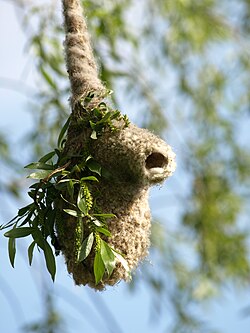
The penduline tits are a family of small passerine birds known for their extraordinary nesting skills. Belonging to the family Remizidae, these birds are close relatives of the true tits (Paridae). Their name, derived from the word "penduline" meaning hanging, refers to the elaborate, bag-like nests they weave, which often dangle from tree branches over water.
Key Facts
- Family: Remizidae, consisting of 11 species across 3 genera.
- Size: Tiny birds ranging from 7.5 to 11 cm in length.
- Specialty: Most species build complex woven hanging nests using spiderwebs and plant fibers.
- Distribution: Found across Eurasia, Africa, and North America.
- Diet: Primarily insectivorous, though they seasonally consume nectar, seeds, and fruits.
Physical Characteristics
Penduline tits are small, agile birds that closely resemble true tits but possess distinct anatomical differences. Most notably, they have finer, more needle-like bills designed for precision. Their wings are short and rounded, and most species feature notched tails, with the exception of the stub-tailed tit.
Plumage varies by species, typically consisting of pale grays, yellows, and whites. However, some exhibit more striking colors; for instance, the Eurasian penduline tit features chestnut and black markings, while other species may display bright red or yellow hues.
Distribution and Habitat
These birds are spread across three continents, divided largely by genus:
- Remiz: Found primarily in the Palearctic region, ranging from Portugal and northern Morocco through Siberia to Japan.
- Anthoscopus: The largest genus, located in sub-Saharan Africa, stretching from the Sahel to South Africa.
- Auriparus: Represented by the verdin, which inhabits the arid regions of northern Mexico and the southwestern United States.
Habitat preferences vary from deserts and marshes to woodlands. While the forest penduline tit resides in rain forests, most other species prefer open country with available bushes or trees. Migration patterns also differ; African species and the verdin are sedentary, whereas Eurasian and Asian species are often migratory. The Chinese penduline tit is a fully migratory species, while the Eurasian penduline tit's migration depends on its latitude.
Behavior and Diet
Penduline tits are active foragers that primarily eat insects. They use their long, conical bills to probe cracks and pry open holes to find prey. Their foraging style is similar to that of true tits, often involving hanging upside-down from branches and using their feet to manipulate leaves or hold large prey while dismembering it.
Avian Architecture: The Hanging Nest
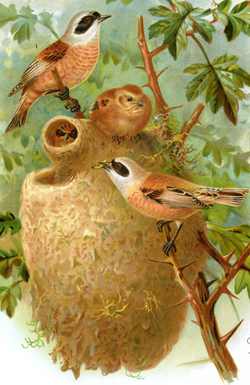
The most defining characteristic of the Remizidae family is the construction of pear-shaped nests. These structures are intricately woven from animal hair, wool, soft plant materials, and spiderwebs, then suspended from twigs.
The African Anthoscopus genus takes this architecture further by creating a false entrance and a false chamber to deceive predators. The parents access the true nesting chamber via a hidden flap that is sealed shut with sticky spiderwebs after each entry.
The verdin is the exception to the hanging nest rule, instead building a domed nest constructed from thorny twigs.
Reproduction and Parenting
Incubation typically lasts 13 to 14 days, with nestlings fledging at approximately 18 days. Egg colors vary: most penduline tits lay white eggs (sometimes with red spots), while the verdin lays blue-green eggs with red spots. Interestingly, research suggests that higher rates of extra-pair paternity in these birds lead to lower levels of male parental care.
Systematics and Classification
The family Remizidae was established in 1891 by French ornithologist Léon Olphe-Galliard. Because of their close relationship to the Paridae family, some scientists classify them as a subfamily (Remizinae) within the true tits. This taxonomic distinction is often a matter of scientific preference, though their close kinship is well-documented.
| Genus | Living Species |
|---|---|
| Remiz | Eurasian, Black-headed, Chinese, and White-crowned penduline tits |
| Anthoscopus | Grey, Forest, Cape, Mouse-colored, Yellow, and Sennar penduline tits |
| Auriparus | Verdin |
Frequently Asked Questions
Why are they called "penduline" tits?
The name comes from the word "penduline," meaning hanging, which describes the way most species in this family build their elaborate nests suspended from tree branches.
How do penduline tits protect their nests from predators?
Species in the Anthoscopus genus build a false entrance and a false chamber. The actual nesting area is accessed through a hidden flap that the parents seal with sticky spiderwebs.
What is the difference between a penduline tit and a true tit?
While they look similar, penduline tits have finer, more needle-like bills and different nesting habits compared to the true tits of the Paridae family.
Do all penduline tits migrate?
No. Migration is primarily seen in European and Asian species. African species and the North American verdin are sedentary.
What materials do they use to build their nests?
They use a combination of spiderwebs, wool, animal hair, and soft plant materials to weave their hanging nests.