Parsley: A Comprehensive Guide to the Versatile Garden Herb
Parsley, known scientifically as Petroselinum crispum, is far more than a simple decorative garnish. A member of the Apiaceae family, this bright green herb is native to the Mediterranean region, including Greece, the Balkans, Algeria, and Morocco. While it is often confused with cilantro (of the genus Coriandrum) due to its appearance, parsley possesses a distinct flavor profile and botanical identity.
Historically, parsley is believed to have originated in Sardinia and was cultivated as early as the 3rd century BC. By 1548, it had established a presence in Britain, though evidence suggests it was used in England as far back as the Anglo-Saxon period. Today, it is a staple in European, Middle Eastern, and American cuisines.
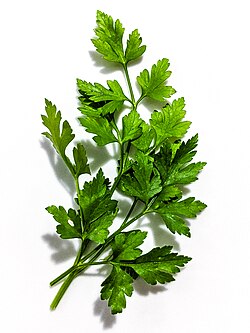
Key Facts
- Scientific Name: Petroselinum crispum.
- Origin: Native to the Mediterranean (Greece, Balkans, North Africa).
- Types: Primarily available as curly-leaf, flat-leaf, and root parsley.
- Nutritional Powerhouse: Exceptionally high in Vitamin K, Vitamin C, and Vitamin A.
- Growth Habit: A biennial in temperate climates and an annual in tropical regions.
Botanical Description
Garden parsley is characterized by its vibrant green foliage. In temperate climates, it grows as a biennial (a plant that takes two years to complete its biological lifecycle). During its first year, it produces a rosette of tripinnate leaves—leaves divided into three leaflets—ranging from 10 to 25 cm in length. It also develops a taproot to store nutrients for the winter.
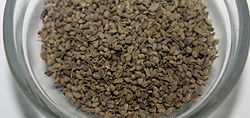
In its second year, the plant produces a flowering stem that can reach up to 75 cm in height. This stem bears flat-topped umbels (umbrella-like flower clusters) containing small yellow to yellowish-green flowers. The resulting seeds are ovoid and contain apiole, a compound found in the plant's essential oil.
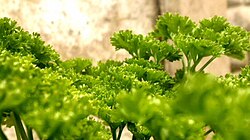
Culinary Uses and Varieties
Parsley is integrated into a vast array of global dishes, serving as both a primary ingredient and a flavor enhancer.
Leaf Parsley
There are two primary cultivars of leaf parsley:
- Curly-leaf (French) Parsley: Highly prized for its decorative appearance, it is frequently used as a garnish for potato, rice, and meat dishes.
- Flat-leaf (Italian) Parsley: Often preferred by professional chefs for its stronger, more robust flavor and ease of cultivation.
Root Parsley
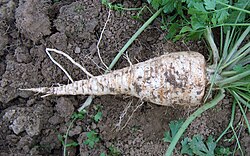
Unlike leaf varieties, Hamburg root parsley is grown for its thickened taproot. Common in Central and Eastern European cuisines, it is used in stews, soups, or eaten raw as a snack. While it resembles a parsnip, it has a distinct taste.
Global Culinary Applications
- Mediterranean & Middle Eastern: A core component of Lebanese tabbouleh, Iranian ghormeh sabzi, and the green interior of falafel.
- European: Used in French persillade (garlic and parsley) and bouquet garni (herb bundles for stocks). In Italy, it is essential for salsa verde and gremolata.
- Brazilian: Combined with scallions to create cheiro-verde, a fundamental seasoning for meats and beans.
- British: Used in traditional parsley sauce or "liquor" served with pie and mash.
Nutritional Composition
Fresh parsley is highly nutritious, consisting of 88% water. It is particularly rich in essential vitamins and minerals that support overall health.
| Nutrient | Amount | % Daily Value (DV) |
|---|---|---|
| Energy | 36 kcal | - |
| Protein | 2.97 g | - |
| Vitamin K | - | 1367% |
| Vitamin C | - | 148% |
| Vitamin A | - | 47% |
| Iron | - | 34% |
| Folate (B9) | - | 38% |
Cultivation and Care
Parsley thrives in full sun and moist, well-drained soil, with an ideal temperature range between 22–30 °C (72–86 °F). It is typically grown from seed, though germination is slow (four to six weeks) due to furanocoumarins in the seed coat, which can inhibit growth.
Gardeners should space leaf crops about 10 cm apart, while root crops require 20 cm to allow for proper root expansion. Interestingly, parsley supports local wildlife; it serves as a host plant for certain swallowtail butterfly larvae and attracts various nectar-feeding insects.
Precautions
While normal culinary amounts of parsley are safe, pregnant women should avoid excessive consumption. In very large quantities, parsley may have uterotonic effects, meaning it can stimulate uterine contractions.
Frequently Asked Questions
Is parsley the same as cilantro?
No. While they look similar, parsley (Petroselinum crispum) and cilantro (Coriandrum sativum) belong to different genera and have very different flavor profiles.
What is the difference between curly and flat-leaf parsley?
Curly-leaf parsley is primarily used for decoration and garnishing due to its appearance. Flat-leaf parsley is generally preferred by chefs for its stronger flavor and resilience to weather.
Can you eat parsley seeds?
It is advised to avoid eating parsley seeds. They contain high quantities of apiol, which can be toxic.
How does parsley help with garlic breath?
Parsley is widely credited with neutralizing the strong odors associated with garlic when consumed after a meal.
What is root parsley?
Root parsley is a specific cultivar grown for its thick, edible taproot rather than its leaves, commonly used as a vegetable in European soups and stews.