Paraguay Campaign of 1810-1811
The Paraguay campaign was a pivotal military expedition launched between September 1810 and March 1811. Commanded by Manuel Belgrano, the operation sought to ensure that the Intendency of Paraguay remained loyal to the Primera Junta—the governing body established in Buenos Aires following the May Revolution. While intended to consolidate power for the Provinces of the Río de la Plata, the campaign ultimately served as a catalyst for Paraguay's own journey toward sovereignty.
Key Facts
- Duration: September 22, 1810, to March 21, 1811.
- Primary Objective: To secure Paraguay's adherence to the Primera Junta of Buenos Aires.
- Outcome: Spanish-Paraguayan victory; Paraguay achieved independence from Buenos Aires and later from Spain.
- Key Commanders: Manuel Belgrano (Buenos Aires) vs. Bernardo de Velasco and Fulgencio Yegros (Paraguay).
- Casualties: Approximately 500 to 1,000 men lost by the Argentine forces.
The Ambitions of the Primera Junta
Shortly after its creation, the Primera Junta appointed Manuel Belgrano as Chief Commander of an army tasked with gathering support across Santa Fe, Corrientes, the Banda Oriental territories, and specifically Paraguay. Based on reports that the Junta was viewed favorably in Paraguay, leadership believed a small force would be sufficient to establish control.
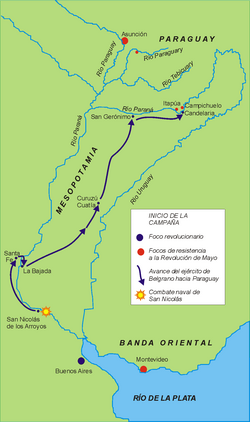
Belgrano began his march north with roughly 200 men. As he progressed toward the Paraná River, his ranks grew through reinforcements from the Blandengues regiments of Santa Fe and San Nicolás, as well as additional troops sent by the Junta. By the time he reached the border, his army had expanded to approximately 950 men, organized into four divisions of infantry and cavalry, each supported by a single piece of artillery.
The Political Climate in Paraguay
While Belgrano expected a welcoming reception, the political landscape in Paraguay was far more complex. The region was relatively isolated within the Viceroyalty of the Río de la Plata, fostering strong sentiments of regional autonomy. On July 24, 1810, a congress was convened by the colonial governor to express loyalty to the Council of Regency of Spain.
During this congress, Paraguayan patriots, led by José Gaspar Rodríguez de Francia, argued that Paraguay should protect its independence from Brazil, Lima, and Buenos Aires. Consequently, Paraguay refused to pledge loyalty to the Primera Junta. By the time Belgrano invaded, the population was split between three factions: those loyal to the Spanish Council of Regency, those supporting the Buenos Aires Junta, and those seeking total independence.
The Military Campaign
Belgrano's advance began with administrative and social reforms. At Curuzú Cuatiá, he resolved a border conflict between Corrientes and Yapeyu. Upon reaching the Paraná River near Apipé island, he granted full civil and political rights to the native populations in the missions, including land grants and the right to hold public office.
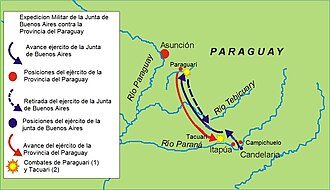
The army established a stronghold at Candelaria before crossing the Paraná River on December 19. The geography heavily favored the defenders; the river acted as a massive natural barrier, and the interior terrain—filled with swamps, hills, and lakes—hindered movement and supply lines. Despite these challenges, Belgrano achieved early success at the Battle of Campichuelo, forcing a small Paraguayan force to flee.
The Turning Point: Paraguarí and Tacuarí
The tide turned at the Battle of Paraguarí. Although Belgrano's troops initially held an advantage, they were overwhelmed by the numerical superiority of the Paraguayan forces, which included roughly 3,500 patriots. Despite having better equipment and supplies, Belgrano was forced to retreat by his officers.
The campaign reached its conclusion at the Battle of Tacuarí on March 9. Belgrano, now leading a depleted force of barely 400 men, was surrounded by nearly 3,000 troops under Fulgencio Yegros and Manuel Atanasio Cabañas. Refusing to surrender, Belgrano ordered the destruction of his personal papers to protect sensitive information and maintained a constant barrage of artillery fire to keep the enemy at bay. He eventually negotiated an armistice, stating he had come to aid Paraguay, not conquer it, and agreed to withdraw from the province within one day.
Campaign Summary
The following table summarizes the opposing forces and the results of the conflict.
| Feature | Provinces of the Río de la Plata | Intendency of Paraguay |
|---|---|---|
| Commander(s) | Manuel Belgrano | Bernardo de Velasco, Fulgencio Yegros |
| Estimated Strength | 1,000 – 2,000 | ~5,000 (1,500 Spanish, 3,500 Patriots) |
| Key Victories | Campichuelo, Campo Maracana | Paraguarí, Tacuarí |
| Final Result | Military Failure | Victory and Independence |
Aftermath
The campaign was a strategic failure for the Primera Junta. However, it inadvertently accelerated the independence of Paraguay. Having successfully repelled the forces from Buenos Aires, Paraguay broke its links with the Spanish crown just two months after Belgrano's withdrawal. While the two regions ceased to be part of the same political entity, they maintained diplomatic relations in the years that followed.
Frequently Asked Questions
Why did Manuel Belgrano launch the campaign?
Belgrano was sent by the Primera Junta of Buenos Aires to ensure that the Intendency of Paraguay remained loyal to the new government established after the May Revolution.
What was the role of José Gaspar Rodríguez de Francia?
Francia was a key leader among the Paraguayan patriots who advocated for independence from both Spain and Buenos Aires during the Congress of July 24, 1810.
Which battles were the most decisive?
The Battles of Paraguarí and Tacuarí were the most decisive, as they resulted in the defeat of Belgrano's forces and forced his withdrawal from Paraguayan territory.
How did the geography of Paraguay affect the war?
The wide Paraná River served as a natural barrier, and the interior's swamps and hills slowed the Argentine army's progress and complicated their logistics and retreat.
What was the ultimate political result of the campaign?
The campaign resulted in Paraguay achieving independence from Buenos Aires and, shortly thereafter, proclaiming its independence from Spain.