Panmunjom: The Historic Site of the Korean Armistice Agreement
Panmunjom (also spelled Panmunjeom) was once a small village located just north of the de facto border between North and South Korea. While the village itself has vanished from the landscape, its name remains globally recognized as the site where the 1953 Korean Armistice Agreement was signed, effectively ending the active fighting of the Korean War.
Today, the term Panmunjom is frequently used as a metonym for the nearby Joint Security Area (JSA). This high-tension zone, characterized by blue buildings that straddle the Military Demarcation Line, continues to serve as the primary venue for discussions between North and South Korea, standing as one of the last remaining vestiges of the Cold War.
Key Facts
- Significance: The location where the 1953 Korean Armistice Agreement was signed.
- Location: Situated in Paju, Gyeonggi Province (South Korea) and Panmun-guyok, Kaesong (North Korea).
- The JSA: A separate facility established in September 1953, located about one kilometer east of the original village.
- The Peace Museum: The original armistice signing building, now renamed and maintained by North Korea.
- The DMZ: A 4-kilometer-wide demilitarized zone established to separate the two nations.
Geography and the Evolution of the Site
The original village of Panmunjom consisted of fewer than ten huts located on the west bank of the Sa'cheon stream, south of the Kaesong-Seoul road. It is positioned approximately 53 kilometers north-northwest of Seoul and 10 kilometers east of Kaesong.
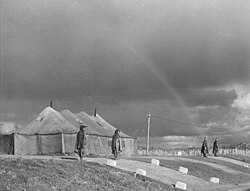
During the truce negotiations, the Military Armistice Commission met in tents on the north side of the village. To finalize the agreement, a specific building was constructed in just 48 hours through a joint effort: North Korea provided labor and supplies, while the United Nations Command supplied generators and lighting to facilitate overnight work. Eighteen copies of the armistice (Volumes I and II) were signed within this structure.
Following the signing, the Joint Security Area (JSA) was constructed in September 1953 to host all future meetings between the United Nations Command, South Korea, and North Korea. As civilians were removed from the Demilitarized Zone (DMZ)—a buffer zone created to prevent further conflict—the original village of Panmunjom fell into disrepair and eventually disappeared. Only the original signing building remains, now operating as the Peace Museum under North Korean administration.
The Truce Talks and the POW Crisis
From 1951 to 1953, United Nations forces engaged in protracted negotiations with North Korean and Chinese officials. These talks were delayed for months, primarily due to two sticking points: the status of prisoners of war (POWs) and South Korea's insistence on a unified state.
A breakthrough regarding the POWs was finally reached on June 8, 1953. The agreement stipulated that prisoners who refused to return to their home countries would be placed under a neutral supervising commission for three months. If they still refused repatriation after this period, they would be released. Notably, 21 American and one British POW refused repatriation, with most choosing to defect to China.
The final armistice was signed on July 27, 1953, by the United Nations Command, the Chinese People's Liberation Army, and the North Korea People's Army. This agreement established the 4-kilometer-wide DMZ. Although the treaty mandated the removal of most troops and heavy weaponry from this zone, it has remained one of the most heavily armed borders in the world.
Summary of Panmunjom and the JSA
| Feature | Panmunjom Village | Joint Security Area (JSA) |
|---|---|---|
| Primary Role | Site of the 1953 Armistice signing | Ongoing diplomatic discussions |
| Current Status | Village disappeared; building is a museum | Active military/diplomatic zone |
| Location | West bank of Sa'cheon stream | ~1 km east of the original village |
| Key Structure | Peace Museum (former signing building) | Blue conference buildings |
Frequently Asked Questions
What is the difference between Panmunjom and the JSA?
Panmunjom was the original village where the 1953 Armistice Agreement was signed. The Joint Security Area (JSA) is a separate facility built shortly after the war to host ongoing meetings. Today, the name Panmunjom is often used to refer to the JSA.
What happened to the prisoners of war (POWs) who refused to go home?
Under the 1953 agreement, POWs who refused repatriation were held by a neutral commission for three months. After this period, they were released; this included 21 Americans and one Briton, most of whom defected to China.
Does the original signing building still exist?
Yes, the building where the armistice was signed still stands, although the surrounding village has disappeared. It has been renamed the Peace Museum by North Korea.
How wide is the Demilitarized Zone (DMZ)?
The armistice agreement established a demilitarized zone that is 4 kilometers wide along the armistice line, dividing the peninsula into two separate countries.
Who signed the Korean Armistice Agreement?
The agreement was signed by senior delegates from the United Nations Command, the Chinese People's Liberation Army, and the North Korea People's Army.