Palazzo Nuovo: A Treasure Trove of Classical Antiquity
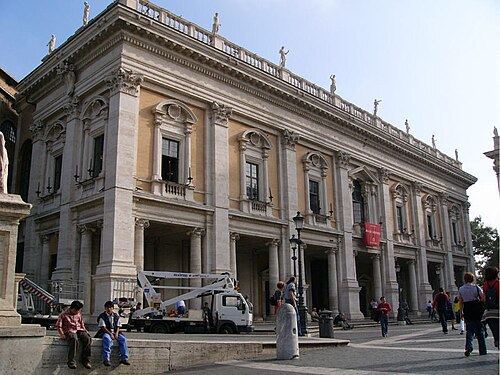
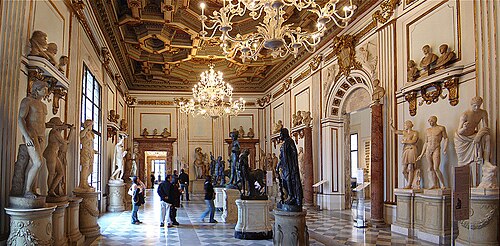
The Palazzo Nuovo stands as a cornerstone of the Capitoline Museums in Rome, serving as a magnificent repository for some of the most significant archaeological finds from the Roman and Greek worlds. While the palace was constructed in the 17th century—designed by Girolamo Rainaldi and completed by his son Carlo in 1663—its architectural soul, particularly the façade, is attributed to the legendary Michelangelo Buonarroti. Since the 19th century, it has functioned as a museum, housing an extraordinary array of sculptures, many of which originated from the sprawling ruins of Hadrian's Villa in Tivoli.
Visitors are greeted by a ground-floor portico featuring monumental statues, including Minerva and Faustina the Elder (Ceres), which were once part of the Vatican Belvedere Collection before being gifted to the city of Rome.
Key Facts
- Architectural Heritage: Façade attributed to Michelangelo; completed in 1663 by the Rainaldi family.
- Primary Collections: Extensive works from Hadrian's Villa and the Albani collection.
- Masterpieces: Home to the Dying Gaul, the Capitoline Venus, and the Red Faun.
- Historical Focus: Specialized halls dedicated to Roman Emperors, ancient philosophers, and Egyptian monuments.
The Atrium and Courtyard
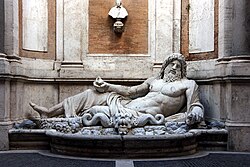
The heart of the ground floor is the open courtyard, centered around a fountain topped by the Marforio, a 1st-century AD talking statue of Rome named after its discovery in the Forum of Mars (the Forum of Augustus). The space also displays a colossal statue of Mars and a group featuring the cyclops Polyphemus.
Adding to the architectural grandeur are two mirror-image statues of the god Pan, depicted as Satyrs carrying fruit baskets. These likely served as telamons—architectural supports carved as human or mythical figures—within the Theatre of Pompey.
The Hall of Egyptian Monuments
This specialized area showcases the intersection of Roman and Egyptian cultures. Originally, the hall housed statues from the Villa Verospi Vitelleschi (Horti Sallustiani) that decorated Emperor Hadrian's Egyptian pavilion. While many pieces moved to the Vatican in 1838, the hall still preserves massive granite works.
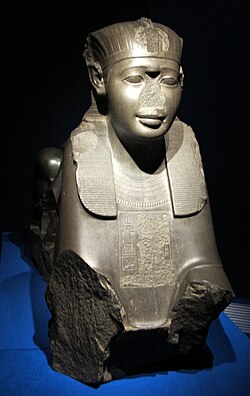
Notable exhibits include a large bell-shaped krater (a wide-mouthed vessel) from Hadrian's Villa and various animal sculptures representing Egyptian deities, such as a crocodile, a sphinx, a scarab, and a sparrowhawk.
Ground Floor Galleries and the Main Gallery
To the right of the atrium, three rooms house critical historical records, including Fasti Minori (lists of magistrates) and Roman calendars from the post-Caesarian era, which reflect Julius Caesar's 365-day year. These rooms also feature intimate portraits of Roman citizens and the cinerary urn of T. Statilius Aper and Orcivia Anthis.
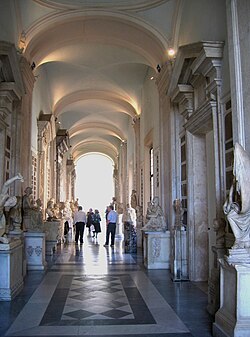
The first floor is dominated by the longitudinal Gallery, a vast corridor connecting the museum's rooms. This space displays a diverse collection of reliefs and statues, including the Hercules Killing the Hydra and the Capitoline Discobolus (a wounded warrior whose torso is ancient, but whose limbs were restored by Pierre-Étienne Monnot between 1658 and 1733).
Notable Gallery Works
- Leda with the Swan: A Roman copy of a 4th-century BC group.
- Young Hercules: Depicting the strangling of the serpent, possibly representing a young Caracalla.
- The Old Drunkard: A marble sculpture from approximately 300-280 BC.
Specialized Halls of the Palazzo Nuovo
The Hall of Doves
Named for its stunning floor mosaic attributed to Sosus of Pergamon, this room primarily houses the collection of Cardinal Alessandro Albani. It features a unique 18th-century arrangement of male and female portraits, including Emperor Trajan.
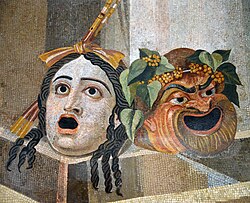
The room is also a center for ancient epigraphy, containing the Senatus consultum (78 BC), the oldest surviving bronze decree of the Senate, and the Bronze of Ascoli (89 BC).
The Cabinet of Venus
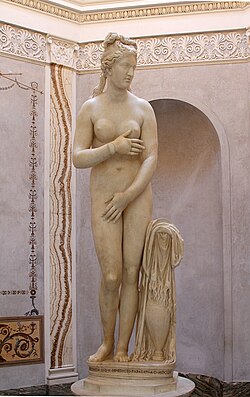
This polygonal room, designed like a nymphaeum (a monument consecrated to nymphs), houses the Capitoline Venus. Standing 193 cm tall and carved from Parian marble, this 4th-century AD statue is a prime example of the Venus pudica (modest Venus) style, showing the goddess emerging from a bath.
The Hall of the Emperors
One of the museum's oldest rooms, this hall allows visitors to trace the evolution of Roman portraiture chronologically. It contains 67 portrait busts, ranging from the Republican Age to Late Antiquity, showcasing changes in hairstyles and beards over centuries.
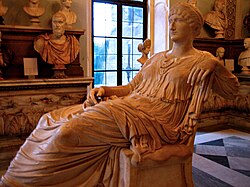
At the center stands the statue of Flavia Julia Helena, mother of Constantine I. The collection includes portraits of Augustus, Nero, the Flavian dynasty, and the Five Good Emperors.
The Hall of the Philosophers
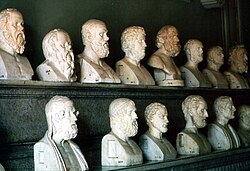
Dedicated to the intellectuals of antiquity, this room contains 79 busts and herms. It features the blind poet Homer, Pythagoras, Socrates, and the great tragedians Aeschylus, Sophocles, and Euripides, as well as the Roman statesman Marcus Tullius Cicero.
The Monumental Hall and the Faun
The Hall of Palazzo Nuovo is the most imposing space in the complex, featuring a grand portal designed by Filippo Barigioni. It houses massive bronze statues and the gray marble Old and Young Centaurs from Hadrian's Villa.
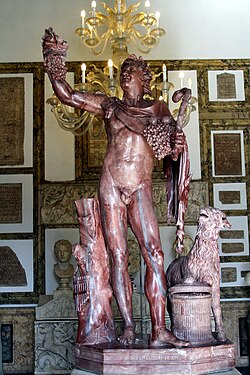
Nearby, the Hall of the Faun is centered around the Red Faun, a 2nd-century AD sculpture from Hadrian's Villa that became a visitor favorite after its 18th-century restoration. This room also preserves the Lex de imperio Vespasiani, a crucial 1st-century decree regarding the powers of Emperor Vespasian.
The Hall of the Galatian
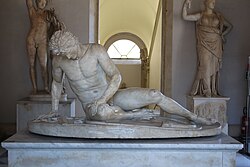
The centerpiece of this hall is the Dying Gaul, a Roman copy of a 3rd-century BC Greek original. Originally part of the Pergamon altar, it was once mistaken for a gladiator. The room also features the Wounded Amazon (Sosikles type), attributed to Polycletus or Phidias, and a Rococo group of Cupid and Psyche.
| Work | Period/Date | Origin/Style | Key Feature |
|---|---|---|---|
| Dying Gaul | 3rd Century BC (Original) | Pergamon/Greek | Triumphal monument copy |
| Capitoline Venus | 4th Century AD | Venus Pudica | Parian marble, 193 cm |
| Red Faun | 2nd Century AD | Hadrian's Villa | Restored by Bianchi and Cavaceppi |
| Senatus consultum | 78 BC | Roman Senate | Oldest surviving bronze decree |
| Wounded Amazon | 5th Century BC (Original) | Sosikles type | Attributed to Polycletus/Phidias |
Frequently Asked Questions
Who designed the Palazzo Nuovo?
The palace was built in the 17th century under the direction of Girolamo Rainaldi and his son Carlo, who completed it in 1663. However, the design of the façade is attributed to Michelangelo Buonarroti.
What is the significance of the Dying Gaul?
The Dying Gaul is a Roman copy of a Greek bronze original from the 3rd century BC. It was part of the Donarium of Attalus in Pergamon and is one of the most famous sculptures in the collection, though it was historically misidentified as a gladiator.
What is a 'Venus Pudica'?
Venus Pudica, or "modest Venus," is a sculptural type where the goddess is depicted emerging from a bath while modestly covering her breasts and pubis, as seen in the Capitoline Venus.
Which famous Roman figures are represented in the Hall of the Emperors?
The hall contains 67 busts, including Augustus (both young and adult), Nero, the Flavian dynasty (Vespasian, Titus, Domitian), the Five Good Emperors, and members of the Severan dynasty.
Where did many of the sculptures in the Palazzo Nuovo originate?
A significant portion of the collection, including the Red Faun and the Centaurs, comes from Hadrian's Villa in Tivoli, while others were acquired from the collection of Cardinal Alessandro Albani.