Aegis: The Divine Shield of Zeus and Athena
In the vast pantheon of Greek mythology, few objects carry as much weight and terror as the aegis (Ancient Greek: αἰγίς). Often described as a shield, a breastplate, or a protective animal skin, the aegis is a divine attribute shared primarily by Zeus and Athena. To be "under someone's aegis" in modern English means to be under the protection of a powerful source—a phrase that directly inherits its meaning from this legendary artifact of power.
Key Facts
- Primary Owners: Associated most closely with Zeus and Athena.
- Physical Forms: Interpreted variously as a goatskin coat, a shield, or a cuirass.
- Defining Feature: Frequently adorned with the Gorgoneion (the head of the Gorgon Medusa).
- Symbolism: Represents divine protection, authority, and the terrifying power of a storm.
- Etymology: Derived from Greek words meaning either "violent windstorm" or "goatskin."
Etymology and Origins
The word aegis has a complex linguistic history. One root suggests a connection to the verb aïssō, meaning "to rush or move violently," linking the object to a violent windstorm or thunderstorm. This aligns with the title Zeus Aigiokhos ("Zeus who holds the aegis"), which may have originally referred to the god's control over the heavens and storms.
Alternatively, the term may derive from aix, the Greek word for goat, suggesting the aegis was originally a goatskin coat. Scholars believe folk etymology may have bridged these meanings, as ancient peoples often draped animal skins over their arms for protection in battle.
The Aegis in Greek Mythology
In Homer's Iliad, the aegis is described as an immortal and ageless device. Athena's version is particularly opulent, featuring a hundred tassels of pure gold, each valued at a hundred oxen. When Zeus shakes the aegis, the effects are cataclysmic: Mount Ida is shrouded in clouds, thunder rolls, and mortals are struck with overwhelming fear.
While Zeus is the primary owner, he frequently lends the aegis to Athena. In one instance in the Iliad, the god Apollo uses the aegis to charge the Achaeans, driving them back toward their ships. While some sources, such as Edith Hamilton, describe it as a breastplate, classical sculpture typically depicts Zeus with a thunderbolt rather than a shield.
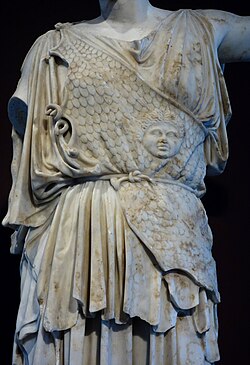
The Gorgoneion and the Aegis
One of the most striking features of the aegis is the Gorgoneion—the severed head of the Gorgon Medusa. Virgil describes the aegis as a fearsome object with a gold surface resembling snake-skin, featuring linked serpents and the rolling eyes of the Gorgon. While some believe the skin itself was that of the Gorgon, the more common tradition suggests that Perseus gave the head to Athena as a votive offering, which she then attached to her shield.
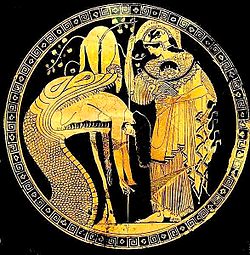
Classical Art and Interpretations
Throughout classical poetry and art, the aegis has taken many forms. Some traditions suggest Athena flayed a fire-breathing serpent named Aex, the daughter of Helios, and wore its skin as a cuirass (body armor) or a chlamys (cloak). Other accounts, such as those by John Tzetzes, claim it was the skin of the giant Pallas.
In later Roman interpretations, Gaius Julius Hyginus suggested the aegis was actually the skin of a pet goat belonging to Amalthea, the nurse who suckled Zeus in Crete. This version reinforces the "goatskin" etymology of the word.
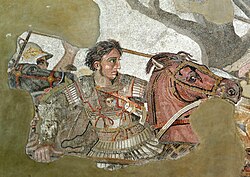
In art, the aegis appears as a tasselled cover or a skin draped over the shoulders. Its influence extended beyond the gods; Roman emperors and legendary heroes were sometimes depicted with the aegis to signal divine favor or authority.
![Augustus shown with an aegis thrown over his shoulder as a divine attribute in the Blacas Cameo; the hole for the head appears at the point of his shoulder.[14]](/images/50/c5/50c53a4d808fe93e5e68034afba54785e7b7e564efa2d8fd289dfa4826906de0.jpg)
Historical and Cultural Theories
Historians have sought real-world inspirations for the aegis. Herodotus noted that women in ancient Libya wore leather garments fringed with thongs, which he believed the Greeks adapted into the serpent-fringed aegis. Robert Graves proposed that it was originally a shamanic pouch used to frighten the uninitiated.
Modern academic interpretations also point toward the Hittite kursas, a shaggy goatskin hunting bag used in sacral rituals, as a potential ancestral source for the Greek myth.
| Source/Theory | Material/Form | Key Characteristic |
|---|---|---|
| Homer (Iliad) | Immortal device | Golden tassels |
| Virgil | Snake-skin surface | Gorgon's head and linked serpents |
| Hyginus | Goatskin | Skin of Amalthea's goat |
| Diodorus Siculus | Serpent skin | Skin of the serpent Aex |
| Hittite Theory | Kursas (hunting bag) | Shaggy goatskin |
Frequently Asked Questions
Who originally owned the aegis?
The aegis is primarily associated with Zeus, who is often called "Aegis-bearing," though he frequently lends it to his daughter, Athena.
What is the Gorgoneion?
The Gorgoneion is the image or severed head of the Gorgon Medusa, which was attached to the aegis to strike terror into the hearts of enemies.
Is the aegis a shield or a piece of clothing?
It is interpreted as both. Depending on the source, it is described as a shield, a breastplate (cuirass), or a goatskin cloak (chlamys).
What does "under the aegis of" mean today?
In modern usage, it means to be under the protection, sponsorship, or guidance of a powerful or influential person or organization.
How did the aegis affect people in mythology?
When shaken by Zeus, the aegis could cause thunder to roll, wrap mountains in clouds, and strike men with intense fear.