Operation Ripper: The UN Offensive to Recapture Seoul
In the spring of 1951, the Korean War entered a decisive phase as United Nations (UN) forces launched Operation Ripper. Conceived by US Eighth Army General Matthew Ridgway, this military offensive was designed to push enemy forces north of the Han River and reclaim vital territory, including the South Korean capital, Seoul. Following the momentum of Operation Killer, Ripper aimed to dismantle the strength of the Chinese People's Volunteer Army (PVA) and the Korean People's Army (KPA) through a coordinated multi-corps advance.
Key Facts
- Date: 7–23 March 1951
- Primary Objective: Recapture Seoul and reach the 38th Parallel
- Key Result: United Nations and South Korean victory; recapture of Seoul
- Commanders: General Matthew Ridgway (UN), General Dehuai (PVA)
- Major Territorial Change: UN forces established the "Idaho Line" salient
Strategic Objectives and Planning
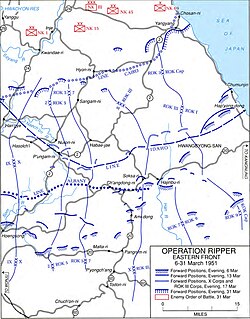
The operation was structured around reaching a specific defensive arc known as the Idaho Line. This line was anchored in the west on the Han River and looped northeast toward the 38th Parallel, eventually falling southeast toward the east coast town of Hap’yong-dong. By pushing into this deep salient, the Eighth Army intended to strike at major PVA/KPA supply hubs and concentrations.
Targeting Key Road Hubs
A central component of the plan involved seizing the towns of Hongch'on and Chuncheon. These locations served as critical road hubs and supply centers for enemy forces. To achieve this, the IX Corps was tasked with a major push toward the deepest point of the Idaho salient, while the X Corps and Republic of Korea (ROK) forces focused on clearing north-south corridors in the eastern sector.
The UN Advance: From the Han River to the Buffalo Line
The offensive began with a massive artillery bombardment, setting the stage for a rapid movement of UN troops. The US 25th Infantry Division was among the first to cross the Han River, establishing a vital bridgehead. As the days progressed, the advance moved through several designated phase lines:
- The Albany Line: Reached between 11–13 March, as the 25th Infantry Division and IX Corps pushed through mountainous terrain.
- The Buffalo Line: Established as the IX Corps moved to block key routes leading toward Chuncheon.
During this period, recovery teams also performed grim but necessary tasks, retrieving equipment and personnel lost during previous engagements in the area, such as the mid-February battles involving Support Force 21.
| Category | Details |
|---|---|
| Belligerents | United Nations (US, UK, Canada, Australia, NZ, Philippines) & South Korea vs. North Korea & China |
| Primary Commanders | Matthew Ridgway, Douglas MacArthur, Lee Hong Sun, Dehuai |
| UN Casualties | 566 killed, 3,220 wounded |
| Enemy Casualties | 7,151 known dead; thousands more wounded or captured |
The Liberation of Seoul and Chuncheon
One of the most significant achievements of Operation Ripper was the Fourth Battle of Seoul. By the night of 14–15 March, elements of the ROK 1st Infantry Division and the US 3rd Infantry Division entered the city. The PVA/KPA forces, facing the threat of encirclement from UN movements to the east, were forced to abandon the capital. This marked the final time Seoul changed hands during the war.
Following the success in Seoul, the focus shifted to Chuncheon. Although planners had prepared an airborne operation (code-named Hawk) involving the 187th Airborne Regimental Combat Team, the rapid withdrawal of enemy forces rendered the drop unnecessary. An armored task force entered the Chuncheon basin on 21 March, finding the town largely vacated by enemy troops.
Aftermath and Strategic Impact
While Operation Ripper was a territorial success, its ability to completely destroy enemy manpower was mixed. Although the Eighth Army successfully reached its primary objectives and recaptured major cities, the PVA/KPA forces managed to conduct a rapid withdrawal rather than being fully annihilated. The operation succeeded in pushing the front lines toward the 38th Parallel, but the enemy remained a significant force in the region.
Frequently Asked Questions
What was the main goal of Operation Ripper?
The primary goal was to destroy PVA/KPA forces around Seoul and the towns of Hongch'on and Chuncheon, and to move UN troops toward the 38th Parallel.
How many times did Seoul change hands during the Korean War?
The liberation of Seoul during Operation Ripper marked the fourth and final time the capital changed hands between belligerents.
What was the "Idaho Line"?
The Idaho Line was the intended final objective line for the operation, forming a deep salient into enemy territory that stretched from the Han River to the east coast.
Why was the planned airborne operation in Chuncheon canceled?
The operation was canceled because the rapid withdrawal of PVA/KPA forces meant that UN ground forces could reach the area without the need for a paratrooper drop.
Who were the primary combatants in Operation Ripper?
The United Nations (including the US, United Kingdom, Canada, Australia, New Zealand, and the Philippines) and South Korea fought against the North Korean (KPA) and Chinese (PVA) forces.