Obverse and Reverse: The Art and Science of Two-Sided Objects
In everyday conversation, we refer to the two sides of a coin as "heads" and "tails." However, in the professional worlds of history, art, and science, these faces are known as the obverse and the reverse. While the obverse is generally considered the front face and the reverse the back, the rules for determining which is which vary significantly depending on the object, the era, and the culture.
Beyond coinage, these terms apply to various two-sided items, including paper money, flags, seals, medals, and fine art prints. In the study of manuscripts and publishing, scholars use the equivalent terms recto (the right-hand page or front) and verso (the left-hand page or back).
Key Facts
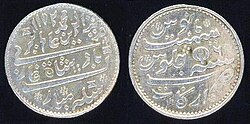
- Obverse: The "front" or primary side of an object, often featuring a portrait or state symbol.
- Reverse: The "back" side, typically containing the value of a coin or secondary imagery.
- Edge: The thin surface area located between the obverse and reverse faces.
- Numismatics: The study of currency, where "obv." and "rev." are standard abbreviations.
- Vexillology: The study of flags, where the obverse is the default illustration side.
Identifying the Obverse in Numismatics
Determining the obverse of a coin is not always intuitive. Generally, numismatists look for the larger-scale image—often a single head—to identify the front. If the images are of similar scale, the side that aligns with the broader tradition of that specific region or mint is designated as the obverse.
In ancient Greek city-states like Athens or Corinth, the obverse typically featured a constant symbol of the state, such as a patron goddess. For example, the Athenian tetradrachm features the head of Athena on the obverse and an owl on the reverse.
![On this tetradrachm of Athens, struck in the mid 5th century BC, the head of Athena is regarded as the obverse because of its larger scale and portrait; the entire owl is depicted in a smaller scale on the reverse. Legend: ΑΘΕ[ΝΑΙOΝ], ie "of Athenians".](/images/0b/1d/0b1d3abaac9415b16578aa59056f39e8c587e4b9eebdb21ce5b1cc79951a835b.jpg)
As coinage evolved, Western monarchies adopted the tradition of placing the ruler's head on the obverse. This practice was solidified by Alexander the Great, who depicted himself as a god-king to secure the loyalty of Egyptian subjects. This convention persisted through the Roman Empire.
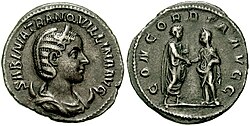
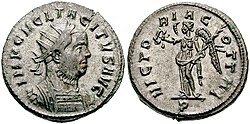
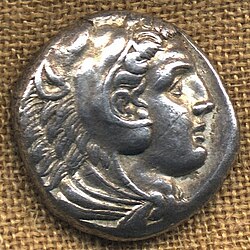
Byzantine coinage eventually shifted this tradition, placing a stylized image of Christ on the obverse and the emperor on the reverse. This shift influenced Islamic coinage; the Caliph Abd al-Malik moved away from imagery entirely, creating a distinctive style using only script. In these Islamic coins, the side featuring the Six Kalimas (the Islamic profession of faith) is defined as the obverse.
![Solidus of Justinian II struck after 705. A stylized Christ is on the obverse, with the emperor on the reverse. Legend: D[OMI]N[US] IHS[US] CH[RI]S[TOS] REX RAGNANTIUM / D[OMI]N[US] IUSTINIANUS MULTUS A[ΝΝΙ].](/images/dc/ee/dcee55f055b61c913dc2dbb900ed85a7b1d94fa4b102c413034f5b7cfea56738.jpg)
Modern Currency Conventions
Modern currency serves as a medium of exchange guaranteed by a state. Consequently, the obverse is designed to evoke the strength and authority of that state, usually through a national symbol or the image of a head of state.
The Eurozone
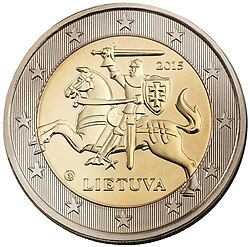
The Euro presents a unique case. Officially, the national side (which varies by country) is the obverse, while the common European side featuring the coin's value is the reverse.
Japan
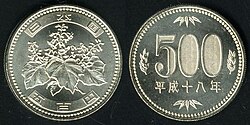
Japanese coins have followed informal conventions since 1897. Before the end of World War II, the side with the Chrysanthemum Crest was the obverse. In the post-war era, the side containing the date is regarded as the reverse, leaving the side without the date as the obverse.
The United Kingdom
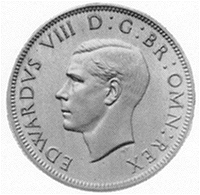
UK coins traditionally feature the monarch's head on the obverse. A curious tradition dictates that each monarch faces the opposite direction of their predecessor. For instance, George VI faced left and Elizabeth II faced right. A brief exception almost occurred with Edward VIII, who preferred to face left to show his hair parting, but his coins were never officially issued.
The United States
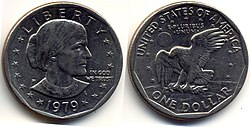
The U.S. government maintains strict specifications for its currency. Standard obverses must include "Liberty," "In God We Trust," and the year of minting. The reverse typically includes "United States of America," "E Pluribus Unum," and the coin's value.
Vexillology: The Obverse of Flags
In the study of flags, the obverse is the side used for default illustrations. It is generally the side visible when the hoist (the edge attached to the mast) is on the viewer's left. Most flags are mirror images on the reverse, though some, like the flag of Paraguay, are truly two-sided.
The flag of Saudi Arabia is a notable exception, utilizing a right-hoisted obverse to ensure the calligraphic Shahada is read correctly on both sides. Additionally, the U.S. Flag Code specifies that when a flag is hung vertically, the reverse side should be displayed so the blue canton remains in the correct relative position.
Summary of Terminology
| Field | Front Side Term | Back Side Term | Key Identifier |
|---|---|---|---|
| Numismatics | Obverse (Heads) | Reverse (Tails) | Portrait or State Symbol |
| Vexillology | Obverse | Reverse | Hoist on the left |
| Codicology | Recto | Verso | Right-hand page |
| General Art | Front | Reverse | Primary image/face |
Frequently Asked Questions
What is the difference between obverse and reverse?
The obverse is the primary or "front" face of a two-sided object, while the reverse is the "back" face. In coinage, the obverse is commonly called "heads" and the reverse is called "tails."
How do you tell which side of an ancient coin is the obverse?
Generally, the side with the larger-scale image, particularly a portrait of a deity or ruler, is the obverse. If images are similar, historians look to the established minting conventions of that specific region.
Why do British monarchs face different directions on coins?
This tradition began in 1661 with Charles II, who faced the opposite direction of Oliver Cromwell. Since then, each successive monarch has faced the opposite way of their predecessor.
Is the value of a Euro coin on the obverse or reverse?
According to official agreements, the common European side containing the coin's value is the reverse, while the unique national design is the obverse.
How is the obverse of a flag determined?
The obverse is the side that is typically used for illustrations and is visible when the hoist (the side attached to the pole) is on the viewer's left.