Obverse and Reverse: The Anatomy of Coins and Flags
In the world of collectibles and historical artifacts, the terms obverse and reverse describe the two flat faces of a two-sided object. While most people colloquially refer to these as "heads" and "tails" when flipping a coin, these technical terms apply to a wide array of items, including paper money, medals, seals, flags, and even fine art prints. Essentially, the obverse is the front face, and the reverse is the back.
Depending on the field of study, different terminology is used. In numismatics (the study of coins), experts use the abbreviations obv. and rev.. In the study of manuscripts and publishing, these sides are known as recto and verso. In vexillology (the study of flags), the obverse is the default side used for illustration.
Key Facts
- Obverse: The "front" or primary side of a coin, flag, or medal.
- Reverse: The "back" or secondary side.
- Edge: The narrow surface located between the obverse and reverse faces.
- Heads/Tails: Common terms for obverse and reverse, stemming from the tradition of placing a portrait on the front.
- Standard Display: In museums, the obverse is typically displayed to the left or above the reverse.
Identifying the Obverse in Numismatics
Determining which side is the obverse is not always intuitive. Generally, the side featuring the larger-scale image—particularly a single head—is designated as the obverse. If the images are of similar scale, historians look to the conventions of the region and era where the coin was minted.
In ancient Greek city-states like Athens or Corinth, the obverse typically featured a constant symbol of the state, such as a patron goddess. For example, the Athenian tetradrachm features the head of Athena on the obverse and an owl on the reverse.
![On this tetradrachm of Athens, struck in the mid 5th century BC, the head of Athena is regarded as the obverse because of its larger scale and portrait; the entire owl is depicted in a smaller scale on the reverse. Legend: ΑΘΕ[ΝΑΙOΝ], ie "of Athenians".](/images/c6/86/c686e1f1b904ab9ac30ab3471e5fb1d7415423136de2df4844b7f7bb80c8dabb.jpg)
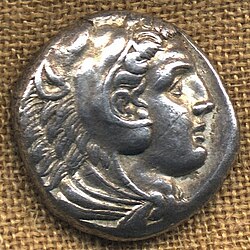
As coinage evolved, Western monarchies adopted the tradition of placing the monarch's head on the obverse. This practice was solidified by Alexander the Great, who depicted himself as a god-king to secure the loyalty of his Egyptian subjects.
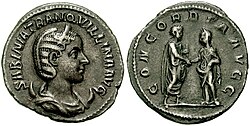
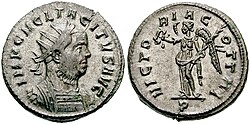
The Roman Empire continued this tradition, using the obverse for imperial portraits and the reverse for symbolic imagery or events.
Shifts in Religious and Cultural Conventions
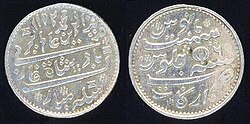
Byzantine coinage saw a shift where the image of Christ took the obverse position, moving the emperor's portrait to the reverse. This change influenced the Islamic Caliph Abd al-Malik, who eventually moved away from imagery entirely to create a distinctive Islamic style consisting solely of script. In these coins, the side containing the Six Kalimas (the Islamic profession of faith) is defined as the obverse.
![Solidus of Justinian II struck after 705. A stylized Christ is on the obverse, with the emperor on the reverse. Legend: D[OMI]N[US] IHS[US] CH[RI]S[TOS] REX RAGNANTIUM / D[OMI]N[US] IUSTINIANUS MULTUS A[ΝΝΙ].](/images/82/1a/821a06c50feda228895931495e6da72f49b8e8e90a2d531869f05b2ffecac0b5.jpg)
Modern Currency Conventions
Modern coins serve as a medium of exchange guaranteed by a state. Consequently, the obverse usually invokes the strength and authority of that state through a national symbol or a reigning monarch. The reverse typically provides functional information, such as the coin's denomination (value), and often reflects the issuing country's culture or geography.
Regional Variations
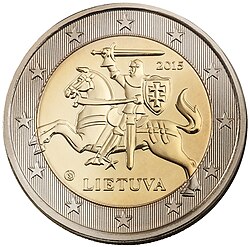
- The Eurozone: Officially, the national side of a euro coin is the obverse, while the common European side containing the value is the reverse.
- Japan: Historically, the side with the Chrysanthemum Crest was the obverse. In the post-WWII era, the side without the date is generally regarded as the obverse.
- United Kingdom: The obverse almost always features the monarch. A unique tradition dictates that each monarch faces the opposite direction of their predecessor.
- United States: The U.S. government strictly specifies that the obverse must include "Liberty," "In God We Trust," and the year of minting.
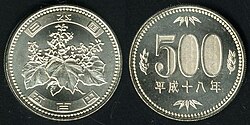
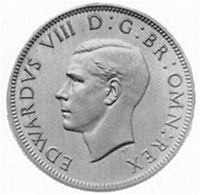
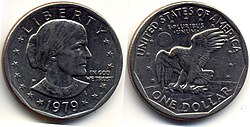
In some cases, specific series like the Statehood quarters have modified these rules to allow more design flexibility on the reverse side.
Obverse and Reverse in Vexillology
In the study of flags, the obverse is the side visible when the hoist (the edge attached to the mast) is on the viewer's left. The reverse is the side where the hoist is on the right. Most flags are mirror images of each other, though some, like the flag of Paraguay, are truly two-sided with different designs.
The flag of Saudi Arabia is a notable exception; it uses a right-hoisted obverse and an equal reverse to ensure the calligraphic Shahada is read correctly on both sides. Additionally, the U.S. Flag Code requires that vertically hung flags be displayed with the reverse side out to keep the blue union in the correct position.
Summary of Terminology
| Field | Front (Obverse) | Back (Reverse) |
|---|---|---|
| Numismatics | Obverse (Heads) | Reverse (Tails) |
| Vexillology | Obverse (Hoist on left) | Reverse (Hoist on right) |
| Codicology/Publishing | Recto | Verso |
| General Scholarship | Front | Reverse |
Frequently Asked Questions
How do I tell the obverse from the reverse on an ancient coin?
Generally, look for the larger-scale image or a portrait of a person; this is typically the obverse. If the images are similar, the side featuring a constant state symbol (like a patron goddess) is usually the obverse.
Why do British monarchs face different directions on coins?
This tradition began in 1661 with Charles II, who faced the opposite direction of Oliver Cromwell. Since then, each successive monarch has faced the opposite direction of their predecessor.
Is the side with the value of a Euro coin the obverse?
No. For circulation coins, the distinctive national side is officially the obverse, and the common European side containing the value is the reverse.
What is the difference between a mirror reverse and an equal reverse on a flag?
A mirror reverse is a flipped copy of the obverse design. An equal reverse ensures that specific elements, such as calligraphy or symbols, appear identical and correctly oriented on both sides of the fabric.
What is the "edge" of a coin?
The edge is the third surface of the coin, located perpendicularly between the obverse and reverse faces.