Norwich Castle: From Norman Fortress to Royal Palace Reborn
Standing as a powerful symbol of Norman conquest and civic evolution, Norwich Castle has transitioned through several identities over nearly a millennium. From its origins as a military stronghold to its long tenure as a county gaol and its current life as a world-class museum, the castle reflects the turbulent and transformative history of East Anglia.
The Norman Foundation and Early Conflict
Founded by William the Conqueror between 1066 and 1075, Norwich Castle began as a motte and bailey—a defensive structure consisting of a raised earth mound (motte) topped by a wooden or stone keep, surrounded by an enclosed courtyard (bailey). Historian R. Allen Brown suggests the castle was likely established around 1067 during William's campaign to subjugate East Anglia.
The castle's early years were marked by rebellion. In 1075, it was besieged for three months during the Revolt of the Earls, led by Ralph de Gael. The siege ended only when Ralph's wife, Emma, secured safe passage for the garrison. The scale of the castle's impact on the local landscape was significant; the Domesday Survey of 1086 lists it as one of 48 castles, and estimates suggest between 17 and 113 houses were destroyed during its construction. Excavations in the 1970s further revealed that the bailey was built over a Saxon cemetery.
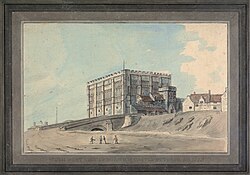
The Stone Keep and Royal Control
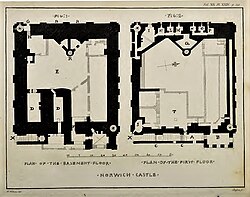
By approximately 1100, the motte was heightened and the ditch deepened. Between 1094 and 1121, the stone keep that remains today was constructed on the south-west part of the motte. This structure featured two internal floors, with the entrance located on the upper floor via an external stone stairway leading to the Bigod Tower. Until the mid-12th century construction of Orford Castle, Norwich served as the only major royal castle in East Anglia.
A History of Turmoil and Sanctuary
The castle remained a focal point of political struggle. During the Revolt of 1173–1174, Hugh Bigod, 1st Earl of Norfolk, captured the castle with a force of 500 of his own men and 318 Flemish soldiers, holding fourteen prisoners for ransom before royal control was restored.
Beyond warfare, the castle served as a place of refuge. In February 1190, during a wave of violence against Jewish populations across East Anglia, the castle provided sanctuary to those seeking safety, while those outside its walls were massacred.
The Castle as a County Gaol
From an early stage, portions of the castle were used as a gaol. An Act of Parliament in 1340 officially gave sheriffs control over the prisons within royal castles, establishing Norwich Castle as the public gaol for the county of Norfolk.
The Soane and Wilkins Eras
By the 18th century, the facility had fallen into decay. Prison reformer John Howard visited between 1773 and 1782, criticizing the lack of facilities for women and the grim conditions for felons and debtors. Between 1789 and 1793, architect John Soane rebuilt the prison for £15,000, removing the keep's interior walls to create cells and adding a new building that obscured the Bigod Tower.
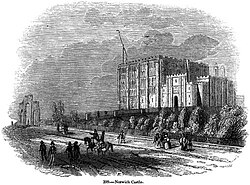
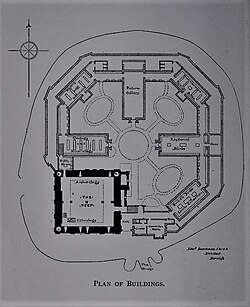
Soane's work was heavily criticized by William Wilkins, who lamented the loss of the building's symmetry and the "wretched" conditions of the interior. In 1806, royal ownership ended when the castle was vested in the Magistrates of Norfolk. The younger William Wilkins subsequently remodeled the site by 1828 at a cost of £50,000, adding an octagonal governor's house and 240 cells in radiating wings.
Executions and Infamous Prisoners
The castle was the site of numerous executions, conducted either publicly at gallows on the bridge or privately within the gaol. Notable figures include:
- Robert Kett: Leader of Kett's Rebellion, who was hanged in chains from the west battlements on December 7, 1549.
- James Rush: Executed on April 21, 1849, for the double murder of the Norwich Recorder and his son.
- George Harmer: The last person executed at the gaol on December 13, 1866.
Transition to Museum and Modern Era
The castle ceased functioning as a gaol in 1887. It was subsequently purchased by the city of Norwich and converted into a museum by Edward Boardman. The conversion removed the cell complexes, installed Norman-style arches and a glazed roof, and transformed cell blocks into viewing galleries. The museum officially opened on October 23, 1894.
The museum has faced modern challenges, including a 2012 attempted theft of a rhinoceros head and the subsequent theft of Admiral Lord Nelson artefacts valued at £36,800.
The Royal Palace Reborn Project
In August 2025, the castle reopened following a £27 million redevelopment titled "Royal Palace Reborn." Funded primarily by the National Lottery Heritage Fund (£13m) and Norfolk County Council, the project removed later additions to expose the original eastern wall and the keep's entrance.
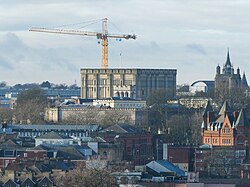
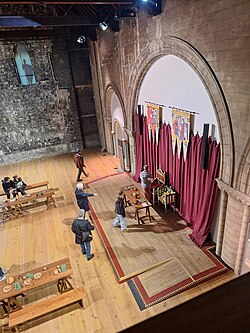
The restoration focused on historical accuracy and accessibility. The interior was reinstated to its original floor positions, recreating the Great Chamber, a banquet hall, and medieval communal toilets. New features include:
- Full wheelchair access to all five floors and the battlements via a new lift.
- A tactile map for blind and partially blind visitors.
- A Gallery of Medieval Life, created in partnership with the British Museum, housing over 900 items.
- Immersive animations and period-accurate furniture and textiles.
Key Facts
- Founded: Between 1066 and 1075 by William the Conqueror.
- Original Style: Motte and bailey.
- Stone Keep: Built between 1094 and 1121.
- Prison Era: Became the official Norfolk county gaol after a 1340 Act of Parliament.
- Museum Opening: October 23, 1894.
- Recent Redevelopment: The £27m "Royal Palace Reborn" project completed in 2025.
| Period | Primary Function | Key Architectural Change |
|---|---|---|
| 11th - 12th Century | Royal Fortress | Construction of the stone keep (1094-1121) |
| 14th - 19th Century | County Gaol | Soane (1789) and Wilkins (1820s) prison remodels |
| 1894 - 2020 | Museum & Art Gallery | Conversion of cells to galleries by Edward Boardman |
| 2025 - Present | Recreated Royal Palace | Removal of prison additions; restoration of medieval rooms |
Frequently Asked Questions
Who founded Norwich Castle and why?
William the Conqueror founded the castle between 1066 and 1075, likely as part of his campaign to subjugate East Anglia and establish Norman control over the region.
What was the "Royal Palace Reborn" project?
It was a £27 million redevelopment completed in 2025 that restored the keep's interior to its original medieval layout, improved accessibility, and created a new Gallery of Medieval Life in partnership with the British Museum.
Who was Robert Kett?
Robert Kett was the leader of a peasant revolt known as Kett's Rebellion. He was executed for high treason on December 7, 1549, and hanged in chains from the castle's west battlements.
How was the castle used as a prison?
After 1340, it became the public gaol for Norfolk. It housed felons and debtors in cells within the keep and later in radiating wings designed by William Wilkins, which included a governor's house and a treadwheel mill.
What happened to the castle's ownership in 1806?
An Act of Parliament on July 12, 1806, ended over 700 years of royal ownership, transferring the castle and surrounding grounds to the Magistrates of Norfolk.