NorwayKingdom of NorwayScandinavian historyNorwegian economyOslo

Norway: A Comprehensive Overview of the Scandinavian Kingdom

Norway: A Comprehensive Overview of the Scandinavian Kingdom The Kingdom of Norway is a Nordic nation characterized by its dramatic landscapes, a rich maritime history, and one of the hig...

Norway: A Comprehensive Overview of the Scandinavian Kingdom

The Kingdom of Norway is a Nordic nation characterized by its dramatic landscapes, a rich maritime history, and one of the highest standards of living in the world. From the deep fjords of the west coast to the Arctic reaches of the north, Norway blends ancient traditions with a modern, high-tech society.

As a unitary parliamentary constitutional monarchy, Norway is governed by a balance of royal tradition and democratic legislation, maintaining a reputation for low inequality and exceptional human development.
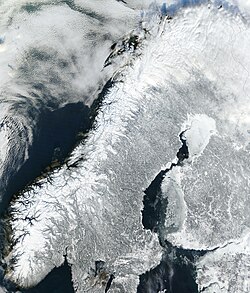
A satellite image of continental Norway and nearby countries in winter

Key Facts

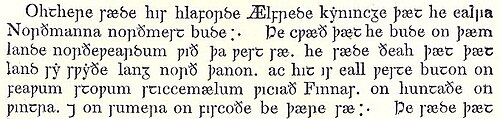
Opening of Ohthere's Old English account, translated: "Ohthere told his lord Ælfrede king that he lived northmost of all Norwegians…"
  • Capital: Oslo (the largest city).
  • Government: Unitary parliamentary constitutional monarchy.
  • Official Languages: Norwegian and Sámi.
  • Economy: Driven by oil production, fishing, and agriculture.
  • HDI: Ranked 2nd globally (2023) with a value of 0.970.
  • Currency: Norwegian krone (NOK).

History and Evolution
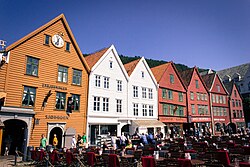
Bryggen in Bergen, once the centre of trade in Norway under the Hanseatic League trade network, now preserved as a World Heritage Site

From Prehistory to the Viking Age

Norway's early history is marked by the transition from the Metal Ages to the Viking Age. The unification of various petty kingdoms began around 872, establishing the early Norwegian state. This era was defined by seafaring, trade, and expansion, leaving behind a legacy of craftsmanship and exploration.
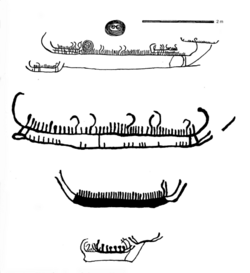
Nordic Bronze Age rock carvings at Steinkjer, Central Norway

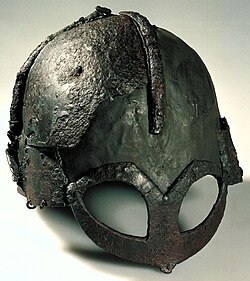
The Gjermundbu helmet found in Buskerud is the only known reconstructable Viking Age helmet.

The Middle Ages and Unions

The Old Kingdom reached its peak extent in 1263. Over the following centuries, Norway entered several unions. The Kalmar Union (1397) brought the Nordic kingdoms together under a single monarch, followed by a real union with Denmark starting in 1524. This period of Danish influence lasted until the early 19th century.
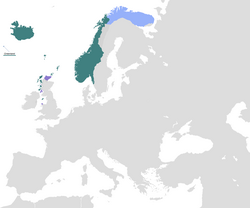
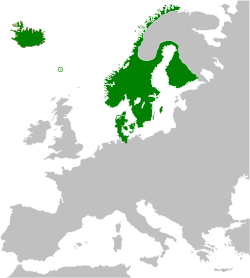
The Norwegian Kingdom at its greatest extent during the 13th century, including the Open Border with the Novgorod Republic

The Kalmar Union, c. 1500

Modern Independence

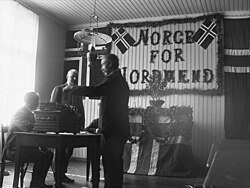
Norway re-established itself as a state on February 25, 1814, with a constitution signed on May 17 of that year. While it entered a personal union with Sweden from November 1814, this union was peacefully dissolved on June 7, 1905, granting Norway full sovereignty.
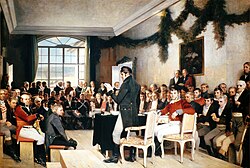
The 1814 constitutional assembly, painted by Oscar Wergeland

The slogan "Norge for Nordmænd" (Norway for Norwegians) at a School in Oslo on 13 August 1905, a voting place during the referendum on the dissolution of the union with Sweden

The 20th Century and Beyond

The Second World War brought significant hardship, including the German invasion in 1940 and the subsequent bombing of 24 towns. Following the war, Norway focused on reconstruction and economic expansion, eventually discovering vast oil reserves in the 1970s that transformed the national economy.
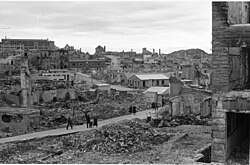
Bombing of Kristiansund. The German invasion resulted in 24 towns being bombed in the spring of 1940.

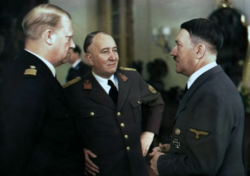
Adolf Hitler meets the Norwegian Prime Minister Vidkun Quisling and minister Albert Viljam Hagelin, 13 February 1942

Geography and Environment

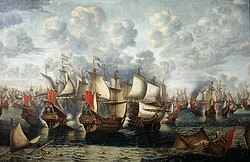
The Battle of the Sound between an allied Dano-Norwegian–Dutch fleet and the Swedish navy, 8 November 1658 (29 October OS)

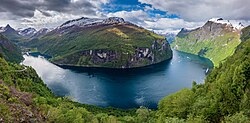
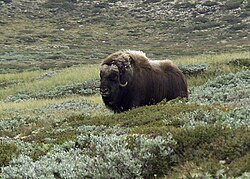
Norway's geography is defined by its rugged coastline and mountainous interior. The country is famous for its fjords—deep, narrow inlets of the sea between high cliffs—and its diverse biodiversity, including the low alpine tundra of Dovrefjell National Park.
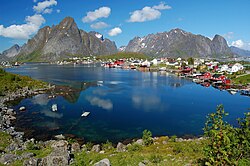
A fishing village on the island of Moskenesøya in the Lofoten archipelago

Muskox in the low alpine tundra at Dovrefjell National Park

The Geirangerfjord in Møre og Romsdal, since 2005 on UNESCO's list of World Heritage Sites.

Climate and Nature

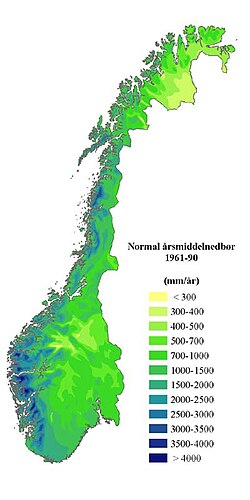
The climate varies significantly from the temperate south to the Arctic north. Precipitation is high, particularly along the western coast, while the interior experiences more continental conditions. The country is committed to environmental preservation, including efforts to ban deforestation.
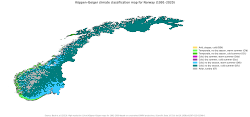
Köppen climate classification types of Norway 1991–2020 (0C/32F isotherm for coldest month dividing C and D climates).

Map of Norway showing the normal precipitation (annual average). Period 1961–1990.

Politics and Government

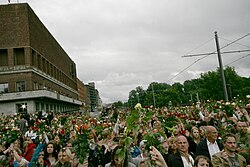
Town Hall Square in Oslo filled with people with roses mourning the victims of the Utøya massacre of 22 July 2011.

Norway is a constitutional monarchy where King Harald V serves as the head of state. Executive power is exercised by the Prime Minister and the Council of State, while legislative power resides in the Storting (the Parliament).
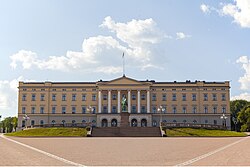
The Royal Palace in Oslo

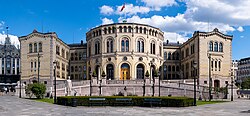
The Storting is the Parliament of Norway.

Administrative Structure

The country is divided into counties and municipalities to manage regional governance. Norway also maintains overseas administrative divisions and manages specific economic zones in the North Atlantic.
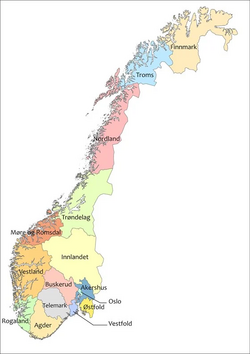
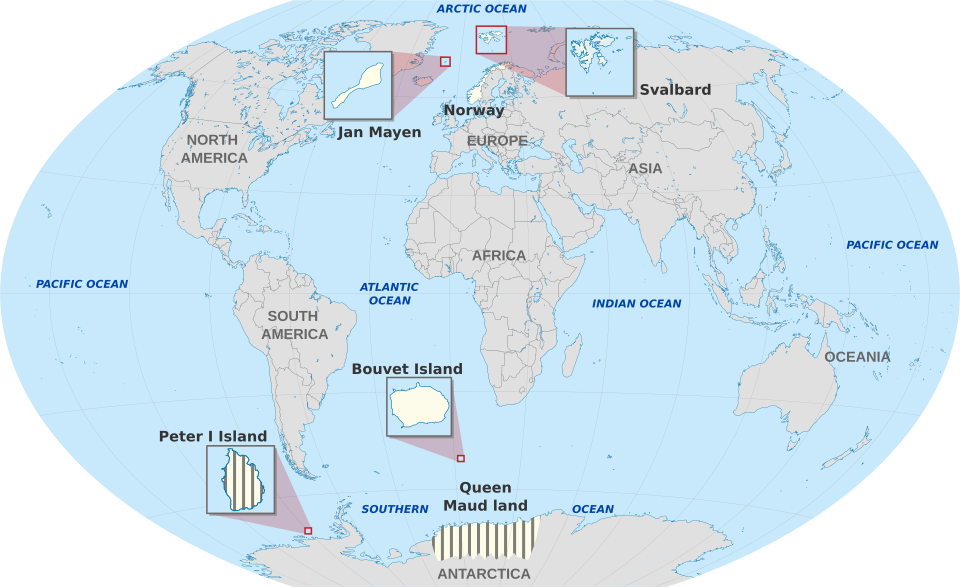
A municipal and regional reform: "From 14 June 2022, the Storting decided the following division of counties."

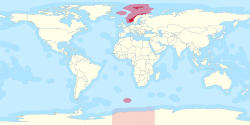
Norway and its overseas administrative divisions

Norway's claimed economic zones

Economy and Infrastructure

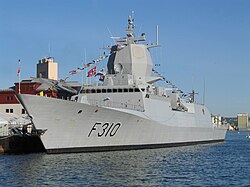
Royal Norwegian Navy Fridtjof Nansen class frigate

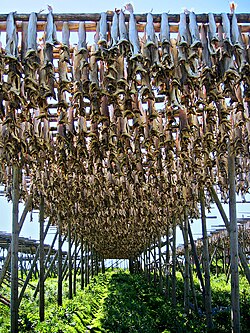
Norway possesses one of the world's highest GDPs per capita. While agriculture and the export of stockfish from the Lofoten archipelago have been staples for over a millennium, the modern economy is dominated by the oil and gas industry.
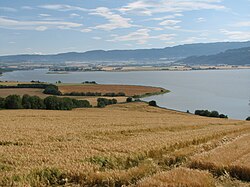
Agriculture is a significant sector, in spite of the mountainous landscape (Øysand).

Stockfish has been exported from Lofoten in Norway for at least 1,000 years.

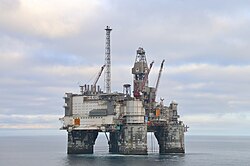
Oil production has been central to the Norwegian economy since the 1970s, with a dominating state ownership (Heidrun oil field).

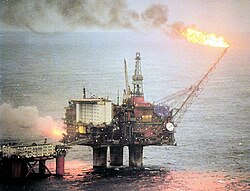
Since the 1970s oil production has helped to expand the Norwegian economy and finance the Norwegian state (Statfjord oil field).

Transport and Trade

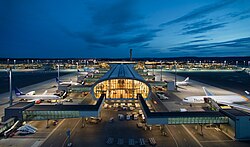
Norway is a member of the European Free Trade Association (EFTA) and participates in the European Single Market and the Schengen Area. Its infrastructure includes advanced aviation hubs like Oslo Airport, Gardermoen, and a strong emphasis on electric vehicle adoption.
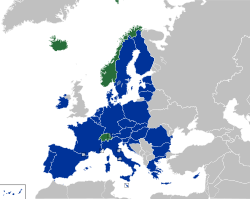
Members of the European Free Trade Association (green) participate in the European Single Market and are part of the Schengen Area.

Oslo Airport, Gardermoen

Society and Culture

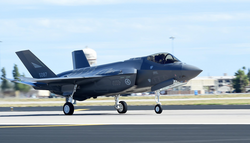
The first Norwegian F-35 Lightning II lands at Luke Air Force Base.

Demographics and Language

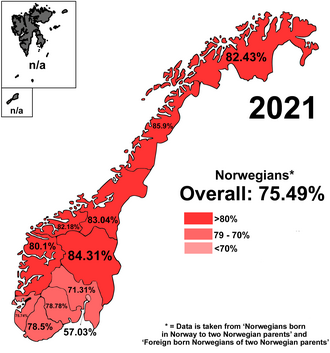
The population is predominantly Norwegian (78.6%), with a significant minority of non-Norwegians (21.4%). The Sámi are the indigenous people of the region, with their languages officially recognized alongside Norwegian.
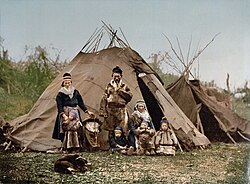
A Sámi family in Norway, c. 1900

Norwegians of two Norwegian parents, either born abroad or in Norway as a percentage proportionally and nationally in Norway as of 2021

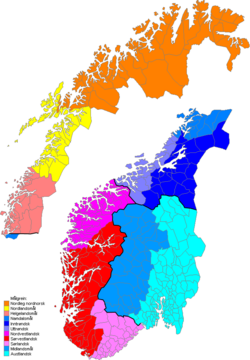
The map shows the division of the Norwegian dialects within the main groups.

Arts and Heritage

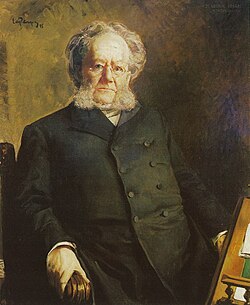
Norwegian culture is world-renowned for its contributions to art and literature. Edvard Munch's The Scream is one of the most iconic images in art history, and playwright Henrik Ibsen remains one of the most performed dramatists globally. Architectural heritage ranges from the ancient Urnes Stave Church to the romantic "Dragon Style" of the late 19th century.
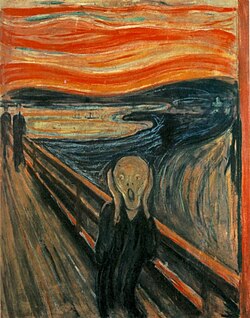
The Scream by Edvard Munch, 1893

Henrik Ibsen, the most frequently performed dramatist in the world after Shakespeare.

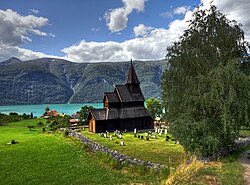
The Urnes Stave Church has been listed by UNESCO as a World Heritage Site.

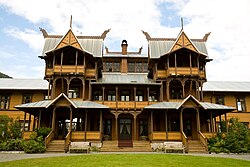
Dalen Hotel in Telemark built in Dragon Style, a style of design architecture that originated during the Norwegian romantic nationalism.

Modern Life and Sports

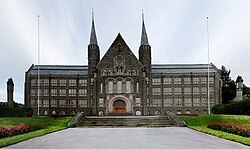
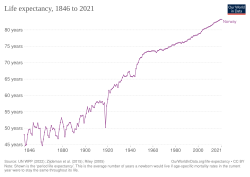
Norway is a powerhouse in winter sports, exemplified by athletes like Marit Bjørgen. The society is characterized by high life expectancy and a strong commitment to public education and research, with institutions like the Norwegian University of Science and Technology leading the way.
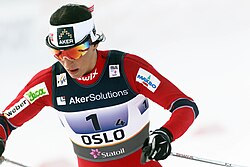
Skier Marit Bjørgen from Norway is the most successful Winter Olympian of all time, with 15 medals

Development of life expectancy in Norway

The main building of the Norwegian University of Science and Technology in Trondheim

National Summary

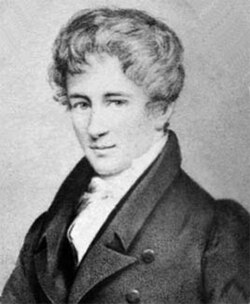
Niels Henrik Abel made pioneering contributions in a variety of fields. The Abel Prize in mathematics, originally proposed in 1899 to complement the Nobel Prizes, is named in his honour.
Category Detail
Total Area 385,207 km²
Estimated Population (2026) 5,627,400
GDP per capita (PPP) $115,548 (5th globally)
Human Development Index 0.970 (2nd globally)
Major Cities Oslo, Bergen, Stavanger, Trondheim

Frequently Asked Questions

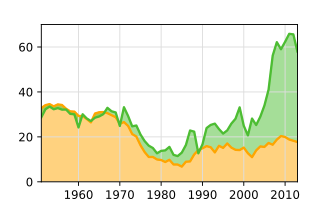
Annual population growth in Norway 1951–2016, in thousands
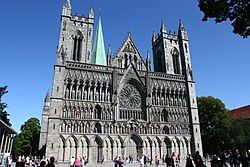
Nidaros Cathedral in Trondheim
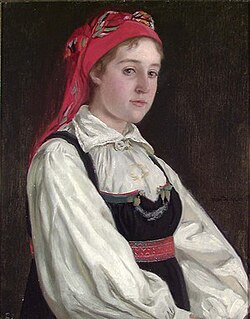
Traditional Norwegian farmer's costumes, known as folkedrakt, and modern costumes inspired by those costumes, known as bunad, are widely used on special occasions.
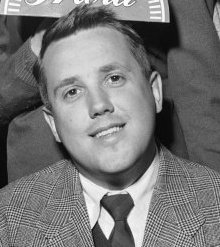
Egil Ragnar Monn-Iversen had so much influence in Norwegian culture that he received the nickname the Godfather.
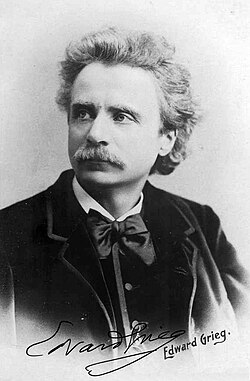
Edvard Grieg, composer and pianist

What is the official language of Norway?

The official language is Norwegian, but Sámi languages are also official. Additionally, Kven, Romani, and Scandoromani are recognized as national minority languages.

How did oil affect the Norwegian economy?

Since the 1970s, oil production has been central to the economy, providing significant state revenue and financing the expansion of the Norwegian welfare state through dominating state ownership.

What is the Storting?

The Storting is the supreme legislative body (Parliament) of Norway, responsible for creating laws and overseeing the government.

When did Norway become fully independent from Sweden?

Norway dissolved its union with Sweden on June 7, 1905, establishing itself as a fully independent sovereign nation.

What are the most significant cultural exports of Norway?

Norway is globally recognized for the art of Edvard Munch, the plays of Henrik Ibsen, the music of Edvard Grieg, and its excellence in winter sports.

References

  1. Bokmål: Norge; Nynorsk: Noreg; Northern Sami: Norga; Lule Sami: Vuodna; Southern Sami: Nöörje; Kven: Norja
  2. Names in the official and recognised languages: Bokmål: Norge [ˈnɔ̂rɡə] ; Nynorsk: Noreg; official names in minority languages: Northern Sami: Norga; Lule Sami: Vuodna; Southern Sami: Nöörje; Kven: Norja.
  3. Written Bokmål and Nynorsk
  4. Norwegian language law paragraph 5 recognises Sámi as an indigenous language of Norway, in which the law reads "Sámi is an indigenous language of Norway. Norwegian and Sámi are equal languages in Norway as per the Sámi law chapter 3". The law specifically recognises Northern Sami, Lule Sami and Southern Sami as official forms in their respective administrative areas for Sámi languages, while other recognised Sámi languages have fewer rights.
  5. Norwegian language law paragraph 7 recognises Norwegian Sign Language as the national sign language of Norway, in which the law reads "Norwegian Sign Language is the national sign language of Norway. As in regards to linguistic and cultural expressions, Norwegian Sign Language is equal to Norwegian".