Nonsuch Park: A Journey Through Ancient Settlements and Royal Grandeur
Nonsuch Park is a site of profound historical layers, where the remnants of prehistoric settlements, Roman infrastructure, and Tudor ambition converge. From its origins as a modest medieval village to its transformation into one of Europe's most opulent royal residences, the park offers a window into the shifting priorities of English society over two millennia.
Key Facts
- Ancient Roots: Evidence of an Iron Age settlement and the Roman road Stane Street.
- Lost Village: The village of Cuddington was entirely demolished in 1538 to make way for a royal palace.
- Royal Ambition: Henry VIII built Nonsuch Palace, named because there was "none such place like it" in Europe.
- Architectural Loss: The palace was demolished in the 1680s to settle the gambling debts of Barbara, Countess of Castlemaine.
- Current Landmark: The Grade II* listed Nonsuch Mansion stands as a mid-18th-century addition to the landscape.
Ancient and Medieval Foundations
Long before the arrival of royalty, the land was inhabited by early settlers. In 1939, road construction uncovered evidence of an Iron Age settlement on the southern side of the park, including hearths, pits, and pottery. While later surveys in the 1990s found no surface earthworks, these early finds establish the area's long-term human occupancy.
The park's northwestern boundary was once traversed by Stane Street, a vital Roman road connecting London to Chichester. This route passed near the spring at Ewell, highlighting the area's strategic importance in antiquity.
By the 11th century, the village of Cuddington (recorded as Codintone in the 1086 Domesday Book) flourished here. The village consisted of 28 households, nine ploughs, and a mill worth three shillings, rendering a total of £9 12s. A remnant of this era is Vicarage Lane, a sunken medieval trackway that once led through Cuddington toward the site of the future palace.
The Rise and Fall of Nonsuch Palace
The trajectory of the park changed forever in November 1538 when Henry VIII ordered the construction of Nonsuch Palace. To create space for this masterpiece, the entire village of Cuddington—including its 12th-century church, manor house, and churchyard—was demolished. The landowner, Richard Codington, was compensated with lands and a dissolved priory in Suffolk.
The palace was designed to be an unrivaled symbol of power. Paul Hentzner, writing in 1598, described the estate as a paradise of deer parks, trellis-work groves, and elaborate gardens. He detailed marble pyramids and imaginative fountains, including one depicting Actaeon being turned into a stag by a goddess and her nymphs.
Despite its splendor, the palace remained incomplete at the time of Henry VIII's death in 1547. Its decline was swift; by 1682–1683, the structure was pulled down and its materials sold to pay the gambling debts of Barbara, Countess of Castlemaine.
Samuel Pepys also documented the area in the 17th century, noting the orderly rows of elm and walnut trees and recalling a moment in 1663 when his dog chased sheep across the common.
Archaeology and Industrial Legacy
Modern understanding of the palace comes from a major 1959 archaeological excavation, which advanced the field of post-medieval archaeology. Today, the palace's footprint is marked by three stone columns featuring groundplan plaques. The banqueting house site remains visible in the west, where a 19th-century retaining wall still incorporates original Tudor bricks.
The land also supported local industry. A chalk quarry, documented as the "Chalk Pitt" by 1731, likely provided the lime necessary for the palace's construction. Additionally, the area's clay deposits led to the establishment of potteries. A small pottery operated from 1708 to 1790, followed by the more substantial Nonsuch Pottery around 1800, which specialized in black abrasive rubbing bricks. The site of this pottery is now home to BMX ramps and trails.
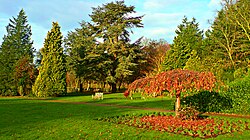
Nonsuch Mansion
The current architectural centerpiece is Nonsuch Mansion (or Nonsuch Park House). Built in the mid-18th century, it was later expanded in the early 19th century by Jeffry Wyattville in the Tudor Gothic style. This historic residence is now recognized as a Grade II* listed building by English Heritage.
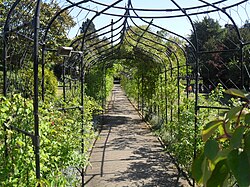
| Era | Key Feature | Significant Detail |
|---|---|---|
| Iron Age / Roman | Settlements & Stane Street | Pottery, hearths, and a road to Chichester. |
| Medieval | Village of Cuddington | 28 households; recorded in the 1086 Domesday Book. |
| Tudor (1538+) | Nonsuch Palace | Built by Henry VIII; demolished in the 1680s. |
| 18th-19th Century | Nonsuch Mansion & Pottery | Tudor Gothic architecture and abrasive brick production. |
Frequently Asked Questions
Why was the palace called "Nonsuch"?
The name was derived from the claim that there was "none such place like it" in Europe, signifying that the palace was without equal in its art and fame.
What happened to the village of Cuddington?
The village was completely demolished in 1538 to provide the site for Henry VIII's Nonsuch Palace, including the removal of the manor house and the 12th-century church.
Who was responsible for the demolition of the palace?
The palace was pulled down around 1682–1683 by the owner, Barbara, Countess of Castlemaine, who sold the building materials to pay off her gambling debts.
What can visitors see of the palace today?
While the buildings are gone, the site is marked by three stone columns with groundplan plaques, and the banqueting house site features a retaining wall with original Tudor bricks.
What is the significance of Nonsuch Mansion?
Built in the mid-18th century and extended in the Tudor Gothic style by Jeffry Wyattville, it is a Grade II* listed building managed under English Heritage guidelines.