Vice-Admiral of the United Kingdom
The Vice-Admiral of the United Kingdom is a prestigious honorary office within the British naval tradition. While it once carried significant operational power, it now serves primarily as a ceremonial role. The title holder acts as the official deputy to the Lord High Admiral—an office that, as of 2025, is vested in the Sovereign.
Historically, the position was typically granted to senior, often retired, admirals of the Royal Navy. It represents a link between the monarchy and the naval forces, maintaining a lineage of leadership that spans over five centuries.
Key Facts
- Established: 25 April 1513 by King Henry VIII.
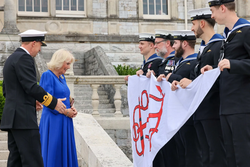
- Current Holder: Queen Camilla (appointed 16 July 2025).
- First Holder: William FitzWilliam, 1st Earl of Southampton.
- Primary Role: Official deputy to the Lord High Admiral.
- Hierarchy: Ranks above the Rear-Admiral of the United Kingdom.
- Historic Status: Formerly a paid position; salary was abolished in 1870.
The Evolution of the Office
In its early years, the Vice-Admiral of England (later Great Britain and then the United Kingdom) was the second most powerful position in the Royal Navy. For a significant period, the role was held jointly with that of the Lieutenant of the Admiralty, a position responsible for the administration of naval affairs.
The terminology of the office shifted to reflect the political union of the British Isles. Following the 1707 union with Scotland, the title became "Vice-Admiral of Great Britain." By the 19th century, this evolved into "Vice-Admiral of the United Kingdom of Great Britain and Ireland." These titles were formally gazetted—published in the official government record—alongside the role of Lieutenant of the Admiralty until the early 21st century.
From Operational Power to Honorary Status
The transition from a functional command to a ceremonial honor was gradual. One notable shift occurred in 1870 when an Order in Council abolished the annual salary for the office, which at the time amounted to £432 1s 9d. Additionally, the Vice-Admiral (or the Rear-Admiral in their absence) traditionally participated in the State Procession during the State Opening of Parliament, a tradition that continued until 1998 when military representation in the procession was reduced.
In more recent history, the appointment was linked to the role of Commander-in-Chief Fleet until that position was discontinued in 2012. Since then, the title has been gazetted simply as Vice-Admiral of the United Kingdom.
Historical Timeline and Notable Holders
The office has seen various periods of activity and abeyance (temporary suspension). From its creation under the Tudors to the modern era, the list of holders includes some of the most distinguished figures in British naval history, including George Anson and Edward Hawke.
| Attribute | Details |
|---|---|
| Date of Formation | 25 April 1513 |
| Appointing Authority | The Monarch |
| First Appointee | William FitzWilliam |
| Current Incumbent | Queen Camilla (since 2025) |
| Subordinate Office | Rear-Admiral of the United Kingdom |
A landmark moment occurred in July 2025, when Queen Camilla was appointed, becoming the first female to hold the office of Vice-Admiral of the United Kingdom.
Frequently Asked Questions
Who is the current Vice-Admiral of the United Kingdom?
As of 16 July 2025, the incumbent is Queen Camilla.
What is the relationship between the Vice-Admiral and the Lord High Admiral?
The Vice-Admiral of the United Kingdom serves as the official deputy to the Lord High Admiral, a role currently held by the Sovereign.
Was the Vice-Admiral of the United Kingdom always an honorary role?
No. In earlier centuries, it was one of the most powerful operational positions in the Royal Navy and included a salary until 1870.
Who was the first person to hold this office?
The first holder was William FitzWilliam, 1st Earl of Southampton, appointed by King Henry VIII on 25 April 1513.
Does the Vice-Admiral still participate in the State Opening of Parliament?
While they did so regularly in the past, representation of the armed forces in the State Procession was scaled back in 1998.