Neoclassical Architecture: The Revival of Classical Antiquity
Neoclassical architecture emerged in the late 18th and early 19th centuries as a sophisticated reaction against the ornate excesses of the Baroque and Rococo styles. Deeply intertwined with the Enlightenment, this movement championed empiricism and the scientific study of antiquity, drawing direct inspiration from the ruins of Ancient Greece and Rome. It was not merely an aesthetic choice but a reflection of a cultural desire for order, reason, and purity.
While the movement peaked between the 18th and mid-19th centuries, its influence persisted. After 1840, classical designs evolved into various "revival" styles, such as the Italianate or Renaissance revivals. In the 21st century, these principles continue to surface through New Classical architecture and historicism, proving the enduring appeal of classical proportions.
Key Facts
- Time Period: Active from the 18th century to the mid-19th century.
- Primary Influences: Ancient Greek and Ancient Roman architecture.
- Core Philosophy: Rooted in the Enlightenment, emphasizing simplicity, symmetry, and archaeological accuracy.
- Major Offshoots: Led to the development of the Adam style, Empire style, Federal architecture, and the Greek Revival.
- Global Reach: Spread across the Western world, including Europe, the Americas, and reaching as far as the Ottoman Empire and Japan.
The Foundations of Palladianism
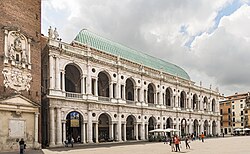
Before the full bloom of Neoclassicism, 18th-century Britain embraced Palladianism, a style based on the works of the 16th-century architect Andrea Palladio. This movement sought a return to the purity of classical forms, rejecting the Baroque taste of the era. The movement was fueled by influential publications, most notably Colen Campbell's Vitruvius Britannicus (1715), which showcased British buildings inspired by classical masters.
Leading figures like Richard Boyle, the 3rd Earl of Burlington, and William Kent pushed this severe lack of ornamentation. A prime example is Chiswick House, a reinterpretation of Palladio's Villa Capra "La Rotonda," stripped of 16th-century decorative elements to achieve a more disciplined aesthetic.
The Evolution of Neoclassicism and Interior Design
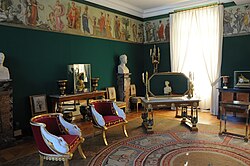
As the movement progressed, it moved beyond structural shells into the realm of interior design. Robert and James Adam revolutionized the Georgian home in the 1770s. After studying ruins in Italy and Dalmatia, they introduced the Adam style, which aimed to lighten the heavy feel of previous eras, creating interiors that were more elegant and airy.
This era also saw the rise of the Empire style, particularly in France, which blended neoclassical rigor with imperial grandeur. This is evident in the lavish rooms of the Château de Malmaison and the Château de Compiègne, where the architecture served to glorify political power.
The Greek Revival
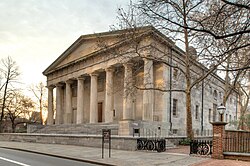
Around 1800, a shift occurred as architects moved from Roman-inspired forms toward a more direct imitation of Ancient Greek architecture. This Greek Revival was sparked by a fresh influx of archaeological data, including etchings and engravings from expeditions led by James Stuart and Nicholas Revett in 1751.
The use of the Doric order became a hallmark of this period. In the United States, this style became synonymous with democratic ideals, manifesting in civic buildings and monuments that evoked the birthplace of democracy.
Regional Trends and Global Impact
Europe
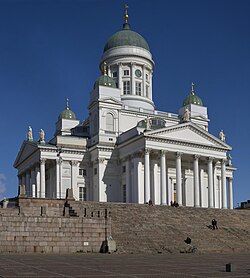
In France, Neoclassicism was used for monumental civic projects like the Panthéon and the Église de la Madeleine. Germany saw the rise of Karl Friedrich Schinkel and Leo von Klenze, who designed the Altes Museum and the Walhalla. In Greece, the establishment of the Kingdom in 1832 led to a national architectural rebirth, with the "Athens Classical Trilogy" serving as a centerpiece of the city's modern plan.
The Americas
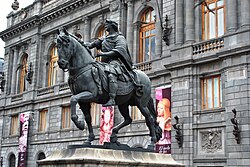
In the United States, the style evolved into Federal architecture, seen in the White House and the L'Enfant Plan for Washington, D.C. In Mexico, Manuel Tolsá brought neoclassical discipline to the Palacio de Minería. Across Latin America, from Brazil's Imperial Palace of Petrópolis to the cathedrals of Colombia and Argentina, the style was employed to signify stability and political authority.

The Ottoman Empire and Beyond
In Turkey, the 19th century brought a blend of neoclassical components and traditional Ottoman layouts, known as structural eclecticism. This is visible in the Dolmabahçe Palace and the Istanbul Archaeology Museum. Similarly, in Malta, British rule in the 19th century popularized the style, resulting in landmarks like the Rotunda of Mosta.
Summary of Neoclassical Styles
| Style | Primary Focus | Key Characteristic | Notable Example |
|---|---|---|---|
| Palladianism | Andrea Palladio's works | Severe lack of ornament, symmetry | Chiswick House |
| Adam Style | Interior elegance | Lighter, refined Georgian interiors | Syon House |
| Empire Style | Imperial grandeur | Lavish, political glorification | Château de Malmaison |
| Greek Revival | Ancient Greek purity | Doric columns, temple fronts | Academy of Athens |
| Federal Style | Early American civic identity | Understated classical proportions | The White House |
Frequently Asked Questions
What is the difference between Neoclassicism and the Greek Revival?
Neoclassicism is a broader movement that drew from both Roman and Greek sources. The Greek Revival is a specific phase within Neoclassicism that began around 1800, focusing more exclusively on the archaeological accuracy of Ancient Greek forms, such as the Doric order.
How did the Enlightenment influence this architecture?
The Enlightenment emphasized reason, logic, and scientific observation. This led architects to reject the "irrational" ornamentation of the Baroque and instead study the mathematical proportions and structural honesty of classical antiquity.
Who was Andrea Palladio and why is he important?
Palladio was a 16th-century Italian architect whose designs emphasized symmetry and perspective. His work became the foundation for Palladianism in the 18th century, serving as a bridge between the Renaissance and the Neoclassical movement.
Is Neoclassical architecture still used today?
Yes, although it is no longer the dominant global style. It persists in the form of New Classical architecture and is often used in historicism or gentrification projects to evoke a sense of timelessness and prestige.
Where can I see examples of Neoclassicism outside of Europe?
Prominent examples exist in the United States (The White House, Jefferson Memorial), Mexico (Palacio de Minería), Brazil (Imperial Palace of Petrópolis), and Turkey (Dolmabahçe Palace).