Mount Nemrut: The Ancient Tomb-Sanctuary of King Antiochus I
Perched atop the Anti-Taurus range in Turkey's Adıyaman Province, Mount Nemrut (also spelled Nemrud) stands as a testament to the ambition of a forgotten kingdom. Reaching an elevation of 2,150 meters (7,050 ft), this mountain peak serves as the site of a massive tomb-sanctuary commissioned in 62 BC by King Antiochus I of Commagene.
Antiochus I sought to reinvigorate the religion of his ancestral dynasty by blending the traditions of the Greek and Iranian worlds. This cultural fusion is evident in the site's hierothesion—a term used to describe this specific arrangement of sacred statues. A similar structure was created for his father, Mithridates I Callinicus, at Arsameia on Nymphaios.
Key Facts
- Location: Adıyaman Province, Turkey (Anti-Taurus range).
- Elevation: 2,150 meters (7,050 ft).
- Founder: King Antiochus I of Commagene.
- Date of Construction: Likely began on July 7, 62 BCE.
- Statue Height: Between 8 and 9 meters (26–30 ft).
- Tumulus Dimensions: 49 meters tall and 152 meters in diameter.
The Pantheon of Gods and Ancestors
The sanctuary is flanked by colossal statues representing King Antiochus I, two lions, two eagles, and a variety of composite deities. These figures merge Greek and Iranian identities, such as Zeus-Oromasdes, Heracles-Artagnes-Ares, and Apollo-Mithras-Helios-Hermes. While the statues feature Greek-style facial features, they are adorned in Persian clothing and hairstyles.
Originally, these figures were seated with their names inscribed upon them. However, the heads were eventually removed from their bodies and now lie scattered across the site. The specific damage to the noses suggests these acts were the result of iconoclasm, the deliberate destruction of religious icons. These heads have not been restored to their original positions.
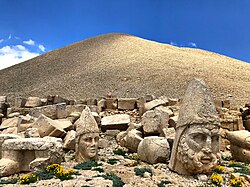
Beyond the statues, the site contains stelae—stone slabs featuring bas-relief figures. These slabs are believed to have once formed a large frieze depicting the Greek and Persian ancestors of King Antiochus I.
The Tumulus and Architectural Layout
At the center of the site is a tumulus, a mound of loose rock measuring 49 meters (161 ft) in height and 152 meters (499 ft) in diameter. This structure likely served as a protective barrier for the tomb, as any attempt by robbers to excavate the site would cause the loose rocks to fill in quickly.
The sanctuary is divided into eastern and western terraces. The eastern portion remains well-preserved, consisting of several rock layers. Evidence of a walled passageway suggests that the two terraces were once linked by a path following the base of the mountain.
Astronomy and Ritual Use
The western terrace holds a significant astronomical clue: a large slab depicting a lion accompanied by an arrangement of stars and the planets Mars, Mercury, and Jupiter. Researchers believe this composition represents a star chart from July 7, 62 BCE, marking the probable start date of the monument's construction.
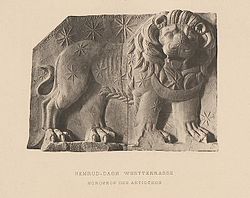
Due to the combination of astronomical alignments and the presence of a divine pantheon, historians believe the site was used for religious ceremonies.
| Feature | Description |
|---|---|
| Statues | 8–9m tall figures of gods, animals, and the King |
| Tumulus | Loose rock mound (49m high, 152m wide) |
| Stelae | Bas-relief slabs depicting ancestors |
| Astronomical Slab | Lion relief showing planets and stars from 62 BCE |
Frequently Asked Questions
Who built the sanctuary on Mount Nemrut?
The sanctuary was built by King Antiochus I of Commagene in 62 BC.
Why are the heads of the statues lying on the ground?
The heads were removed from their bodies, likely due to iconoclasm (the deliberate destruction of religious images), and have not been restored.
What is a hierothesion?
A hierothesion is the specific arrangement of statues found at this site, a style also used by Antiochus' father at Arsameia on Nymphaios.
What is the significance of the lion slab?
The slab depicts a chart of the sky including Jupiter, Mercury, and Mars, which suggests the monument's construction began on July 7, 62 BCE.
How did the tumulus protect the tomb?
The tumulus was made of loose rock, meaning any excavation attempt by tomb robbers would cause the rocks to collapse and fill the hole back in.