Monetarism: The Role of Money Supply in Economic Stability
Monetarism is a macroeconomic theory that emphasizes the critical impact of the money supply—the total amount of money in circulation—and the actions of central banks on the broader economy. Formulated by economist Milton Friedman, this school of thought posits that the primary driver of inflation is the excessive expansion of the money supply. Consequently, monetarists argue that central banking authorities should prioritize price stability above other interventions.
The foundations of monetarism lie in the quantity theory of money. This centuries-old concept was championed by economists such as Irving Fisher and Alfred Marshall before Friedman revitalized and restated the theory in 1956, providing a framework to analyze how changes in the volume of money affect price levels.
Key Facts
- Core Premise: Inflation is viewed as a purely monetary phenomenon caused by too much money chasing too few goods.
- Primary Goal: Central banks should focus on maintaining price stability rather than actively managing demand.
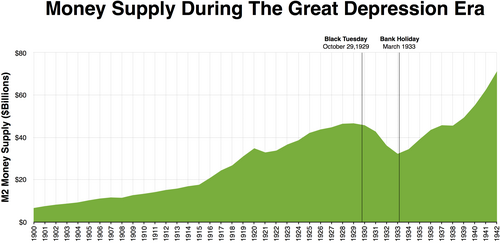
- The Great Contraction: Monetarists attribute the Great Depression to a massive contraction of the money supply.
- Policy Recommendation: Friedman advocated for a fixed percentage increase in the money supply annually (the k-percent rule).
- Gold Standard View: Most monetarists oppose the gold standard due to its inability to prevent deflation during periods of rapid population or trade growth.
Monetary History of the United States
A cornerstone of monetarist thought is the belief that central banks often inadvertently cause unexpected economic fluctuations. In the 1963 work A Monetary History of the United States, 1867–1960, coauthored with Anna Schwartz, Milton Friedman argued that active attempts to stabilize demand through discretionary monetary policy often lead to negative unintended consequences.
The authors linked inflation to an excess money supply generated by the central bank. Conversely, they attributed deflationary spirals to a failure by the central bank to support the money supply during a liquidity crunch—a situation where cash and easily convertible assets become scarce.
Most notably, Friedman and Schwartz challenged the Keynesian view of the 1930s. They argued that the Great Depression was not caused by a lack of investment, but by a massive contraction of the money supply, which they termed "the Great Contraction." They similarly asserted that post-war inflation resulted from an over-expansion of the money supply, cementing the famous phrase: "inflation is always and everywhere a monetary phenomenon."
The Fixed Monetary Rule
To avoid the pitfalls of discretionary policy, Friedman proposed the k-percent rule. This rule suggests that the money supply should automatically increase by a fixed percentage every year, ideally matching the growth rate of real GDP (Gross Domestic Product). For example, if the economy is expected to grow by 2 percent, the Federal Reserve should increase the money supply by exactly 2 percent to keep price levels unchanged.
The effectiveness of such rules depends heavily on how money is measured. Traditional "simple-sum" aggregates, which treat all monetary assets as identical, can be misleading during times of financial innovation. In contrast, Divisia monetary aggregates—which use a more theoretically grounded measurement—have shown a more stable relationship between money growth, inflation expectations, and economic activity. Integrating these precise measurements into forward-looking models can improve the transmission of monetary policy and the success of rules-based approaches.
Opposition to the Gold Standard
Most monetarists, including Friedman, oppose the gold standard. While the gold standard prevents inflation by limiting the growth of the money supply to the availability of gold, it creates a significant risk of deflation. If trade or population growth outpaces the supply of gold, the economy may suffer from reduced liquidity and recession, with no way to counteract the trend other than mining more gold.
Friedman acknowledged that a gold-based economy could function only if a government were willing to completely surrender control over its monetary policy and refrain from interfering with economic activities.
| Economic Event | Monetarist Explanation | Proposed Solution/Rule |
|---|---|---|
| Inflation | Excessive expansion of money supply | Maintain price stability |
| The Great Depression | The "Great Contraction" of money supply | Central bank support during liquidity crunches |
| Economic Instability | Discretionary monetary policy changes | Fixed k-percent rule (match GDP growth) |
| Deflation (Gold Standard) | Money supply cannot keep up with trade/population | Flexible monetary control (Oppose gold standard) |
Frequently Asked Questions
What is the main goal of monetarism?
The main goal of monetarism is to maintain price stability by controlling the growth of the money supply, preventing the excessive expansion that leads to inflation.
What is the k-percent rule?
The k-percent rule is a proposal by Milton Friedman that the money supply should increase automatically by a fixed percentage each year, equal to the growth rate of real GDP.
How do monetarists explain the Great Depression?
Monetarists argue that the Great Depression was caused by a "Great Contraction," where a massive decrease in the money supply led to a severe economic downturn.
Why do monetarists generally oppose the gold standard?
They believe the gold standard is impractical because it cannot prevent deflation or liquidity shortages if the economy's growth exceeds the rate at which gold is mined.
What are Divisia monetary aggregates?
Divisia monetary aggregates are a sophisticated way of measuring money that accounts for the different roles of various monetary assets, providing a more accurate signal for monetary policy than simple-sum aggregates.