Full Employment: Economic Definitions, NAIRU, and Inflationary Trade-offs
In the realm of macroeconomics, full employment is often misunderstood as a state where every single person in a population has a job. In reality, it is a more nuanced concept that describes an economic equilibrium where specific types of unemployment are eliminated, but others remain. Understanding full employment is critical for policymakers because it marks the threshold beyond which attempts to further lower unemployment can trigger rising inflation.
Defining Full Employment
Economists disagree on the exact definition of full employment. Some argue for a 100% employment-to-population ratio, but most modern economists view it as the absence of cyclical unemployment—the type of unemployment caused by a deficiency in aggregate demand during economic downturns.
Under most definitions, full employment still allows for two other types of unemployment:
- Frictional Unemployment: Temporary unemployment occurring when workers are "between jobs" while searching for better opportunities.
- Structural Unemployment: A mismatch between a worker's skills and the requirements of available jobs, or underemployment where workers cannot find roles appropriate to their skill level.
The NAIRU and the Natural Rate of Unemployment
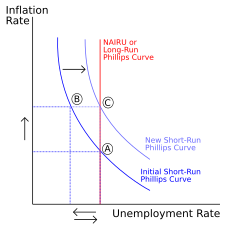
A central concept in modern economics is the Non-Accelerating Inflation Rate of Unemployment (NAIRU), also described by Milton Friedman as the "natural" rate of unemployment. The NAIRU is the specific unemployment rate at which inflation remains stable. If a government uses expansionary fiscal or monetary policy to push unemployment below this rate, the resulting labor shortage typically leads to accelerating inflation.
This relationship is often illustrated via the Phillips Curve, which suggests a short-term trade-off between inflation and unemployment. However, the NAIRU theory posits that this trade-off is not sustainable. When unemployment stays below the NAIRU, inflationary expectations rise; workers demand higher wages, and businesses raise prices, shifting the short-run Phillips curve upward and neutralizing the initial gains in employment.
Measuring the NAIRU
Determining the exact percentage of the NAIRU is notoriously difficult. For example, in the United States, economist William T. Dickens found the rate averaged around 5.5% during the 2000s. The OECD has provided various estimates, such as a range of 4% to 6.4% for the U.S. in 1999. Because these numbers fluctuate, many economists now view full employment as a "range" rather than a single fixed point.
Key Facts
- Full employment does not mean 0% unemployment; it typically means 0% cyclical unemployment.
- NAIRU is the unemployment rate that allows for stable inflation.
- Expansionary policies (like lowering interest rates) can reduce unemployment temporarily but may cause inflation if they push the rate below the NAIRU.
- Classical economists traditionally viewed full employment as the normal state of a free market, while Keynesians argued that persistent failures in aggregate demand could keep unemployment high.
- U.S. Law: The Employment Act of 1946 and the 1978 amendment set statutory goals for unemployment rates (3% for those 20+ and 4% for those 16+), though these are rarely met.
Comparative NAIRU Estimates
The following table provides a snapshot of OECD estimates for the NAIRU in the United Kingdom and the United States over several periods.
| Period/Year | United Kingdom (%) | United States (%) |
|---|---|---|
| 1988–1997 (Avg) | 8.5 | 5.8 |
| 1998–2007 (Avg) | 5.9 | 5.5 |
| 2008 | 6.2 | 5.8 |
| 2009 | 6.6 | 6.0 |
| 2010 | 6.7 | 6.1 |
| 2011–2013 | 6.9 | 6.1 |
Theoretical Perspectives and Policy
Keynesian vs. Classical Views
John Maynard Keynes challenged the Classical view that all unemployment is voluntary. He argued that involuntary unemployment occurs when the demand for final products is too low compared to the economy's potential output. In his later work, he defined full employment as the point where further increases in effective demand no longer increase output.
Global Policy Applications
Post-WWII, many Western nations adopted interventionist policies to maintain full employment. The Nordic countries continue to use targeted policies for young people, and the UK implemented the "New Deal" from 1998 to 2010. In Australia, the government pursued a formal full employment policy from 1945 until 1975, beginning with the 1945 white paper Full Employment in Australia.
Frequently Asked Questions
Does full employment mean everyone has a job?
No. In economic terms, full employment refers to the absence of cyclical unemployment. It still accounts for frictional unemployment (people transitioning between jobs) and structural unemployment (skill mismatches).
What happens if unemployment falls below the NAIRU?
When unemployment drops below the Non-Accelerating Inflation Rate of Unemployment, labor becomes scarce, leading to higher wages and prices. This typically results in accelerating inflation as inflationary expectations become embedded in the economy.
What is the difference between the natural rate and the NAIRU?
In most modern macroeconomic contexts, these terms are used interchangeably to describe the level of unemployment that is consistent with a stable rate of inflation.
Why is it difficult to measure the full employment rate?
The rate is not a constant number; it varies over time based on economic conditions. Empirical research has shown that the range of possible values can be quite large, making it difficult for policymakers to pinpoint a single target number.
How does the U.S. government legally approach full employment?
Under the Employment Act of 1946 and the Full Employment and Balanced Growth Act of 1978, the U.S. is committed to maintaining low unemployment rates (3-4%) and is authorized to create a "reservoir of public employment" for low-skill workers if necessary, though this has rarely been implemented.