Missionary Work: History, Religious Traditions, and Global Impact
A missionary is a member of a religious group sent to a specific area to promote their faith or provide essential services to the local population. While often associated with spiritual conversion, missionary work frequently encompasses humanitarian efforts, including education, literacy programs, social justice initiatives, health care, and economic development.
The term originates from the Latin missionem (nominative missio), meaning an "act of sending," derived from mittere ("to send"). While the word is most commonly linked to Christian traditions—referencing the biblical accounts of Jesus Christ sending his disciples to preach the gospel—it applies to any creed or ideology that seeks to spread its teachings.
Key Facts
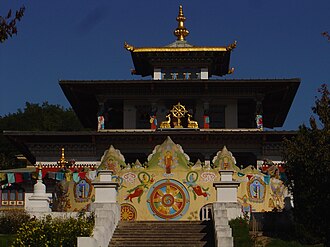
- Diverse Roles: Missionaries provide both spiritual guidance and social services like medical care and schooling.
- Christian Roots: Much of Christian missionary work is driven by the "Great Commission," the biblical instruction to make disciples of all nations.
- Global Reach: Missions have been central to the spread of Buddhism, Christianity, and Islam across Asia, Africa, and the Americas.
- Modern Scale: The Church of Jesus Christ of Latter-day Saints maintains one of the most active modern programs, with over 100,000 full-time and service missionaries as of 2026.
- Interdisciplinary Impact: Missionary efforts have historically influenced linguistics, medicine, and international diplomacy.
Christian Missions
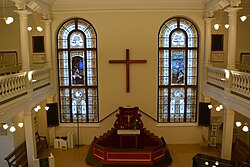
Christian missionary work is primarily inspired by the Great Commission, found in the books of Matthew and Mark, where Jesus instructs his apostles to spread the gospel globally.
Historic Expansion
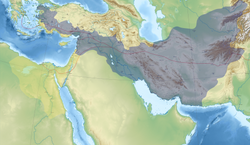
The early Church expanded through the Roman Empire and reached as far as India (Saint Thomas Christians) and Persia (Church of the East). During the Middle Ages, figures like Saint Patrick and Adalbert of Prague brought teachings beyond Roman borders. In 596, Pope Gregory the Great initiated the Gregorian Mission to England, while later Hiberno-Scottish and Anglo-Saxon missions converted much of central Europe.
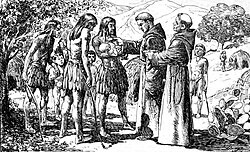
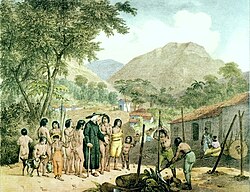
During the Age of Discovery, the Catholic Church utilized the Augustinians, Franciscans, and Dominicans to establish missions in the Americas. Simultaneously, Jesuits like Francis Xavier reached Asia. A notable example is Matteo Ricci's 1582 mission to China, which is remembered for its peaceful approach.

In the 19th century, the Russian Empire propagated Orthodoxy across Belarus, Latvia, Finland, and China, while Saint Nicholas of Japan brought the faith to Japan. In the Americas, the Russian Orthodox Church ministered to Natives in Alaska starting in the 18th century.
Protestant and Modern Movements
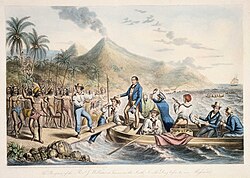
The Danish government established the first organized Protestant mission work via the College of Missions in 1714, funding figures like Bartholomaeus Ziegenbalg in India. The Moravian Church, inspired by Count von Zinzendorf, became famous for their selfless approach, often living as slaves among slaves in the West Indies and working with the Lenape and Cherokee tribes.
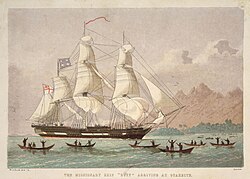
Anglican efforts were largely managed by the Society for the Propagation of the Gospel in Foreign Parts (SPG) and the Church Missionary Society (CMS). In the modern era, the London Missionary Society and the Colonial Missionary Society merged in 1966 to form the Council for World Mission.

The Church of Jesus Christ of Latter-day Saints
The LDS Church operates a highly structured program where young men (18–25) serve two-year missions and young women (18+) serve for 1.5 years. These missionaries undergo rigorous training in Missionary Training Centers to learn scriptures, languages, and local cultures. As of April 2026, the church reported 78,000 full-time and 31,000 service missionaries across 451 active missions.
Buddhist and Hindu Missions
Buddhism engaged in some of the earliest large-scale missionary efforts, notably during the reign of King Ashoka (260–218 BCE).
In modern times, Buddhism has seen growth in Europe. The French Buddhist Union estimated between 600,000 and 650,000 Buddhists in France in the early 1990s, including roughly 150,000 converts.
![Central Asian Buddhist monk teaching a Chinese monk. Bezeklik, 9th–10th century; although Albert von Le Coq (1913) assumed the blue-eyed, red-haired monk was a Tocharian,[5] modern scholarship has identified similar Caucasian figures of the same cave temple (No. 9) as ethnic Sogdians,[6] an Eastern Iranian people who inhabited Turfan as an ethnic minority community during the phases of Tang Chinese (7th–8th century) and Uyghur rule (9th–13th century).[7]](/images/ee/3f/ee3f60a984649c72e03c7f47fac2b9a5ca9dd39a80a895f7ec35b2fc76fc01bb.jpg)
Hindu missions, such as those by Ananda Marga, focus heavily on social welfare, including the management of research institutes, primary and higher schools, medical camps for tribal welfare, and nursing homes for women.
Islamic Missions
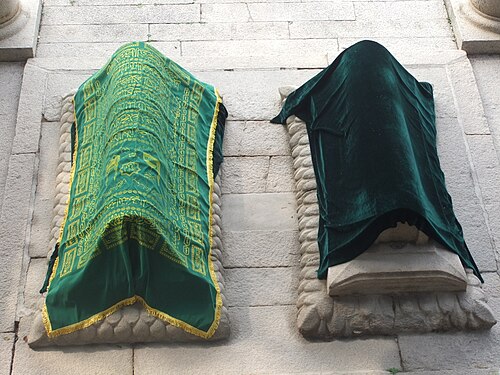
Islamic missions have historically spread through both preaching and settlement. In 1380, Karim ul' Makhdum became the first Arabian Islamic missionary to reach the Philippines, establishing Islam in the Sulu Archipelago and Jolo.

Subsequent Arab missionaries traveling to Malaysia and Indonesia further strengthened the faith in the Philippines, leading to the creation of sultanates such as Maguindanao and Sulu.
Other Religious Missions
Jainism: Virchand Gandhi represented Jains at the first Parliament of the World's Religions in Chicago in 1893. Because Jain monks traditionally do not travel overseas, Gandhi served as the emissary. Today, there are approximately 100,000 Jains in the United States.
Sikhism: Sikh missionary work has been carried out by figures such as Giani Pritam Singh Dhillon, who was also an Indian freedom fighter.
Summary of Missionary Traditions
| Religion | Key Drivers/Figures | Primary Focus Areas | Notable Characteristics |
|---|---|---|---|
| Christianity | Great Commission, Jesuits, Moravians | Global (Americas, Africa, Asia) | Strong emphasis on both proselytizing and social services. |
| Buddhism | King Ashoka | Asia, Europe (Modern) | Early large-scale organized efforts in the 3rd century BCE. |
| Islam | Karim ul' Makhdum, Arab traders | Southeast Asia, Africa | Spread through preaching and the establishment of sultanates. |
| Hinduism | Ananda Marga | Global | Heavy focus on education, tribal welfare, and healthcare. |
| Jainism | Virchand Gandhi | United States (Modern) | Use of scholarly emissaries due to monastic travel restrictions. |
Frequently Asked Questions


What is the primary goal of a missionary?
The primary goal is to promote a specific faith or ideology in a new area, though this often includes providing humanitarian services such as education, healthcare, and economic development.
What is the "Great Commission"?
The Great Commission refers to the biblical instruction given by Jesus Christ to his apostles to go into all the world and make disciples of all nations, serving as the foundational motivation for Christian missions.
Do all missionaries focus only on conversion?
No. Many missionary organizations focus on social welfare. For example, Ananda Marga missions emphasize tribal welfare, women's homes, and the creation of research institutes.
How do LDS missions differ from others?
The Church of Jesus Christ of Latter-day Saints utilizes a highly standardized program where young adults serve full-time, self-funded missions for a set period (1.5 to 2 years) after completing specialized training.
Who was Virchand Gandhi in the context of Jain missions?
Virchand Gandhi was a scholar who represented Jainism at the first Parliament of the World's Religions in 1893 in Chicago, acting as an emissary because Jain monks do not travel overseas.