Miracle of Bern: The Legendary 1954 FIFA World Cup Final
In the annals of sporting history, few matches carry as much emotional and political weight as the 1954 FIFA World Cup final. Known in Germany as the Miracle of Bern (Wunder von Bern), this encounter saw West Germany secure a stunning 3–2 victory over the heavily favored Hungarian national team. It was more than just a game; it was a moment of national rebirth for a defeated Germany and a harbinger of political unrest in communist Hungary.
The match took place on July 4, 1954, at the Wankdorf Stadium in Bern, Switzerland. While the final score suggested a close contest, the narrative leading up to the whistle was one of David versus Goliath. Earlier in the tournament's group stage, Hungary had utterly dominated West Germany with a crushing 8–3 victory, making the eventual final result one of the greatest upsets in football history.
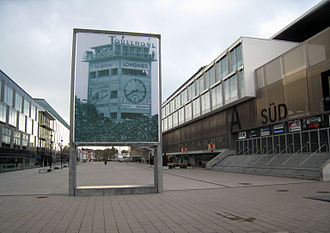
Key Facts
- Date: July 4, 1954
- Venue: Wankdorf Stadium, Bern, Switzerland
- Final Score: West Germany 3, Hungary 2
- Attendance: 62,500 spectators
- Weather: Rainy conditions
- Referee: William Ling (England)
- Significance: West Germany's first World Cup title
The Contenders: The Mighty Magyars and the New West Germans
Hungary's Golden Team
Hungary entered the 1954 tournament as the undisputed favorites. Their legendary squad, known as the Golden Team or the Mighty Magyars, had remained unbeaten in 31 games over the preceding five years. They were the reigning Olympic Champions and had famously defeated England 6–3 at Wembley in 1953—the first non-UK/Ireland team to do so on English soil. Statistically, they held the highest Elo score (a system used to calculate relative skill levels of national teams) of any side in the world at the time.
West Germany's Ascent
West Germany's journey was far more tentative. Following World War II, the German entities—West Germany, East Germany, and the Saar protectorate—were not readmitted to FIFA until late 1950. Under the guidance of coach Sepp Herberger, the team was built around a core of players from 1. FC Kaiserslautern, led by the veteran playmaker Fritz Walter.
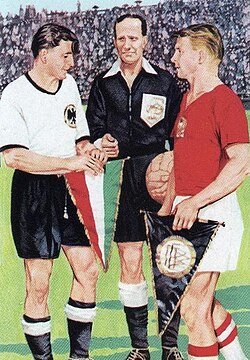
The Road to the Final
The path to the championship was a rollercoaster for the Germans. After their devastating 8–3 loss to Hungary in the first stage, they had to fight through a play-off and knockout rounds, defeating Yugoslavia, Austria, and Uruguay to reach the final. Hungary, meanwhile, cruised through the competition, overcoming South Korea, Turkey, Brazil, and Uruguay.
| Detail | West Germany | Hungary |
|---|---|---|
| Final Score | 3 | 2 |
| Goal Scorers | Morlock (10'), Rahn (18', 84') | Puskás (6'), Czibor (8') |
| Captain | Fritz Walter | Ferenc Puskás |
| Manager | Sepp Herberger | Gusztáv Sebes |
The Match: A Rainy Drama
The final began as a nightmare for West Germany. Hungary struck twice in the opening eight minutes, with goals from Ferenc Puskás and Zoltán Czibor. However, the Germans refused to collapse. Max Morlock scored in the 10th minute, and Helmut Rahn brought the game level in the 18th.
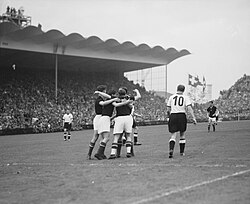
Despite Hungarian dominance in possession and territory for much of the match, West Germany remained resilient. The climax arrived in the 84th minute when Helmut Rahn scored his second goal of the match, sealing a 3–2 victory. A post-match analysis based on radio commentary suggests that while Hungary led in most statistical categories, West Germany's efficiency in front of the goal proved decisive.
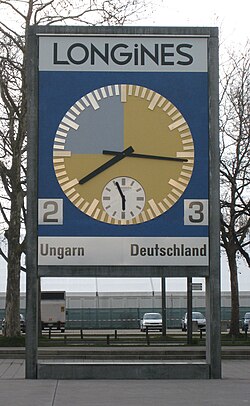
Controversies and Aftermath
Doping Allegations
In later years, the victory was clouded by allegations of doping. A study publicized in 2013 suggested that some players may have received injections of Pervitin (an amphetamine). While the German Football Association contested these claims, it is noted that doping controls were not introduced by FIFA until 1966, meaning such practices were not illegal at the time.
Sociopolitical Impact
The match had profound effects beyond the pitch. In West Germany, the win provided a sense of international recognition and psychological recovery following the devastation of World War II and the process of denazification. In Hungary, the loss contributed to a growing sense of discontent with the communist-authoritarian regime, which eventually culminated in the 1956 Hungarian Revolution.
Legacy of the Players
The "Heroes of Bern" became instant celebrities in Germany, though many remained semi-professionals. The Hungarian Golden Team was dismantled following the 1956 revolution, with stars like Puskás, Czibor, and Kocsis emigrating to play for Real Madrid and FC Barcelona. Decades later, the surviving members of both teams formed a lasting friendship, holding annual get-togethers until the passing of the final survivors: Jenő Buzánszky in 2015 and Horst Eckel in 2021.
Frequently Asked Questions
Why is the 1954 final called the "Miracle of Bern"?
It is called the Miracle of Bern because West Germany defeated the heavily favored Hungarian "Golden Team," who had beaten them 8–3 earlier in the same tournament and were considered nearly invincible.
Who were the key players in the match?
Key figures included West Germany's Fritz Walter (captain) and Helmut Rahn, who scored two goals, and Hungary's legendary Ferenc Puskás and Zoltán Czibor.
Did the 1954 final have any political significance?
Yes. For West Germany, it symbolized a return to international respectability after WWII. For Hungary, the loss is seen by some historians as a contributing factor to the social unrest that led to the 1956 revolution.
Were there any doping scandals associated with the win?
Research published in 2013 alleged that some West German players were injected with Pervitin, an amphetamine. However, doping was not banned by FIFA until 1966.
What happened to the Hungarian Golden Team after the match?
The team remained strong until the 1956 Hungarian Revolution, after which several key players emigrated to Spain to play for clubs like Real Madrid and FC Barcelona.