Michigan Department of Transportation: A History of Innovation
The evolution of Michigan's road networks is more than just a story of asphalt and concrete; it is a chronicle of pioneering spirit. From the early days of bicycle enthusiasts demanding better paths to the construction of massive interstate bridges, Michigan has consistently led the nation in transportation infrastructure and safety innovations.
The Good Roads Movement and Early Foundations
The origins of Michigan's organized road system lie in the Good Roads Movement at the turn of the 20th century. Driven largely by the League of American Wheelmen, bicycle enthusiasts campaigned for improved streets to ensure safe travel free from the interference of horse-drawn vehicles. This advocacy led the Michigan State Legislature to form a State Highway Commission in 1892, followed by a 1893 law allowing counties to establish their own road commissions.
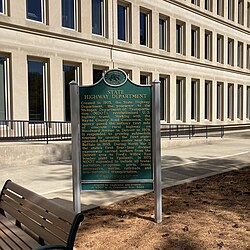
Horatio S. Earle, a pivotal figure in this movement, organized the first International Road Congress in Port Huron in 1900 and promoted the use of macadam (a type of road construction using layers of small crushed stones). After a brief legal battle regarding the constitutionality of the office, the State Highway Department was officially established on July 1, 1905, with Earle appointed as the first commissioner by Governor Fred M. Warner.
Transitioning from Mud to Concrete
In 1905, Michigan had 68,000 miles of roads, but the vast majority were unimproved. Only 7,700 miles were gravel and a mere 245 miles were macadam. A significant shift occurred in 1907 when the state abolished the "statute labor system," which had allowed farmers to work on roads in lieu of paying taxes, replacing it with a property tax system dedicated to permanent improvements.
Michigan soon made global history on April 2, 1909, when the Wayne County Road Commission began work on the nation's first mile of concrete roadway. Located on Woodward Avenue in Detroit between Six Mile and Seven Mile roads, this 17-foot 8-inch wide stretch was completed on July 4, 1909, at a cost of $13,354.
Pioneering Road Safety and Infrastructure
As automobile registrations skyrocketed—reaching 60,438 by the time Frank Rogers was elected highway commissioner in 1913—the state introduced the "State Trunkline Act" to create 3,000 miles of high-priority roadways. This era saw the introduction of weight- and horsepower-based taxes for cars and the first official naming and signage for state roads.
Michigan's contribution to road safety is particularly noteworthy. In 1911, Edward N. Hines invented the centerline, which saw its first state highway implementation in 1917 along the Marquette-Negaunee Road. That same year, Michigan introduced the first stop sign and the first "crow's nest" traffic signal tower in Detroit, featuring the red-yellow-green sequence developed by officer William Potts.
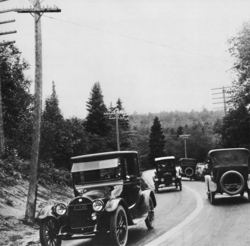
Other "firsts" included the invention of the snowplow, utilized during World War I to maintain 590 miles of strategic highways, and the development of yellow centerlines to mark no-passing zones on dangerous curves and hills.
Expansion and the Interstate Era
The 1920s marked the end of the "age of mud." The state shifted toward concrete and asphalt, exemplified by M-16, the first concrete trunkline, which exceeded standard width and thickness specifications of the time. However, the Great Depression slowed progress, leading the state to use "reliefers" (unemployed workers) for road projects funded by federal aid and license plate fees.
World War II accelerated infrastructure needs, resulting in the rapid 11-month construction of the Willow Run and Detroit Industrial Expressways to support the Ford Motor Company bomber plant. By the late 1950s, Michigan adapted its plans for the new Interstate Highway System, becoming the first state to complete a border-to-border interstate with I-94, stretching 205 miles from New Buffalo to Detroit.
This period also saw the completion of iconic structures, including the Mackinac Bridge (1957), the Portage Lake Lift Bridge (1959), and the International Bridge (1962), as well as the massive 8,367-foot bridge over the River Rouge for the Fisher Freeway (I-75).
The Evolution of MDOT
The department underwent several structural changes to reflect its growing scope. The 1963 Constitution ended the election of the highway commissioner, replacing the role with a governor-appointed commission and a department director. In 1973, the agency was renamed the Michigan Department of State Highways and Transportation to include oversight of aviation, railroads, buses, ships, and trails.
In 1976, the department made its first rolling stock purchase by acquiring the Ann Arbor Railroad. Finally, in 1978, the name was shortened to the current Michigan Department of Transportation (MDOT), and Proposal M was approved by voters to reorganize the commission and allocate gas tax revenues.
Key Facts
- First Concrete Road: Laid on Woodward Avenue in Detroit (1909).
- Safety Firsts: Invented the centerline (1911), the first stop sign (1917), and the red-yellow-green traffic light (1917).
- Interstate Milestone: First state to complete a border-to-border interstate (I-94).
- Winter Maintenance: Home to the first snowplow, used for strategic highways during WWI.
- Department Origin: Formed July 1, 1905, evolving from the Good Roads Movement.
| Year | Milestone | Significance |
|---|---|---|
| 1905 | State Highway Department Formed | Established centralized road management. |
| 1909 | First Concrete Road | First mile of concrete roadway in the U.S. |
| 1917 | Centerline & Traffic Lights | Introduced critical road safety markers. |
| 1957 | Mackinac Bridge | Major infrastructure link between peninsulas. |
| 1973 | Renamed to MDOT (Precursor) | Expanded scope to all transportation modes. |
Frequently Asked Questions
Who started the movement for better roads in Michigan?
The movement was driven by bicycle enthusiasts and the League of American Wheelmen, who wanted safer streets free from horse-drawn vehicle interference.
Where was the first concrete road in the United States located?
The first mile of concrete roadway was built on Woodward Avenue in Detroit, between Six Mile and Seven Mile roads, and was completed in July 1909.
What safety innovations did Michigan introduce to the world?
Michigan pioneered the road centerline, the first stop sign, the red-yellow-green traffic signal, and the yellow no-passing line for curves and hills.
When did the department become the Michigan Department of Transportation?
The department's name was shortened to its current form in 1978, following a period of expansion that included aviation, railroads, and shipping.
What was the "statute labor system"?
It was a system abolished in 1907 that allowed farmers and their teams of horses to perform road work instead of paying road taxes.