Indianapolis Transportation History: From Flatboats to International Flight
The growth of Indianapolis was fundamentally shaped by its geography. Positioned near the center of the state, the city was originally established with the hope that river navigation would drive its economy. However, the White River proved too shallow for commercial shipping; after the steamboat Robert Hanna ran aground in 1831, steamboats ceased operations in the city. While flatboats continued for a time, the construction of new dams eventually blocked their passage, forcing the city to look toward land-based transit for its survival and expansion.
The Era of Early Roads and Highways
To overcome the limitations of the river, the Indiana General Assembly authorized ten state roads in 1821 to link Indianapolis with other population centers. Two major arteries defined this era: the National Road and the Michigan Road.
The National Road, the first major federally funded improved highway in the county, reached Indianapolis by 1836. Spanning 620 miles (1,000 km) between Cumberland, Maryland, and Vandalia, Illinois, it provided a vital east-west connection. Complementing this was the Michigan Road, completed in 1839, which bisected the state from north to south. By connecting Indianapolis to the inland ports of Madison and Michigan City, the city finally gained access to maritime transport via the Ohio River and Lake Michigan.
The Rise of Rail and the Union Station Concept
The arrival of the first two trains on October 1, 1847, marked the completion of the Madison and Indianapolis Railroad and signaled a new era of mobility. Within five years, seven different rail lines converged in the city, including the Indianapolis and Cincinnati and the Indianapolis and Lafayette railroads.
To manage this congestion, Indianapolis pioneered the union station concept—a single terminal shared by multiple competing railroad companies. The Indianapolis Union Railway Company was formed in 1849, leading to the completion of the world's first union depot on September 20, 1853.
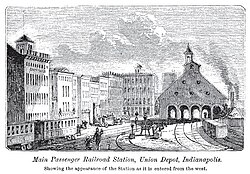
As rail traffic surged, the original depot became obsolete. A larger Indianapolis Union Station opened in 1888, initially servicing 80 passenger trains daily from 16 companies. By 1900, this number grew to 150 trains per day. To resolve the resulting traffic congestion at level crossings, the city worked with railroads to elevate the tracks between 1905 and 1920.
Urban Transit and the Interurban Boom
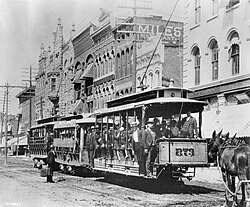
Public transit began on October 3, 1864, with 12-seat mule-drawn streetcars running between Union Station and Military Park. The Citizens Street Railway Company later expanded this into a hub-and-spoke system. The transition to electricity began on June 18, 1890, and by 1894, all mule-drawn cars were replaced. This electrification allowed for the development of "streetcar suburbs" such as Riverside, Irvington, and Woodruff Place, as residents could now live further from the downtown business center.
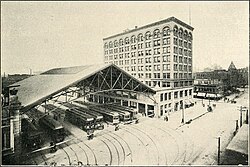
Parallel to city streetcars was the rise of the interurban—electric railways connecting different cities. The Indianapolis Traction Terminal opened in September 1904 to serve 12 of the 13 interurban lines in the city. As the busiest interurban station globally, it served as the heart of a 1,825-mile (2,937 km) network, peaking at seven million passengers annually and over 600 trains daily before the rise of the automobile led to its closure in September 1941.
Aviation and the Shift to Highways
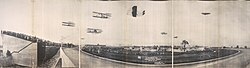
Indianapolis entered the aviation age in June 1910, when the Indianapolis Motor Speedway hosted the first licensed aviation meet in the U.S., featuring pioneers Orville and Wilbur Wright.
The 1920s saw a proliferation of airfields, including Crawford and Schoen Fields. Cox Field, established in 1926, became the city's first municipal airport and hosted the first regularly scheduled commercial flight on December 17, 1927. This evolved into the Indianapolis Municipal Airport in 1931 (now Indianapolis International Airport), which was renamed Weir Cook Municipal Airport in 1944.
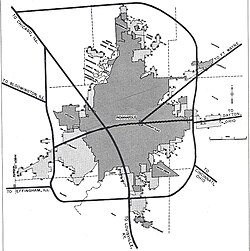
Following World War II, the preference for personal automobiles led to the decline of streetcars, with the last one decommissioned in January 1953. The Federal Aid Highway Act of 1956 ushered in the Interstate Highway System, with construction of the I-465 beltway beginning in 1959 and finishing in 1970. While Interstates 65, 69, 70, and 74 were completed by the mid-1970s, the planned I-165 spur was withdrawn from the system in 1981.
Modern Infrastructure and Innovation
The Indianapolis Airport Authority was established in 1962 to oversee regional air transport. The airport has undergone numerous expansions, most notably the 2008 opening of the 1.2-million-square-foot Colonel H. Weir Cook Terminal, a project costing US$1.1 billion.
In recent years, the city experimented with sustainable transit via BlueIndy, the first electric carsharing service in the U.S. Launched in September 2015, it operated 200 electric cars and 92 charging stations until its closure in May 2020.
Key Facts
- First Union Depot: Indianapolis opened the world's first union station on September 20, 1853.
- Interurban Hub: The Indianapolis Traction Terminal was once the busiest interurban station in the world, serving 7 million passengers annually.
- Aviation Milestone: The 1910 aviation meet at the Indianapolis Motor Speedway was the first licensed event of its kind in the U.S.
- Highway Network: The I-465 beltway was completed on October 5, 1970.
- Airport Investment: The Colonel H. Weir Cook Terminal opened in 2008 at a cost of $1.1 billion.
| Era/Mode | Key Milestone | Date |
|---|---|---|
| Roads | National Road reaches Indianapolis | 1836 |
| Rail | First Union Depot completed | 1853 |
| Public Transit | First electric streetcar operation | 1890 |
| Interurban | Indianapolis Traction Terminal opens | 1904 |
| Aviation | First licensed U.S. aviation meet | 1910 |
| Highways | I-465 beltway completed | 1970 |
Frequently Asked Questions
Why did river navigation fail in early Indianapolis?
The White River was too shallow for commercial shipping. After the steamboat Robert Hanna ran aground in 1831, no other steamboats successfully returned to the city.
What was the significance of the Indianapolis Union Railway Company?
Formed in 1849, this company allowed competing railroad lines to cooperate and operate out of a single shared terminal, creating the world's first union depot in 1853.
How did electric streetcars change the city's layout?
Electrification improved efficiency and speed, allowing residents to live further from the downtown core, which led to the creation of streetcar suburbs like Irvington, Riverside, and Woodruff Place.
Which interstate highway was planned but never built?
Interstate 165, a planned 2.7-mile spur between I-65 and 38th Street, was withdrawn from the Interstate System on July 30, 1981.
What was BlueIndy?
BlueIndy was the first electric carsharing service in the United States, operating from September 2015 to May 2020 with 200 electric vehicles.