Megalopolis: From Prehistoric Giants to Industrial Powerhouse
Megalopolis is a site where myth, prehistoric discovery, and political ambition converge. Long before it became a strategic city-state, the region was steeped in legend, believed by ancient Greeks to be the site of the Gigantomachy—the epic battle where the gods defeated the giants. This myth was likely fueled by the discovery of massive bones in the area, which ancient writers like Pausanias attributed to giants.
Modern science provides a different explanation for these remains. The "giant bones" are actually fossils from Pleistocene animals, such as the extinct straight-tusked elephant. These fossils, along with lignite (a soft, brown coal) deposits, were left behind 900,000 to 150,000 years ago when the area was a large, shallow lake.
Prehistoric Discoveries and Early Humans
The Megalopolis basin is a treasure trove for paleoanthropology. Evidence shows that Homo heidelbergensis, an extinct human species, inhabited the region approximately 500,000 to 400,000 years ago. These early humans survived by butchering large prehistoric animals, including the straight-tusked elephant and the extinct large hippopotamus, Hippopotamus antiquus.
Perhaps most significantly, wooden tools discovered in the basin dating to roughly 430,000 years ago represent the oldest known evidence of handheld wooden tools in the world as of 2026.
The Rise of the Ancient City
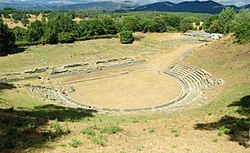
The city of Megalopolis was formally established between 371 and 368 BC. It was founded by the Theban general Epaminondas and the Arcadian League—a federation of twenty to forty neighboring communities—to serve as a political counterweight to the power of Sparta.
Throughout its early history, Megalopolis was a focal point of conflict. It survived a Spartan attempt to reduce the city in 353 BC with Theban help and a Spartan invasion in 331 BC with Macedonian assistance. In 317 BC, during the Second War of the Diadochi, the city withstood a siege by Polyperchon, the Regent of the Macedonian Empire, after Megalopolis aligned with Cassander.
Tyranny and the Achaean League
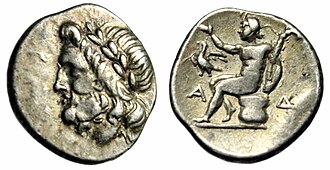
The city's governance shifted over the centuries. In the 270s BC, Aristodemus the Good took control as a tyrant with Macedonian backing. Later, in 235 BC, the second tyrant, Lydiadas of Megalopolis, relinquished power, and the city joined the Achaean League.
Despite being burned down by the Spartan king Cleomenes III in 222 BC, the city was rebuilt. As a prominent member of the Achaean League, Megalopolis influenced federal politics and produced notable figures such as Polybius, Lykortas, and Philopoemen.
Roman Conquest and Later Eras
The era of Greek independence ended in 146 BC when Rome conquered Megalopolis during the Third Macedonian War. While the city remained inhabited under Roman rule, it was almost entirely abandoned by the 6th century. During the Byzantine and Ottoman periods, the settlement was known as Sináno, only regaining the name Megalopoli after the Greek War of Independence.
Modern Industrialization and Challenges
Megalopolis remained primarily rural until the 1960s. This changed when Professor Leonidas Zervas, then Minister of Industry, facilitated the Greek Public Power Corporation's entry into the region. This led to the creation of the Megalopoli Mine—one of Greece's largest lignite mines—and the subsequent construction of the Megalopoli Power Plant.
The modern town also faced a natural disaster on April 5, 1965, when the massive Arcadia earthquake struck. The event resulted in 17 deaths and left 80% of the residences demolished or uninhabitable.
Key Facts
- Oldest Tools: Home to the world's oldest handheld wooden tools (approx. 430,000 years old).
- Prehistoric Inhabitants: Evidence of Homo heidelbergensis butchering extinct elephants and hippopotamuses.
- Foundation: Established 371–368 BC by Epaminondas to counter Spartan influence.
- Political Ties: Member of both the Arcadian League and the Achaean League.
- Industrial Role: Site of one of Greece's largest lignite mines and a major power plant.
| Era | Key Characteristic/Event | Approximate Timeframe |
|---|---|---|
| Prehistoric | Homo heidelbergensis & Pleistocene fossils | 500,000 – 150,000 years ago |
| Classical/Hellenistic | Foundation & conflict with Sparta | 371 BC – 146 BC |
| Roman/Byzantine | Conquest and eventual abandonment | 146 BC – 6th Century AD |
| Modern | Lignite mining and industrialization | 1960s – Present |
Frequently Asked Questions
Why was Megalopolis associated with the Gigantomachy?
Ancient Greeks believed it was the site where gods defeated the giants, likely because they discovered enormous fossils of Pleistocene animals, such as straight-tusked elephants, which they mistook for the remains of giants.
Who founded the city of Megalopolis?
The city was founded between 371 and 368 BC by the Theban general Epaminondas and the Arcadian League to act as a political counterweight to Sparta.
What is the significance of the wooden tools found there?
Wooden tools dating to approximately 430,000 years ago are currently the oldest evidence of handheld wooden tools discovered anywhere in the world.
Which leagues did Megalopolis belong to?
Megalopolis was initially a member of the Arcadian League and later became a member of the Achaean League, where it exerted significant political influence.
What caused the town's modern industrial growth?
The growth was driven by the discovery and mining of lignite, led by the Greek Public Power Corporation in the early 1960s, resulting in one of the country's largest mines and a major power plant.