Media Coverage of Social Protests: Analyzing the Protest Paradigm
When social movements take to the streets to demand change, the lens through which the public views them is often shaped by the media. This phenomenon is frequently analyzed through the protest paradigm, a framework where news coverage focuses more on the tactics, spectacle, and disruptions of a protest rather than the underlying grievances or goals of the participants.
From economic uprisings in New York City to global climate strikes and racial justice movements, the way journalists frame these events can significantly influence public perception and the perceived legitimacy of the cause.
Key Facts
- The Protest Paradigm: A media tendency to prioritize the "spectacle" of a protest over the actual demands of the protesters.
- Occupy Wall Street: Mainstream media often used dismissive terms like "carnival" or "circus" to characterize the movement.
- Black Lives Matter: Research shows a sharp partisan divide in the use of the word "riot" versus "protest" across different news networks.
- Greta Thunberg: Activism is often met with delegitimization through personal ad hominem attacks rather than engagement with climate science.
- Gaza War Protests: Media coverage tends to emphasize confrontation and spectacle while neglecting the specific grievances and demands of protesters.
Case Studies in the United States
Occupy Wall Street and the Tea Party
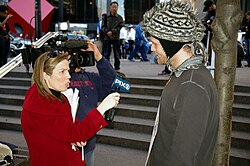
Occupy Wall Street (OWS) emerged in September 2011 in New York City's Zuccotti Park as a progressive movement against corporate greed, economic inequality, and the influence of money in politics. Despite its scale, research suggests a disparity in how it was covered compared to the 2009 Tea Party protests. Eric Alterman noted that the Tea Party received more favorable press despite having lower public support and smaller turnouts.
Studies on OWS coverage identified five primary "marginalization devices" that accounted for 66% of the tone variability: public disapproval, negative impact, show, ineffective goals, and lawlessness. Major outlets like USA Today, The New York Times, and The Boston Globe were cited for using the protest paradigm, describing the movement as a "carnival" or "circus" and quoting critics to imply the movement was unrealistic.
Black Lives Matter (BLM)
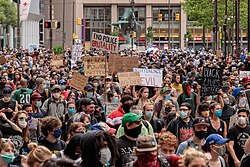
Black Lives Matter is a decentralized movement focused on anti-racism and ending police brutality. While the movement is a broad network without a formal hierarchy, it gained global visibility following the murder of George Floyd in May 2020. The subsequent protests were overwhelmingly peaceful, yet media framing varied wildly by political leaning.
Analysis of news terminology revealed that right-wing outlets, such as Fox News, used the word "riot" significantly more often (1.15 times per story) than left-wing outlets like MSNBC (0.24 times per story). Furthermore, a report involving the Minneapolis Star-Tribune and other papers found that police sources were cited more frequently than community sources, and police violence was often described using "distancing" language, such as "officer-involved shooting."
Global Perspectives on Protest Framing
Gaza War Protests
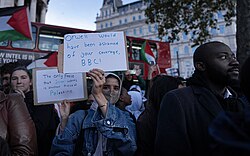
Protests surrounding the Gaza war, which began on October 7, 2023, have focused on demands for ceasefires, humanitarian aid, and an end to the Israeli blockade. Dr. Brown of Michigan State University observes that while the media extensively covers the "spectacle" and "confrontation" of these events, the actual grievances and demands of the protesters are frequently neglected in favor of official government statements.
Climate Activism and Greta Thunberg
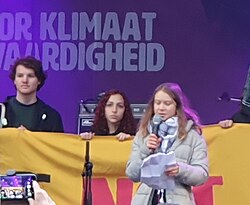
The experience of Swedish activist Greta Thunberg illustrates delegitimization—a tactic within the protest paradigm where the messenger is attacked to invalidate the message. Rather than debating climate policy, various columnists and political groups, including Germany's Alternative for Germany (AfD), have employed personal attacks, often targeting her autism to blunt her influence.
Anti-Corruption in Serbia
In Serbia, the 2024 anti-corruption protests provide an example of state-aligned media influence. Outlets such as RTS, Pink, and TV Informer have portrayed the protests negatively, even disseminating false claims that the movements were backed by Kosovo to undermine their domestic legitimacy.
Summary of Media Framing Trends
| Movement | Common Media Framing | Key Marginalization Tactic |
|---|---|---|
| Occupy Wall Street | "Carnival" / "Circus" | Dismissing goals as unrealistic |
| Black Lives Matter | "Riot" vs. "Protest" | Overemphasizing violence over peace |
| Gaza War Protests | Spectacle and Confrontation | Neglecting core grievances |
| Greta Thunberg | Personal Attacks | Ad hominem attacks / Delegitimization |
Frequently Asked Questions
What is the protest paradigm?
The protest paradigm is a pattern in news coverage where the media focuses on the disruptive behavior, appearance, and tactics of protesters rather than the social or political issues they are trying to address.
How did media coverage differ between the Tea Party and Occupy Wall Street?
Research indicates that the Tea Party protests received more favorable press coverage than Occupy Wall Street, despite the Tea Party having smaller turnouts and lower levels of public support.
What role did terminology play in the coverage of Black Lives Matter?
Terminology served as a marker of partisan divide; right-wing outlets were significantly more likely to use the word "riot" to describe the events, while left-wing outlets used the term less frequently.
How is delegitimization used against activists like Greta Thunberg?
Delegitimization occurs when media outlets or political opponents use personal attacks—such as mocking an activist's autism or character—to distract from their message and reduce their influence.
Why is the use of "distancing language" significant in police reporting?
Phrases like "officer-involved shooting" are considered distancing language because they frame police violence in a way that can obscure individual accountability and the nature of the force used.