Medal Ribbons: The Design, Order, and Significance of Military Service Ribbons
In the world of military honors, a medal ribbon (also known as a service ribbon or ribbon bar) serves as a compact visual shorthand for a service member's achievements and history. These small strips of fabric, mounted on metal bars, are designed to be worn in place of full-sized medals when the occasion does not call for formal decorations.
While they may appear simple, these ribbons are governed by strict regulations. Each government establishes its own rules regarding which ribbons may be worn, the circumstances under which they are displayed, and the specific sequence in which they must appear—a system known as the order of precedence or the order of wearing.
Key Facts
- Purpose: Ribbons are worn as substitutes for full medals in less formal settings.
- Ribbon-Only Awards: In some regions, such as Israel and North America, certain awards consist only of a ribbon without an associated medal.
- Standard US Size: The U.S. military standard is 1 3/8 inches wide, 3/8 inch tall, and 0.8 mm thick.
- Phaleristics: The formal study and collection of ribbons and military decorations is called phaleristics.
- Placement: Ribbons are typically worn on the left side of the chest, though specific exceptions exist for memorial or non-standard awards.
Design and Construction
Most service ribbons are identical to the suspension ribbon—the fabric that connects a medal to its pendant. For instance, the U.S. Purple Heart features a purple ribbon with white vertical stripes at each end, a design mirrored exactly on its service ribbon counterpart.
Not all awards follow this pattern. Some decorations, such as the Soviet Order of Victory, are badges intended for parade uniforms but utilize a specific ribbon bar for wear on military field uniforms.
Construction methods vary by nation. Some ribbons use a "pin backing" that is pushed through the uniform fabric and secured internally. These may be attached individually or mounted together on a single fastener. Since the end of the Second World War, mounting all ribbons on a single metal bar—similar to a brooch—has become common, though some traditions still involve sewing ribbons directly onto the garment.
The Science of Color
Colors are critical for the immediate identification of an award. The U.S. government utilizes a precise palette based on the Pantone Matching System and Federal Standard 595 to ensure consistency across all branches of service.
| Color Name | RGB Value | Pantone MS Value |
|---|---|---|
| Air Force Yellow | 255, 205, 0 | 116 |
| Apple Red | 213, 0, 50 | 119 |
| Army Green (Uniform) | 40, 71, 52 | 553 |
| Cobalt Blue | 0, 32, 91 | 281 |
| Imperial Purple | 152, 29, 151 | 254 |
| Old Glory Blue | 1, 33, 105 | 280 |
Display and Uniform Regulations
The "order of wearing" dictates the placement of ribbons based on the type of uniform. For example, full medals are reserved for parade dress, while miniature medals are used for dinner dress. Ribbons are common on dress shirts, but many militaries prohibit decorations on combat or working clothing to prevent opposing forces from identifying high-ranking targets on the battlefield.
In contrast, some nations, such as Cuba, maintain the practice of wearing full service ribbons on combat utility clothing. In wartime, it is not uncommon for high-value commanders to wear no markings at all or to adopt the insignia of lower-ranking soldiers for security.
In the United States, ribbons are sequenced by status, with those awarded for heroism or distinguished service placed at the top. Foreign decorations are typically placed in the bottom rows. If a person wears medals on the left, any "ribbon-only" awards are placed on the right side of the chest.
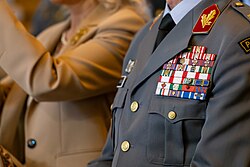
Branch-Specific Styles in the U.S. Military
Different U.S. services employ distinct mounting styles. The U.S. Navy wears ribbons in rows of three with no spacing or staggering, though the top row may be staggered if obscured by a lapel. Navy members with three or more ribbons may choose to wear only their top three. The U.S. Marine Corps allows rows of three or four with optional staggering and spacing. The U.S. Army typically wears ribbons staggered with spacing between rows.
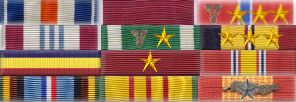
Among U.S. service members, the complete display of ribbons is colloquially known as a "ribbon rack," a "rack," or a "fruit salad."
Notable Examples of Decorated Individuals
- Australia: Keith Payne, VC, OAM; General The Honourable Sir Peter Cosgrove, AK, MC.
- Canada: Romeo Dallaire.
- Denmark: Sir Hans Jesper Helsø.
- Ecuador: General of the Army Paco Moncayo.
- Germany: Generalfeldmarschall Wilhelm Keitel.
- India: Field Marshal S.H.F.J. Manekshaw.
- United Kingdom: Admiral of the Fleet Louis Mountbatten.
- United States: General George S. Patton.
Frequently Asked Questions
What is the difference between a medal and a service ribbon?
A medal is a full-sized decoration typically reserved for formal ceremonies. A service ribbon is a small fabric bar representing that medal, worn on daily or semi-formal uniforms when full medals are inappropriate.
What does "order of precedence" mean?
The order of precedence is the official hierarchy that determines the sequence in which ribbons are worn on a uniform, usually placing the most prestigious awards (such as those for heroism) at the top.
Can ribbons be worn on combat uniforms?
This depends on the country. Some nations strictly prohibit ribbons on combat clothing to avoid revealing the rank or experience of high-value targets to the enemy, while others, like Cuba, allow them.
What is phaleristics?
Phaleristics is the formal study, history, and collection of military ribbons, medals, and other decorations.
Are there awards that only have a ribbon?
Yes. In certain countries, particularly in North America and Israel, some awards are designated as "ribbon only" and have no associated physical medal.