Mauricio Macri Presidency: Economic Shifts and Global Diplomacy (2015–2019)
From December 10, 2015, to December 10, 2019, Mauricio Macri served as the President of Argentina. Running under the Juntos por el Cambio coalition and the Republican Proposal party, Macri's administration marked a significant shift in Argentina's domestic and foreign policy, moving away from the previous era of Kirchnerism to embrace a more globalized economic approach.
Operating from the Casa Rosada (the executive mansion and office of the President), Macri and his Vice President, Gabriela Michetti, sought to reintegrate Argentina into the international community and stabilize a volatile economy through a strategy of gradualism.
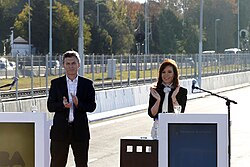
Key Facts
- Term: December 10, 2015 – December 10, 2019.
- Political Coalition: Juntos por el Cambio (Republican Proposal).
- Economic Strategy: Lifted currency controls (cepo cambiario) and floated the peso in December 2015.
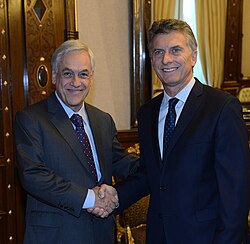
- International Relations: Re-established ties with the US, IMF, and various G20 nations.
- Major Financial Event: Negotiated a $50 billion loan with the International Monetary Fund (IMF) in 2018.
Economic Policy and Domestic Challenges
Upon taking office, the Macri administration focused on removing barriers to foreign investment. One of the first major actions was the elimination of the cepo cambiario (currency controls) on December 17, 2015, allowing the peso to float. The government also implemented "zero retentions" (export taxes) on most agricultural products, with the exception of soy.
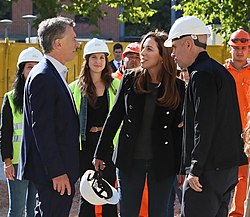
To stimulate regional growth, the administration introduced the Plan Belgrano, aimed at developing the northern regions of the country. However, the path to stability was fraught with challenges. The government faced a crisis over utility bills in 2016 and struggled with rising inflation, which reached 53.8% by 2019—the highest in 28 years.
By 2018, the economic situation worsened, leading the administration to raise interest rates to 40% as the peso plummeted. This culminated in a request for a $50 billion loan from the International Monetary Fund (IMF) to stabilize the economy.
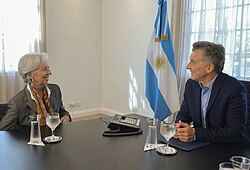
Foreign Affairs and Global Diplomacy
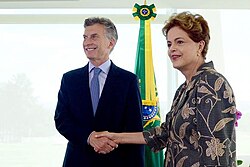
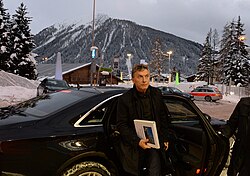
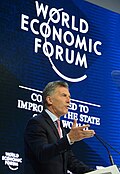
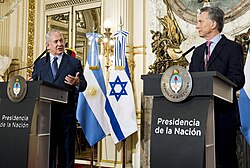
Mauricio Macri pursued an active international agenda, positioning Argentina as a pro-market, open economy. He frequently attended the World Economic Forum in Davos to attract foreign investment and strengthened ties with major global powers.
Relations with the Americas
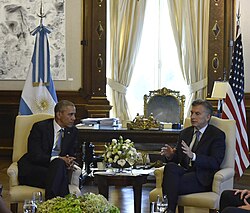
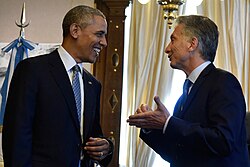
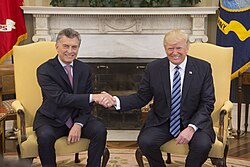
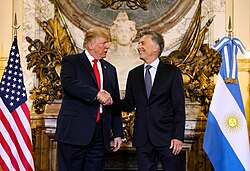
Macri focused on resetting relations with the United States. In March 2016, President Barack Obama conducted a historic state visit to Buenos Aires. Following this, Argentina signed agreements to rejoin the Visa Waiver Program, which allows citizens to travel to the US without a visa.
Within Latin America, Macri maintained strong ties with Brazil—Argentina's largest trade partner—and Mexico. Both nations, along with Argentina, are members of the G20.
![Macri with Mexican president Enrique Peña Nieto in the Casa Rosada. Argentina and Mexico, along with Brazil are the most developed economies in Latin America, and members of the G20 major economies[63]](/images/c9/90/c990286f1b902b1f5a3ab7b9e23928ac95026fd70f38472ec744378f5acc00ce.png)
![Macri with Brazilian president Michel Temer in Brasília. Brazil is Argentina's biggest trade partner.[71]](/images/7b/46/7b46cf64450416afee21d5db6b2fca08741e6cdddc64db8e075051ebcbc269a1.jpg)
Global Outreach: Europe and Asia
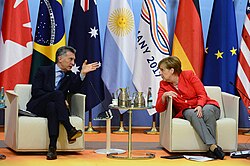
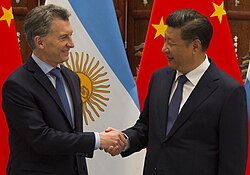
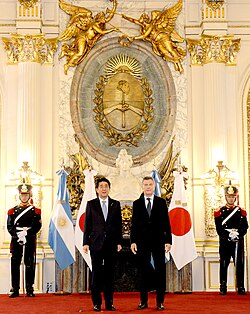
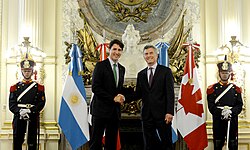
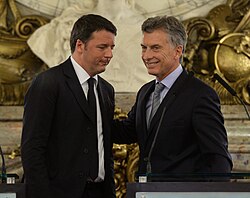
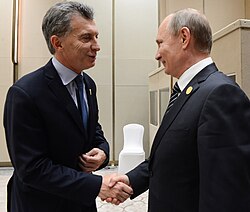
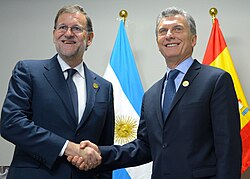
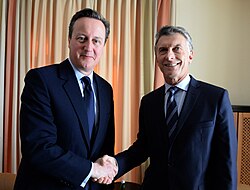
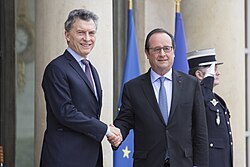
The administration's diplomatic efforts extended to Europe and Asia. Macri conducted tours meeting with leaders such as Angela Merkel of Germany, Mariano Rajoy of Spain, and Vladimir Putin of Russia. In Asia, he engaged with President Xi Jinping of China and Prime Minister Shinzo Abe of Japan to foster economic cooperation.
Administrative Structure
The Macri government began with a large cabinet of 22 ministries, which was later reduced to 11 in September 2018 to streamline operations. The administration was led by Cabinet Chief Marcos Peña throughout the entire term.
| Category | Details |
|---|---|
| President | Mauricio Macri |
| Vice President | Gabriela Michetti |
| Key Party | Republican Proposal (Juntos por el Cambio) |
| Primary Economic Goal | Global reintegration and currency liberalization |
| Major IMF Loan | $50 billion (2018) |
| Key Diplomatic Win | Rejoining the US Visa Waiver Program |
Frequently Asked Questions
What was the "cepo cambiario" and why was it removed?
The cepo cambiario refers to strict currency controls that limited the purchase of foreign currency. Macri removed these controls in December 2015 to encourage foreign investment and normalize the Argentine economy.
How did the relationship with the United States change under Macri?
Relations were significantly reset, highlighted by President Obama's 2016 visit and Argentina's efforts to rejoin the US Visa Waiver Program to facilitate easier travel for citizens.
Why did Argentina seek a loan from the IMF in 2018?
Argentina requested a $50 billion loan as the economic crisis worsened, characterized by a plummeting peso and high inflation, in an attempt to stabilize the national economy.
What was the Plan Belgrano?
The Plan Belgrano was a strategic initiative launched by the Macri administration to promote economic development and infrastructure in the northern regions of Argentina.
How did the cabinet structure change during the presidency?
The administration initially started with 22 ministries but reduced the number to 11 in September 2018 to increase efficiency and reduce government spending.