Marine One and HMX-1: The History of Presidential Helicopter Transport
The sight of a white-topped helicopter landing on the South Lawn of the White House is one of the most iconic images of American executive power. This specialized capability is provided by HMX-1, the Marine Corps squadron responsible for the transport of the President of the United States and other high-ranking officials. The journey from experimental military tactics to a global presidential support mission is a story of innovation, urgency, and precision.
The Origins of Vertical Envelopment
The conceptual roots of HMX-1 date back to 1946. After observing atomic bomb tests at Bikini Atoll, General Roy S. Geiger realized that traditional amphibious landings—which required dense concentrations of ships and troops at a single beachhead—were too vulnerable to nuclear weapons. To mitigate this risk, the Hogaboom Board recommended the development of transport helicopters to allow for a more diffuse attack on enemy shores.
This led to the commissioning of HMX-1 on December 1, 1947, based at MCAS Quantico, Virginia. The squadron initially operated the Sikorsky HO3S-1 and Piasecki HRP-1. In May 1948, the squadron proved the concept by transporting 66 Marines from the USS Palau (CVE-122) to Camp Lejeune. This era saw the birth of vertical envelopment—the Marine Corps term for airmobile operations—and the publication of the first manual for such tactics, Phib-31.
Combat Experience and Training
The Korean War served as a critical proving ground for HMX-1. In 1950, helicopters were attached to VMO-6 to support the 1st Provisional Marine Brigade during the Battle of Pusan Perimeter. Their roles were diverse, encompassing battlefield observation, control, medical evacuation, and the rescue of downed fliers. During the Chosin campaign, they provided vital liaison services between units along the Chosin Reservoir.
Because the demands of the war outpaced the Navy's training capacity, HMX-1 also functioned as a training command. This effort created the pilot nucleus for HMR-161, the first dedicated Marine helicopter transport squadron.
The Birth of Presidential Transport
The transition to presidential service occurred by necessity on September 7, 1957. President Dwight D. Eisenhower was vacationing in Newport, Rhode Island, when he was urgently needed in Washington, D.C., to address the "Little Rock Nine" crisis. To enforce the Supreme Court's desegregation ruling in Brown vs. Topeka Board of Education, Eisenhower had ordered the 101st Airborne into Arkansas.
The standard return trip involved a ferry ride, a flight from Quonset Point Naval Air Station to Andrews Air Force Base, and a motorcade. To save time, President Eisenhower approved the use of an HMX-1 UH-34 helicopter. Colonel Virgil D. Olson flew the President and First Lady from the Naval War College to Air Force One in just six minutes.
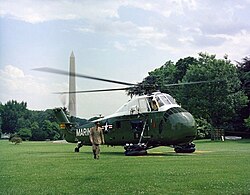
This mission established a lasting precedent. Colonel Olson became the first presidential helicopter pilot and led an expanded HMX-1 squadron. His contributions were so significant that the squadron's facility at Marine Base Quantico was dedicated in his honor on August 12, 2010.
Establishing the "White Top" Tradition
Following the 1957 mission, HMX-1 evaluated the feasibility of landing directly on the White House South Lawn. Once safety was confirmed, the squadron began regular flights between the lawn and Andrews AFB. Colonel Olson is credited with creating several standard operating procedures still used today, including painting the tops of the green helicopters white—earning them the nickname "White Tops."
Additionally, to protect the White House gardens from rotor wash and landing damage, Olson introduced the large white circular target on the lawn to ensure precise landings.
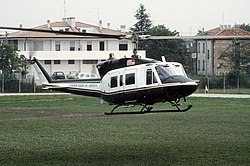
While the Army initially shared these duties, the Marine Corps was granted sole responsibility for worldwide presidential helicopter support in 1976. Today, HMX-1 supports the President, Vice President, Secretary of Defense, Secretary of the Navy, Commandant of the Marine Corps, and visiting heads of state.
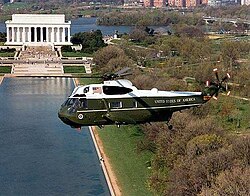
The squadron continues to break barriers; on July 16, 2009, Marine One flew with its first all-female crew, featuring Major Jennifer Grieves as the first woman to fly the president.
Key Facts
- Founded: HMX-1 was commissioned on December 1, 1947.
- Core Concept: Developed to enable "vertical envelopment" to avoid dense troop concentrations.
- First Presidential Flight: September 7, 1957, piloted by Col. Virgil D. Olson.
- Sole Responsibility: The Marine Corps has been the exclusive provider of presidential helicopter support since 1976.
- Notable Milestone: The first all-female crew flew Marine One on July 16, 2009.
| Year | Event | Significance |
|---|---|---|
| 1947 | Commissioning of HMX-1 | Established experimental helicopter squadron. |
| 1948 | Phib-31 Publication | First manual for airmobile operations. |
| 1950 | Korean War Deployment | Proven use in MEDEVAC and battlefield control. |
| 1957 | First Presidential Lift | Col. Olson flies Eisenhower to Air Force One. |
| 1976 | Exclusive Mandate | Marine Corps becomes sole provider of presidential support. |
Frequently Asked Questions
Why did the Marine Corps start using helicopters?
General Roy S. Geiger recognized that atomic weapons made traditional, concentrated beach landings too dangerous. Helicopters allowed for "vertical envelopment," enabling troops to be landed in a more diffuse manner.
Who was the first presidential helicopter pilot?
Colonel Virgil D. Olson was the first presidential helicopter pilot, having flown President Eisenhower from Newport, Rhode Island, to Air Force One in 1957.
What is the significance of the "White Top" helicopters?
The "White Top" nickname comes from a procedure initiated by Col. Olson to paint the tops of the standard Marine green helicopters white for presidential service.
Why is there a target on the White House South Lawn?
The white circular target was created to ensure the pilot lands the helicopter in a specific spot, preventing the aircraft from destroying the trees, shrubs, and flowers on the lawn.
Who does HMX-1 support besides the President?
In addition to the President, HMX-1 supports the Vice President, Secretary of Defense, Secretary of the Navy, Commandant of the Marine Corps, and visiting foreign heads of state.