Marin Drinov: Architect of the Bulgarian Language and State
Marin Drinov was a pivotal figure in the intellectual and political rebirth of Bulgaria. A scholar of immense breadth, he bridged the gap between academic linguistics and state-building, ensuring that the newly liberated Bulgarian nation possessed both a standardized language and a stable administrative foundation.
Early Life and Academic Journey
Born in Panagyurishte in 1838, Drinov sought advanced education abroad, departing for Russia in 1858. He immersed himself in the study of history and philology—the study of language in oral and written historical sources—at Kiev and Moscow State University. Between 1865 and 1871, his intellectual curiosity led him to travel and work across Austria and Italy.
Drinov's commitment to Bulgarian culture was evident early on; in 1869, he became a co-founder and active member of the Bulgarian Literary Society. His academic career flourished at Kharkiv University, where he earned a master's degree and served as a reader of Slavistics (the study of Slavic languages and peoples). By the end of 1876, he had attained the rank of regular professor and became a distinguished member of the Kharkiv Linguistic School.
Political Leadership and State Building
Following the liberation of Bulgaria, Drinov served as the Minister of Popular Enlightenment and Spiritual Affairs during the period of Russian government from 1878 to 1879. His influence extended far beyond education, as he became a key architect of the modern Bulgarian state.
Drinov is recognized as one of the authors of the Tarnovo Constitution, the nation's fundamental law. He also played a strategic role in the geography of power, proposing Sofia as the new Bulgarian capital over Tarnovo, which had been favored by Austrian diplomats.
Standardizing the Bulgarian Language
Perhaps Drinov's most enduring legacy is his role in the standardization of the Bulgarian language. He introduced a standardized 32-letter edition of the Cyrillic alphabet, which remained the national standard until the orthographic reform of 1945.
His approach to linguistics was one of conviction. In 1870, writing for the newspaper Makedoniya, he rejected a proposal by Shapkarev to create a mixed foundation for the standard language based on eastern and western Bulgarian/Macedonian dialects. Drinov dismissed this as an "artificial assembly" that was "impossible, unattainable and never heard of." While this stance has been criticized by modern linguists such as Blagoy Shklifov, it provided the decisive direction for the language's development.
The formal orthography of standard Bulgarian, established by a decree from Minister of Education Todor Ivanchov in 1899, is attributed to Drinov's work. Since then, the language has undergone three further orthographic reforms in 1921, 1923, and 1945.
Key Facts
- Born: 1838 in Panagyurishte.
- Academic Affiliation: Member of the Kharkiv Linguistic School and professor at Kharkiv University.
- Political Role: Minister of Popular Enlightenment and Spiritual Affairs (1878–1879).
- State Contributions: Co-author of the Tarnovo Constitution and proponent of Sofia as the capital.
- Linguistic Legacy: Introduced the 32-letter Cyrillic edition and shaped the 1899 standard orthography.
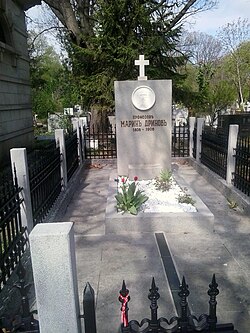
- Death: March 13, 1906, in Kharkiv, following a battle with tuberculosis.
| Domain | Key Contribution | Impact/Detail |
|---|---|---|
| Politics | Tarnovo Constitution | Co-authored the foundational law of Bulgaria. |
| Urban Planning | Selection of Sofia | Proposed Sofia as the capital over Tarnovo. |
| Linguistics | Cyrillic Standardization | Introduced the 32-letter alphabet used until 1945. |
| Education | Ministerial Leadership | Led Popular Enlightenment and Spiritual Affairs. |
Drinov spent his final years in Kharkiv after 1881, where he continued his scientific and educational pursuits until his passing in 1906.
Frequently Asked Questions
What was Marin Drinov's role in the Bulgarian government?
Drinov served as the Minister of Popular Enlightenment and Spiritual Affairs between 1878 and 1879 during the period of Russian government in Bulgaria.
How did Drinov influence the location of the Bulgarian capital?
He proposed that Sofia be chosen as the new capital of Bulgaria, successfully opposing the preference for Tarnovo held by Austrian diplomats.
What was Drinov's contribution to the Bulgarian alphabet?
He introduced the standardized 32-letter edition of the Cyrillic alphabet, which served as the basis for Bulgarian writing until the reform of 1945.
Why is Drinov's linguistic approach controversial today?
Some modern linguists, including Blagoy Shklifov, criticize Drinov for rejecting Shapkarev's proposal to base the standard language on a mix of eastern and western Bulgarian/Macedonian dialects.
Where did Marin Drinov spend his final years?
Drinov lived and worked in Kharkiv after 1881, continuing his academic activities until his death from tuberculosis on March 13, 1906.