Mapudungun: The Language and Heritage of the Mapuche People
Mapudungun (also known as Mapuche or Chilidúgu) is the ancestral tongue of the Mapuche people, spoken primarily across the regions of Chile and Argentina. As a member of the Araucanian language family, it serves as a vital link to the cultural identity of the Mapuche, who inhabit the ancestral territory known as Wallmapu. While the language has faced significant pressure from colonization, it remains a symbol of resilience and cultural pride.
The term Mapudungun is derived from mapu, meaning "land," and dungun, meaning "language." Today, it holds official status in several Chilean communes, including Galvarino, Padre Las Casas, and Temuco.
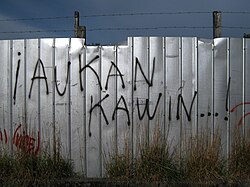
![Chilean proverb written in Mapuche and Chilean Spanish. The Mapudungun alphabet used here does not reflect an agreed-upon standard. In fact, there are three distinct alphabets currently used to write the Mapuche language.[25]](/images/8a/36/8a36df33b6a97ab9f6211e5536a32b9743cbf542c375d265331b243dd0d4c7a5.jpg)
Key Facts
- Native Speakers: Approximately 410,000 as of 2024.
- Geographic Range: Chile and Argentina.
- Language Family: Araucanian.
- Typology: Polysynthetic language featuring noun incorporation and root composition.
- Official Status: Co-official in Galvarino, Padre Las Casas, and Temuco (Chile).
Language Vitality and Revitalization
The health of Mapudungun varies significantly between rural and urban environments. Historical estimates from 1982 and 2000 suggested hundreds of thousands of speakers, but a 2002 study indicated a sharper divide: only 16% of those identifying as Mapuche were active speakers, while 18% were passive speakers (those who understand but cannot speak the language).
Language transmission to younger generations is a critical concern. In the south of Chile, the language's stronghold, only 3.8% of speakers aged 10–19 are considered "highly competent." Furthermore, usage among children is significantly lower in urban areas (2.4%) compared to rural areas (16%).
Efforts to revitalize the language have seen mixed results. In 1996, the Chilean Ministry of Education established the Office of Intercultural Bilingual Education. However, implementation has been uneven; for instance, by 2004, public schools in Santiago lacked programs despite 50% of the Mapuche population living in or around the capital. Some community members express concern that prioritizing Mapudungun in schools might disadvantage children in a society that has historically devalued indigenous culture.
Linguistic Structure and Phonology
Mapudungun is a polysynthetic language, meaning it combines multiple morphemes (the smallest units of meaning) into a single complex word. This allows a single word to convey a meaning that would require an entire sentence in English. For example, the word Trarimansunparkelayayngu translates to "Those two won't yoke the oxen here!"
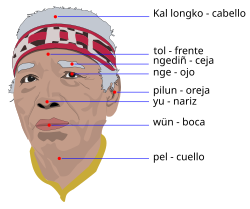
Phonology and Sound System
The language features a distinct set of vowels and consonants, including retroflex and palatal sounds. Its prosody—the rhythm and intonation of speech—is a defining characteristic of its spoken form.

Grammar and Numerals
The language employs a highly regular system for numbers. The base numbers 1 through 10 are: kiñe (1), epu (2), küla (3), meli (4), kechu (5), kayu (6), regle (7), pura (8), aylla (9), and mari (10). Higher numbers follow a consistent pattern, such as epu mari for 20.
Pronouns in Mapudungun are categorized by three persons (first, second, and third) and three numbers: singular, dual (referring to exactly two people), and plural (more than two).
Historical Documentation
The formal study of Mapudungun began in the colonial era. The first grammar was published by Jesuit priest Luis de Valdivia in 1606. This was followed by Andrés Fabrés' Arte de la Lengua General del Reyno de Chile in 1765, which provided a crucial grammar and dictionary used by missionaries for centuries.
In the modern era, comprehensive works by scholars such as Félix José de Augusta (1903, 1916) and Fernando Zúñiga (2000, 2006) have provided the academic foundation for current linguistic study and educational materials.
Summary of Mapudungun Characteristics
| Feature | Description |
|---|---|
| Language Family | Araucanian |
| Morphology | Polysynthetic (Agglutinative) |
| Pronoun System | Singular, Dual, and Plural |
| Primary Regions | Chile and Argentina |
| Key Dialects | Includes Pehuenche and Huilliche |
Frequently Asked Questions
What does the word Mapudungun mean?
The name is a combination of mapu (land) and dungun (language), literally translating to "the language of the land."
Is Mapudungun still spoken today?
Yes, there are approximately 410,000 speakers as of 2024, though the number of active speakers is lower than the number of people who identify as Mapuche.
What makes Mapudungun linguistically unique?
It is a polysynthetic language, meaning it can incorporate nouns and multiple roots into a single word to create complex meanings that would be full sentences in other languages.
Where is Mapudungun an official language?
In Chile, it has been granted official status at the local level in the communes of Galvarino, Padre Las Casas, and Temuco.
How is the language being preserved?
Preservation efforts include the Office of Intercultural Bilingual Education in Chile, university courses (such as at the Pontifical Catholic University of Chile), and community-led revitalization programs in rural areas.