Mamluk Sultanate: The Rise and Fall of the Slave-Soldier Empire
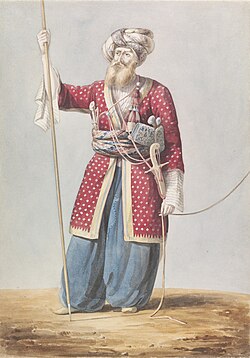
From the mid-13th to the early 16th centuries, the Mamluk Sultanate stood as one of the most formidable powers in the medieval Islamic world. Ruling over Egypt, the Levant, and the Hejaz from its magnificent capital in Cairo, this state was unique in its social structure: it was governed by a military caste of mamluks—freed slave soldiers who rose through the ranks to become the ruling elite.
The sultanate emerged in 1250 after the overthrow of the Ayyubid dynasty and persisted until 1517, when it was absorbed by the Ottoman Empire. Its history is traditionally divided into two major eras: the Turkic or Bahri period (1250–1382) and the Circassian or Burji period (1382–1517), reflecting the dominant ethnicity of the ruling military corps at the time.
![Frontispiece of Sulwan al-Muta’ fi ‘Udwan al-Atba’ by Ibn Zafar al-Siqilli, Mamluk Egypt or Syria, circa 1330.[20]](/images/51/dc/51dcd844efcbea56d06518a6f5995cccb475616e613cd553924bcf2fef494422.jpg)
Key Facts
- Capital: Cairo, Egypt.
- Ruling Class: A stratocratic elective monarchy led by freed slave soldiers.
- Major Eras: Bahri (Turkic) and Burji (Circassian).
- Key Achievements: Halted Mongol expansion and eliminated the Crusader states in the Levant.
- Official Language: Arabic, though Mamluk-Kipchak, Circassian, and Oghuz Turkic were common among the elite.
- End of Empire: Conquered by the Ottoman Empire in 1517.
The Bahri Period: Consolidation and Conquest (1250–1382)
![Horseman impales a bear. Nihāyat al-suʾl by Aḥmad al-Miṣrī ("the Egyptian"), dated 1371, Mamluk Egypt or Syria. He is wearing the kallawtah headgear.[56]](/images/db/ad/dbad5639aaadde93a854d7bea1058f3befb5e25c44ba89a7959c6351e1111320.jpg)
The Mamluks originated as elite regiments under the Ayyubid sultan al-Salih Ayyub. By 1250, these soldiers, known as the Salihiyya, seized power. The early Bahri period was defined by military brilliance and the defense of the Islamic world. Under Sultan Qutuz and Sultan Baybars, the Mamluks achieved a historic victory by routing the Mongols in 1260, effectively stopping their southward advance.
![Enthroned ruler and attendants in the Baptistère de Saint Louis (1320–1340). This is a probable depiction of Sultan Baybars.[45]](/images/8d/94/8d94e809794ec78573a4a6312bf6d197898ddd6c52bde326ac5a54ad43afa5ba.jpg)
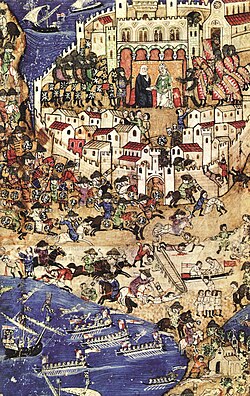
Baybars further solidified the state by reestablishing the Abbasid caliphs in Cairo. Although the caliphs held a primarily ceremonial role, their presence provided religious legitimacy to the Mamluk sultans. Throughout the late 13th century, sultans Baybars, Qalawun, and al-Ashraf Khalil systematically dismantled the remaining Crusader states, culminating in the capture of Acre in 1291.
The sultanate reached a peak of stability and prosperity during the third reign of al-Nasir Muhammad. This era saw significant investment in infrastructure and the arts, though it was eventually followed by internal strife as senior emirs began to compete for control over the sultan's successors.
![Mamluk court scene, with possible depiction of Mamluk Sultan al-Nasir Muhammad.[75][76] Probably Egypt, dated 1334. Maqamat of al-Hariri.[77] "In the paintings the facial cast of these [ruling] Turks is obviously reflected, and so are the special fashions and accoutrements they favored".[78] The brimmed hats in the bottom right corner are Mongol.[79] Al-Nasir Muhammad was himself of Kipchak (Turkic) and Mongol descent.[80]](/images/a3/83/a383d29755e0f42d86ce82b43876e2de69ba648f1a62fe0dbd0bc54f2a415931.jpg)
The Burji Period: Transition and Turmoil (1382–1517)
![Interior of the Mausoleum of Sultan Qalawun in Cairo (1284–1285)[69]](/images/ff/84/ff84a68f2a6241dc1797aced4c0a38a5c56b319a2eb4138a8e4402b0909ce392.jpg)
The transition to the Burji period occurred in 1382 when the Circassian mamluk Barquq overthrew al-Salih Hajji. Unlike the Bahri period, the Burji era was often characterized by more volatile successions and external pressures.
The early 15th century brought severe challenges. The invasion of Syria by Timur (Tamerlane) led to the sacking of Aleppo and Damascus. This external shock coincided with internal disasters, including a famine in Egypt in 1403 and a devastating plague in 1405, which eroded the economic stability of Cairo.
![The complex of Sultan Hasan (1356–1363) is the largest and costliest Mamluk building in Cairo, despite being built in a time of plague.[92][93][94]](/images/5d/db/5ddbd66d34d45e628052e17c36dd186990b0c1a5a7e48f228e562fe8d1ca652b.jpg)
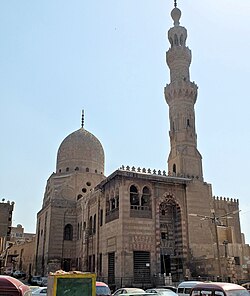
Despite these crises, the late Mamluk period produced some of the most exquisite architecture and art in Islamic history. Sultans like Qaitbay and al-Ghuri commissioned grand funerary complexes and mosques that still define the skyline of Cairo today.
The Fall to the Ottoman Empire
![Interior of the Al-Nasir Muhammad Mosque in the Citadel of Cairo (1318–1335)[85]](/images/a7/a1/a7a1fc69d4aacdb6b8072aa37bdf83cee0dadcdaeddc314aaaf0802470b671a2.jpg)
The end of the Mamluk Sultanate came swiftly in the early 16th century. Following a series of defeats, the Ottoman Sultan Selim I advanced toward Egypt. The final Mamluk sultan, Tuman Bay II, attempted a desperate defense at al-Raydaniyya in January 1517, but the Ottoman forces overwhelmed them.
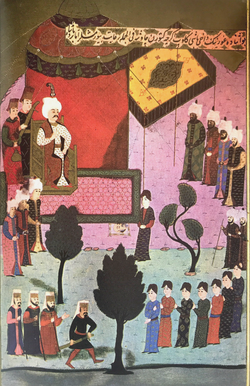
After a final bloody battle near Giza on April 2, 1517, Tuman Bay was captured. Despite initial offers of peace, he was executed by hanging at Bab Zuwayla on April 13, 1517, marking the official end of the Mamluk Sultanate. Egypt and Syria were subsequently incorporated as provinces of the Ottoman Empire.
Culture, Science, and Architecture
![Interior of the Mosque-Madrasa of Sultan Barquq in Cairo (1384–1386)[110]](/images/fb/0d/fb0d59fdd6bb0b568035ca60a58cece2383b1f61b91bae014abf2da5400b24d8.jpg)
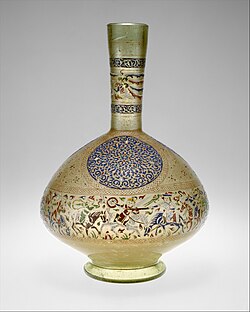
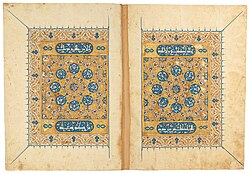
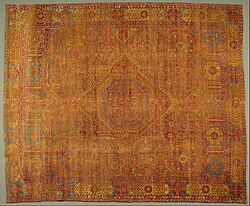
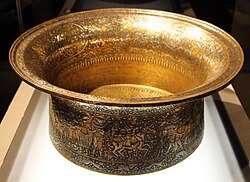
The Mamluks were great patrons of the arts and sciences. Their architectural legacy is characterized by massive complexes that combined mosques, madrasas (educational institutions), and mausoleums. They also excelled in the production of luxury goods, including enameled glass, gilded metalwork, and intricate wool carpets.
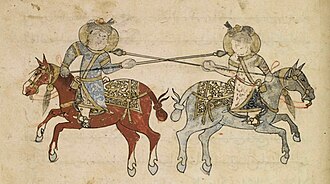
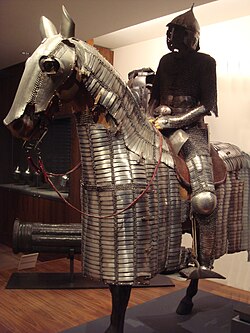
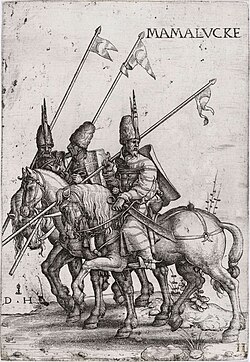
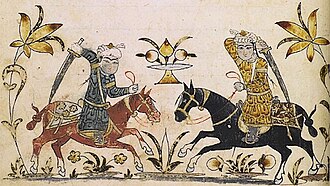
In the realm of science, the Mamluks maintained a high level of technical proficiency. The use of astrolabes and the preservation of scientific manuscripts demonstrate a commitment to astronomy and mathematics. They also maintained a sophisticated military tradition known as furusiyya, which combined horsemanship, archery, and combat tactics.
![Mamluk-era astrolabe with Coptic numerals, dated 1282/1283. This astrolabe and other items of its kind are proof that Mamluks still used Coptic numerals and Coptic calendar for various practical and scientific purposes.[201] Turkish and Islamic Arts Museum](/images/0f/19/0f193dd890c77856bbb84e39b5a56cfba0c1b85cc6cf7f7cf73435feb22814c6.jpg)
| Feature | Bahri Period | Burji Period |
|---|---|---|
| Duration | 1250–1382 | 1382–1517 |
| Dominant Ethnicity | Turkic | Circassian |
| Key Military Feat | Defeat of Mongols & Crusaders | Defense against Timur |
| Political Nature | Consolidation and Expansion | Internal Strife and Decline |
Frequently Asked Questions
![Barsbay's mausoleum complex in Cairo, completed in 1432. The carved dome (center) covers his tomb.[117]](/images/bf/fa/bffa6bca18b0442168a26497d1027340e5c7971b39f3c5958d1c5717ec4ebd1d.jpg)
![Mamluk Sultan Qaitbay (r.1468-1496, here "Mag Caitbeivs Cairi Svltan", "The great Caitbeius, Sultan of Cairo") by Florentine painter Cristofano dell'Altissimo (16th century), Galleria degli Uffizi.[134]](/images/a7/07/a7073fed6822da68c4b3a11b028971540e3a107a84694e4a4aae27e6977f2401.jpg)
![Sabil of Qaitbay at al-Aqsa in Jerusalem (1482)[141]](/images/8a/2a/8a2a2e3163d078a56205ec0d9b7edbc5e6f2941cdad9a680d96a73a388fa4236.jpg)
![A shirt of mail and plate armor belonging to Sultan Qaitbay, one of the few surviving sets of armor from the Mamluk period.[146]](/images/80/36/8036785a7c6e4e5a2f021bf5fac5e679da2a6e007240040287ea306686d91d55.jpg)
![Mamluk Sultan Qansuh al-Ghuri (r. 1501–1516, here "Campson Gavro re d'Egitto", "Campson Gauro, king of Egypt") by Florentine painter Cristofano dell'Altissimo, Galleria degli Uffizi.[153]](/images/15/84/1584e9b5aaf7e84d665ffbc99203eb18151707f2a23d473290a8665d9ce41873.jpg)
![Anonymous 1511 painting depicting a reception of Venetian ambassadors in Damascus during the time of al-Ghuri[160]](/images/92/3a/923a3dd30341ef0aa0e56057df716103f14755011a746fae75c025672d26320b.jpg)
![The only known surviving manuscript copy of Mahmud al-Kashgari’s Dīwān Lughāt al-Turk, copied in 1266 in Damascus, within the territory of the Mamluk Sultanate.[186]](/images/5d/1d/5d1d7f78562d71576622d718a9b84111d8b025f732e40b476af6e3eb14a8be33.jpg)
![A manuscript of an Oghuz Turkic translation of Ferdowsi’s Shahnameh, dated 1510, created for the library of Qansuh al-Ghawri, translated and copied by Sharīf of Amid.[186]](/images/9e/6b/9e6b72e9e6c623966178a733325331479ee80a282be8b379c555697251fcc0e0.jpg)
![A Blood-Measuring Device: folio from a manuscript of The Book of Knowledge of Ingenious Mechanical Devices (Kitab al-hiyal al-nafisa) of Al-Jazari (1136–1206). Edition created for an amir of Mamluk Sultan Al-Nasir Muhammad in Cairo in 1354.[243]](/images/2c/62/2c62031d2962621c40b703a30b0563d3b040760e700d978d90a3a4e6b5716555.jpg)
![Al-Jazarī (d. 1206), The Musical Boat. Mamluk period, 1315.[261]](/images/ab/30/ab30b5790bb3353249b002a25cf9b9d4f0ed71e518441d0a693c32631c538ca1.jpg)
![Qur'an commissioned by sultan al-Ashraf Sha'ban, dated to 1372[274][275]](/images/68/55/685526a45e49949d48fc5c8b2e1202e28bc28384bcd2d8e77f363462f9cacf5d.jpg)
![Mosque lamp of Amir Qawsun, dated 1329. Qawsun's blazon, a red cup on a yellow field, is prominently visible on the upper section. Metropolitan Museum of Art.[295]](/images/81/22/81223a246b365d44c52be987fac69450d0df62c12c10ef0d6c81d3b9e35da85c.jpg)
Who were the Mamluks?
The Mamluks were a military caste of freed slave soldiers, primarily of Turkic and Circassian origin, who rose to power in Egypt and the Levant to establish their own sultanate.
How did the Mamluks stop the Mongol expansion?
Under the leadership of Sultans Qutuz and Baybars, the Mamluks routed the Mongol forces in 1260, which halted the Mongol southward expansion into Africa.
What was the role of the Caliph in the Mamluk Sultanate?
Sultan Baybars reestablished the Abbasid caliphate in Cairo; however, the caliphs served a primarily ceremonial role, providing religious legitimacy to the ruling Mamluk sultans.
What caused the fall of the Mamluk Sultanate?
The sultanate fell due to a combination of internal economic crises, plagues, and the superior military force of the Ottoman Empire under Sultan Selim I, leading to the final defeat in 1517.
What is the architectural legacy of the Mamluks?
The Mamluks left behind massive, ornate complexes in Cairo, including the Complex of Sultan Hasan and the funerary complex of Sultan Qaitbay, known for their intricate stone carving and grand scale.