Makemake: The Creator God and Birdman Cult of Easter Island
In the rich tapestry of Rapa Nui mythology, Makemake stands as the central figure of creation and fertility. Known as the creator of humanity, this deity presided over a pivotal shift in the spiritual life of Easter Island, leading the transition from the era of the monolithic Moai statues to the rise of the Tangata manu, or "bird-man" sect. Scholars suggest that Makemake may be the local manifestation of Tane, an ancient Polynesian god.
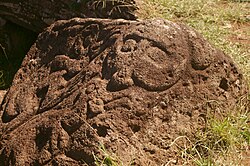
Visually, Makemake is frequently depicted in Rapa Nui petroglyphs—rock carvings—as a face characterized by strikingly large eyes or a skull with prominent eye sockets and a phallic nose.
Key Facts
- Role: Creator of humanity and god of fertility.
- Affiliation: Chief deity of the Tangata manu (bird-man) sect.
- Iconography: Depicted in petroglyphs with large eyes and a phallic nose.
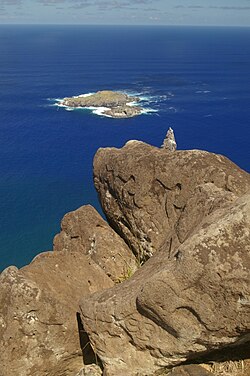
- Key Location: Motu Nui, the islet central to the bird-man ceremonies.
- Sacred Bird: The manutara (sooty tern).
The Birdman Sect and the Ritual of Motu Nui
The bird-man cult represented one of the most significant religious festivals on Easter Island. According to the researcher Alfred Métraux, this tradition was intimately linked to the worship of Makemake, who was believed to drive birds to nest on the islet of Motu Nui ("big islet").
The religious hierarchy of the sect involved four primary gods: Makemake, Haua-tuꞌu-take-take (often called Haua), vîꞌe Hoa (Haua's wife), and vîꞌe Kenatea. Each of these deities was served by a supernatural servant who played a role in the ceremonies.
The Ceremony of the First Egg
The ritual process was highly structured, involving specific roles to determine leadership and spiritual favor:
- Ivi atua: The "seer" who possessed the vision to select the candidates for the swim.
- Hopu: The swimmers who ventured from the mainland to Motu Nui.
- Hopu manu: Those who served the bird-man and sought the first egg of the manutara (sooty tern).
The ultimate goal of the competition was to retrieve the first manutara egg and bring it back to the village of Orongo on the mainland.
Divine Companions and Lineage
While Makemake had no wife, he was closely associated with Haua. In Rapa Nui tradition, any offering made to Makemake typically included a mention of Haua, his principal companion. The deity's offspring included Tive, Rorai, Hova, and a noblewoman named Arangi-kote-kote.
Makemake in the Modern World
Archaeological Discoveries
The legacy of Makemake continues to surface through historical artifacts. A notable example featured in a BBC documentary, The Lost Gods of Easter Island, involved a wooden idol purchased by David Attenborough. Initially dismissed as a forgery, the idol was later proven to be an authentic representation of Makemake, carved from the now-extinct Toromiro tree. The piece had traveled from Easter Island to Tahiti via the crew of Captain Cook's ship before eventually entering the auction market.
Astronomical Tribute
The name Makemake has also extended into the cosmos. A trans-Neptunian dwarf planet was named Makemake due to a chronological coincidence: the dwarf planet was discovered shortly after Easter 2005, and the first European contact with Easter Island occurred on Easter Sunday in 1722. During its discovery phase, the celestial body was known by the code name "Easterbunny."
| Category | Details |
|---|---|
| Primary Domain | Creation, Fertility, Birdman Sect |
| Associated Islet | Motu Nui |
| Sacred Animal | Manutara (Sooty Tern) |
| Key Ritual Site | Orongo |
| Modern Namesake | Trans-Neptunian Dwarf Planet |
Frequently Asked Questions
Who is Makemake in Rapa Nui mythology?
Makemake is the creator of humanity and the god of fertility. He served as the chief deity of the Tangata manu (bird-man) sect, which succeeded the Moai-building era on Easter Island.
What was the purpose of the bird-man ceremony?
The ceremony centered on a competition to retrieve the first egg of the manutara (sooty tern) from the islet of Motu Nui and bring it back to Orongo.
How is Makemake depicted in art?
He is commonly shown in petroglyphs as a face or skull with very large eyes and a phallic nose.
Why is there a dwarf planet named Makemake?
The dwarf planet was named after the Rapa Nui god because it was discovered shortly after Easter 2005, mirroring the date of the first European arrival on Easter Island (Easter Sunday, 1722).
Who were the other gods associated with the bird-man sect?
Alongside Makemake, the sect recognized Haua-tuꞌu-take-take (Haua), vîꞌe Hoa, and vîꞌe Kenatea.