Màiri Mhòr nan Òran: The Voice of the Highland Land League
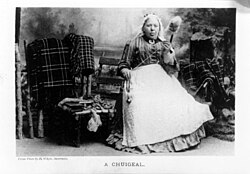
In the history of Scottish Gaelic literature, few figures embody the struggle and spirit of the crofting community as powerfully as Màiri Mhòr nan Òran (Great Mary of the Songs). Born Mary MacDonald in 1821 on the Isle of Skye, she rose from a life of domestic service and hardship to become a celebrated poet and activist. Her work serves as a vital oral record of the Highland Clearances—the forced displacement of people from their ancestral lands—and the subsequent Crofters War.
Despite her literary significance, Màiri Mhòr was unable to write her own work. She composed her poems and songs in her memory, dictating them to others for publication. This oral tradition allowed her messages to reach a wide audience, particularly those in Gaelic-speaking communities who were not literate in their native tongue.
Key Facts
- Native Name: Màiri Mhòr nan Òran (Mary MacPherson).
- Lifespan: 10 March 1821 – 7 November 1898.
- Primary Focus: The Highland Clearances and the Crofters War.
- Education: Qualified nurse and midwife from Glasgow Royal Infirmary.
- Literary Style: Oral composition focused on social and private passion.
- Legacy: Her songs spread from Scotland to Cape Breton and California.
Early Life and Trials
Mary MacDonald was born in Skeabost, Skye, to John Macdonald and Flora MacInnes. In 1844, she moved to Inverness, where she married a shoemaker named Isaac MacPherson in 1847. Together they had five children. However, following Isaac's death in 1871, Mary's life took a difficult turn.
While working as a domestic servant for a British Army officer's family, Mary was accused of stealing clothes from the officer's late wife. Though she protested her innocence for the rest of her life—and was widely believed by the Gaelic community—she was sentenced to 40 days in prison. This period of humiliation became a catalyst for her creativity; she later noted that this experience brought her "muse to life," a sentiment captured in her poem Tha mi sgìth de luchd na Beurla (I'm tired of the English speakers).
Professional Growth and Activism
After her release in 1872, Mary moved to Glasgow. During this time, she expanded her skills, learning to read and write in English and earning a nursing certificate and a diploma in obstetrics from the Glasgow Royal Infirmary. She later worked in Greenock, remaining active in the Gaelic-speaking communities of both cities through cèilidhs (traditional social gatherings with music and dancing).
Upon returning to Skye in 1882, Mary became a central figure in the Highland Land League, an organization fighting for crofters' rights. She collaborated with activists like Alexander Mackenzie and politician Charles Fraser-Mackintosh, contributing to the momentum that led to the Napier Commission (1883-4) and the Crofters Act of 1886.
The "Great" Mary
The epithet mhòr (great) in her name referred to both her stature in poetry and her physical presence. Standing 5 feet 9 inches tall and weighing 17 stone (108 kg), her physique was a point of humor in her own songs. In one account of crossing the Strome Ferry, she recalls being told the boat would sink if she boarded with the others, requiring the boatman to return for her alone.
Artistry and Influence
Beyond her poetry, Mary was a skilled wool worker and spinner. She maintained a friendship with Professor John Stuart Blackie, for whom she created a tartan plaid and a specific tartan she named "The Blackie." In return, Blackie gifted her a cromag, a traditional shepherd's crook.
Her work provided a crucial medium for spreading information during the land struggles. Her songs, such as Oran Beinn Li and Eilean a’ Cheò, are noted for their vitality and emotional depth. While some critics, like Sheriff Alexander Nicolson, argued her work had little permanent value once the events passed, the renowned poet Sorley Maclean praised her for fusing social and private passion with extraordinary vitality.
| Category | Details |
|---|---|
| Birthplace | Skeabost, Isle of Skye |
| Key Works | Gaelic Songs and Poems (1891) |
| Political Affiliation | Highland Land League |
| Professional Training | Nursing and Obstetrics (Glasgow Royal Infirmary) |
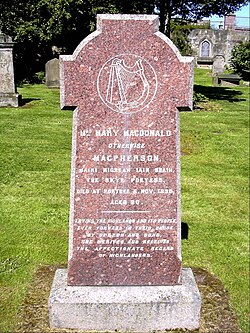
| Death/Burial | Portree (1898); buried in Chapel Yard Cemetery, Inverness |
Frequently Asked Questions
Why was she called Màiri Mhòr nan Òran?
The name translates to "Great Mary of the Songs." The term "great" (mhòr) referred to both her significant status as a Gaelic poet and her physical height and build.
Could Màiri Mhòr write her own poetry?
No, she could not write her poems down herself, although she could read them once they were transcribed. She composed her work in her memory and dictated it to others for publication.
What was the primary theme of her work?
Her work focused heavily on the social and political struggles of the Highland people, specifically the Highland Clearances and the Crofters War involving the Highland Land League.
How is her work viewed by historians and critics?
Opinions vary; some early critics found her imagery superficial, while others, like Sorley Maclean, viewed her work as a powerful fusion of personal and social passion. Historians also value her songs as evidence of the crofters' uprisings.
Where can her legacy be seen today?
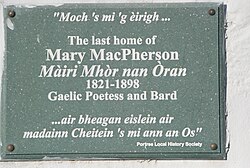
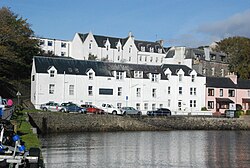
A blue plaque commemorates her last known address at the Rosedale Hotel in Portree, and she is buried in the Chapel Yard Cemetery in Inverness.