Magnetic Field Strengths: From Earth's Surface to Magnetars
Magnetism is a fundamental force of nature that manifests in a vast array of scales, from the subtle pull of a compass needle to the crushing intensity of a collapsed star. To measure these forces, scientists use the Tesla (T), the SI unit of magnetic flux density. Because the range of magnetic intensity is so extreme, measurements often span from nanoTeslas (nT) to GigaTeslas (GT).
Understanding these magnitudes helps us appreciate the engineering required for medical imaging, the physics of particle accelerators, and the violent environments of deep space.
Key Facts
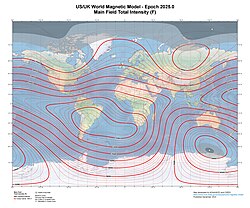
- Earth's surface magnetic field is relatively weak, ranging between 25,000 and 65,000 nT.
- Medical MRI systems typically operate between 1.5 T and 3 T.
- The strongest non-destructive magnet ever produced reached 97.4 T.
- Magnetars, a type of neutron star, possess the most intense magnetic fields known, reaching up to 1011 T.
- Diamagnetic levitation of a living organism (like a frog) requires a field of 16 T.
Common and Industrial Magnetic Fields
In our daily lives, we encounter magnetic fields that are barely perceptible. The Earth's own magnetic field is the most ubiquitous, though it is measured in nanoTeslas (nT), where one nanoTesla is one-billionth of a Tesla.
As we move toward human-made technology, the strength increases. Walking under a high-voltage power line exposes one to approximately 40 μT (microTeslas), while a common refrigerator magnet provides a modest 5 mT (milliTeslas). In audio equipment, the coil gap of a typical loudspeaker magnet ranges from 1 T to 2.4 T.
Medical and Scientific Applications
High-intensity magnets are essential for modern medicine and physics. Magnetic Resonance Imaging (MRI) systems generally use fields between 1.5 T and 3 T, though experimental systems have reached 17 T. The largest MRI scanner, utilizing INUMAC magnets, operates at 11.75 T.
In the realm of particle physics, superconducting magnets—magnets that lose electrical resistance at very low temperatures—are used to steer particles. The CMS detector at CERN uses a 4 T magnet, while the Large Hadron Collider (LHC) employs magnets with a strength of 8 T. Fermilab has recorded the highest strength for an accelerator steering magnet at 14.5 T.
Extreme Laboratory and Astrophysical Fields
Pushing the boundaries of physics requires specialized arrays and cryogenic cooling. A specially designed room temperature Halbach array (a specific arrangement of permanent magnets to augment the field on one side) can reach 5.16 T. In laboratory settings, superconducting electromagnets at cryogenic temperatures can reach 27 T, with a 2009 record of 35.4 T achieved within a background magnetic field.
Some of the most extreme human-made fields are temporary. The electromagnetic flux-compression technique can generate a field of 1200 T, though it only lasts for about 100 microseconds. The current world record for continuous field magnets stands at 45 T (as of 2015).
Cosmic Magnitudes
Nature produces fields that dwarf any human achievement. A typical white dwarf star has a magnetic field of approximately 100 T. Even more extreme are magnetars (highly magnetized neutron stars), which exhibit fields ranging from 108 T to 1011 T.
At these levels, physics enters the realm of the Schwinger limit (109 T), the point above which the electromagnetic field is expected to become nonlinear, fundamentally altering the behavior of light and matter.
Magnetic Field Strength Comparison
| Source/Object | Magnetic Field Strength | Category |
|---|---|---|
| Earth's Surface | 25,000 – 65,000 nT | Natural (Low) |
| Refrigerator Magnet | 5 mT | Permanent Magnet |
| Standard MRI | 1.5 T – 3 T | Medical |
| LHC Magnets | 8 T | Scientific Accelerator |
| ITER Magnet System | 13 T | Fusion Energy |
| Non-destructive Record | 97.4 T | Laboratory Record |
| White Dwarf Star | ~100 T | Astrophysical |
| Magnetar | 108 – 1011 T | Astrophysical (Extreme) |
Frequently Asked Questions
What is the strength of the magnetic field required to levitate a frog?
According to the 2000 Ig Nobel Prize in Physics, a magnetic field strength of 16 T is required to levitate a frog via the diamagnetic levitation of the water within its body tissues.
What is the Schwinger limit?
The Schwinger limit is a theoretical threshold of 109 T. Above this intensity, the electromagnetic field is expected to become nonlinear.
How strong are the magnets used in fusion reactors?
MIT and Commonwealth Fusion Systems have developed large-scale high-temperature superconducting magnets with a strength of 20 T for use in fusion reactors.
What is the difference between a standard MRI and the largest MRI scanner?
While typical clinical MRI systems operate between 1.5 T and 3 T, the largest MRI scanner uses INUMAC magnets to achieve a strength of 11.75 T.
What is the strongest magnetic field ever trapped in a lab superconductor?
As of July 2014, the strongest field trapped in a superconductor in a laboratory setting was 17.6 T.