ATLAS Detector: Engineering the World's Largest Particle Collider Instrument
The ATLAS detector is a monumental feat of engineering located at CERN, designed to operate within the 27-kilometer circumference of the Large Hadron Collider (LHC). Measuring 46 meters in length and 25 meters in diameter, this 7,000-tonne instrument contains approximately 3,000 kilometers of cabling. Its primary purpose is to observe the results of high-energy proton collisions, where beams carrying up to 6.8 TeV of energy interact to potentially produce particles with masses far exceeding any currently known to science.
Unlike specialized instruments, ATLAS is a general-purpose detector. This means it is engineered to measure the broadest possible range of signals, ensuring that regardless of the form new physical processes or particles take, ATLAS can determine their properties, including mass, momentum, energy, lifetime, charge, and nuclear spin.
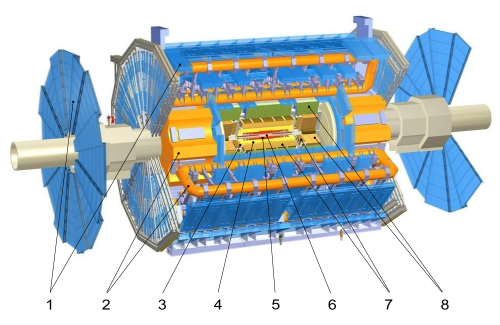
Key Facts
- Dimensions: 46m long, 25m diameter, weighing 7,000 tonnes.
- Purpose: General-purpose detection of a wide range of particles and physical processes.
- Core Systems: Inner Detector, Calorimeters, Muon Spectrometer, and Magnet System.
- Data Volume: Generates 1 petabyte of raw data per second before filtering.
- Capability: Designed to be "hermetic," meaning it detects all non-neutrino particles without blind spots.
Layered Architecture for Particle Identification
To identify the diverse array of particles produced at the interaction point, ATLAS utilizes a layered design. Each layer consists of different detector types tailored to observe specific particle behaviors. As particles pass through these concentric cylinders, they leave distinct traces that allow scientists to calculate their energy and momentum with high precision.
The detector is divided into four primary systems that work complementarily: the Inner Detector for precise tracking, the Calorimeters for energy measurement of stopped particles, the Muon Spectrometer for penetrating muons, and the Magnet System to bend charged particles for momentum analysis.
The Inner Detector
The Inner Detector is the first line of observation, extending 6.2 meters along the beam pipe with a radius of 1.2 meters. It tracks charged particles by detecting interactions at discrete points. Because it sits within a magnetic field, charged particles curve; the direction of this curve indicates the particle's charge, while the degree of curvature reveals its momentum.
Pixel Detector
The innermost layer, the Pixel Detector, consists of 1,744 modules made of 250 μm thick silicon. With over 92 million readout channels, it provides extremely precise tracking very close to the collision point. Due to its proximity to the beam, all components are radiation-hardened to withstand intense exposure.
Semi-Conductor Tracker (SCT)
The SCT serves as the middle component, using long, narrow silicon strips (80 micrometres by 12 centimetres) rather than pixels. This allows it to cover a larger area (61 square meters) while maintaining high accuracy, making it critical for basic tracking perpendicular to the beam.
Transition Radiation Tracker (TRT)
The outermost part of the Inner Detector, the TRT, uses 298,000 gas-filled drift tubes known as "straws." It identifies electrons and positrons by detecting transition radiation—stronger signals produced when ultra-relativistic charged particles pass through materials with varying indices of refraction.
![The TRT (Transition Radiation Tracker) central section, the outermost part of the Inner Detector, assembled above ground and taking data from cosmic rays[28] in September 2005.](/images/61/65/6165533cd037dc2d2c2d579856d0fa044e72705e1cb3df2ad80bf160da974094.jpg)
Calorimeters: Measuring Energy
Located outside the solenoidal magnet, calorimeters are sampling detectors that absorb particle energy in high-density metal and sample the resulting particle shower to infer the original energy.
Electromagnetic Calorimeter
The electromagnetic (EM) calorimeter targets particles that interact electromagnetically, such as photons and charged particles. It uses lead and stainless steel as absorbers with liquid argon as the sampling material, requiring a cryostat for cooling.
Hadron Calorimeter
The hadron calorimeter captures particles that pass through the EM calorimeter but interact via the strong force (primarily hadrons). It uses steel absorbers and scintillating tiles. The main tile calorimeter is 8 meters in diameter and 12 meters long.
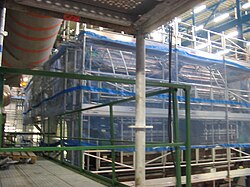
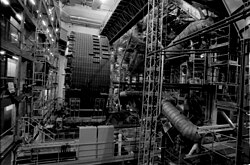
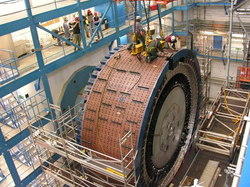
Muon Spectrometer and Magnet Systems
The Muon Spectrometer is the largest sub-detector, extending to the full 11-meter radius of the instrument. Because muons are highly penetrating, they pass through all other layers before reaching this system. It consists of 1,200 precision chambers and triggering chambers, designed to measure 1 TeV muons with 10% accuracy.
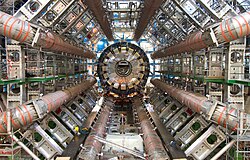
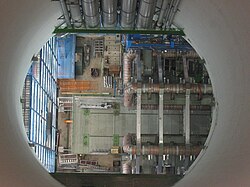
To enable these measurements, ATLAS employs two superconducting magnet systems that utilize the Lorentz force to bend the paths of charged particles. The Solenoid Magnet provides a uniform two-tesla field for the Inner Detector, while the Toroid Magnets—consisting of 24 barrel loops and two end-caps—provide a non-uniform field between 2 and 8 Teslameters for the Muon Spectrometer.
Forward Detectors and Data Management
ATLAS is supplemented by four forward detectors to measure particles at very small angles: LUCID (luminosity), ZDC (neutral particles), AFP (diffractive events), and ALFA (elastic proton scattering).
The Challenge of Big Data
The detector generates a staggering 1 petabyte of raw data per second. To manage this, ATLAS uses a sophisticated trigger system:
- Level 1 (L1): Custom hardware that reduces the event rate from 40 MHz to 100 kHz in less than 2.5 μs.
- High Level Trigger (HLT): A software farm of 40,000 CPUs that further reduces the rate to 1 kHz.
The remaining data, totaling over 10 petabytes per year, is processed via Grid computing, a global network of university and laboratory computers that reconstruct raw signals into physics objects like jets, photons, and leptons.
| System | Primary Function | Key Technology | Target Particles |
|---|---|---|---|
| Inner Detector | Precise Tracking | Silicon Pixels/Strips & Straws | All charged particles |
| EM Calorimeter | Energy Measurement | Liquid Argon / Lead / Steel | Electrons, Photons |
| Hadron Calorimeter | Energy Measurement | Scintillating Tiles / Steel | Hadrons |
| Muon Spectrometer | Momentum Measurement | Precision Chambers / Toroids | Muons |
Frequently Asked Questions
How does ATLAS detect neutrinos?
Neutrinos cannot be detected directly as they do not interact with the detector material. Their presence is inferred by measuring a momentum imbalance among all other detected particles, which is possible because the detector is designed to be hermetic.
What is the purpose of the superconducting magnets?
The magnets create a magnetic field that exerts a Lorentz force on charged particles, causing their trajectories to curve. By measuring the radius of this curvature, scientists can determine the particle's electric charge and momentum.
Why is the trigger system necessary?
The raw data rate of 1 petabyte per second is too massive to store or process. The trigger system acts as a real-time filter, using hardware and software to discard uninteresting events and retain only those likely to contain significant physics data.
What is the difference between the EM and Hadron calorimeters?
The EM calorimeter is designed for particles that interact electromagnetically (like electrons and photons) and offers high precision. The Hadron calorimeter is designed for particles that interact via the strong force (hadrons) and is larger and less precise.
What is the role of Grid computing in ATLAS?
Grid computing allows the CPU-intensive task of offline event reconstruction to be distributed across a global network of computers, turning raw electronic signals into identifiable physics objects for analysis.