Machine Guns: Evolution, Technology, and Military Impact
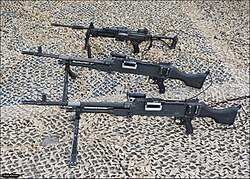
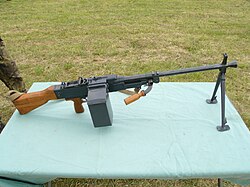
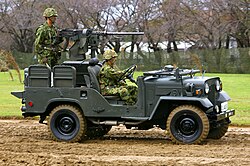
A machine gun (MG) is a fully automatic, rifled firearm engineered for sustained direct fire. Unlike standard infantry rifles, these weapons are designed to provide continuous suppressive fire, typically serving as critical infantry support. To manage the intense recoil generated by rapid firing, they are generally deployed using bipods, tripods, fixed mounts, or heavy weapons platforms.
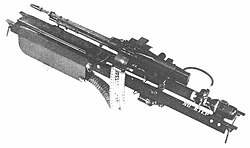
Technologically, many machine guns utilize belt feeding (where ammunition is linked in a continuous strip) and open bolt operation (where the bolt remains open until the trigger is pulled), features that distinguish them from most other infantry firearms. In military classification, firearms with a caliber of 20 mm (0.79 in) or larger are typically categorized as autocannons rather than machine guns.
Key Facts
- Definition: Fully automatic rifled firearms designed for sustained direct fire.
- Caliber Limits: Machine guns are generally under 20 mm; those 12.7 mm (0.5 in) to 20 mm are classified as heavy machine guns.
- Stability: Require mounts (bipods/tripods) to counteract recoil.
- Innovation: Sir Hiram Maxim created the first practical self-powered machine gun in 1884.
- Cooling: Water jackets were early innovations used to prevent barrel overheating.
The Evolution of Rapid-Fire Weaponry
Medieval and Early Experiments
The ancestors of the modern machine gun date back to medieval organ guns. In the mid-1570s, an English "engine of war" was developed, capable of firing between 160 and 320 shots, discharging 4 to 24 bullets at a time. While it boasted a rate of fire roughly three times that of a typical arquebusier and claimed all-weather reliability, the English government never adopted it.
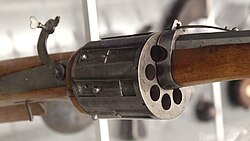
By the late 1500s, Europe saw the emergence of the first firearms capable of firing multiple shots from a single barrel without a full manual reload: the revolvers. Notable examples include a shoulder-length weapon from Nuremberg, Germany (c. 1580) and Hans Stopler's revolving arquebus (1597).
The 18th Century: The Puckle Gun and Pyroballistics
One of the most documented early designs was the Puckle Gun, patented by London lawyer James Puckle on May 15, 1718. This 1.25 in. (32 mm) flintlock cannon used a revolver cylinder to fire six to eleven rounds. Though described as a "machine gun" as early as 1722, it was a commercial failure and never saw widespread production.
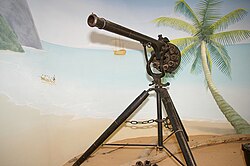
Throughout the 1700s, Continental inventors pushed the boundaries of "pyroballistic" machines. French reports from 1729 described machines firing 600 balls in minutes, and by the 1790s, Joseph-François-Louis Grobert invented a multi-barreled machine operated by four men that could fire 360 rifle shots per minute.
19th Century Innovations
The 1800s were marked by a surge in self-loading and rapid-fire designs. In 1830, Swiss inventor John Steuble developed a breech-loading machine gun fed by a hopper, capable of firing 136 to 204 shots per minute from 34 barrels. However, political and financial disputes with the English, Russian, and French governments hindered its adoption.
Other notable attempts included J.R. Nichols' electrically ignited prototype in 1847 and Cesare Rosaglio's single-operator gun in 1848, which claimed a rate of 300 shots per minute.
The Maxim Era and the World Wars
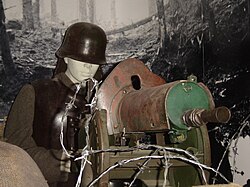
The landscape of warfare changed forever in 1884 when Sir Hiram Maxim invented the first practical self-powered machine gun. Unlike the hand-powered Gatling or Nordenfelt guns, the Maxim gun used the recoil energy of the fired bullet to cycle the action. To combat the heat generated by this high rate of fire, Maxim introduced a water jacket around the barrel for cooling.
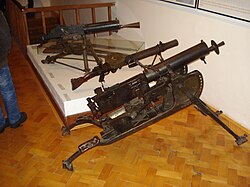
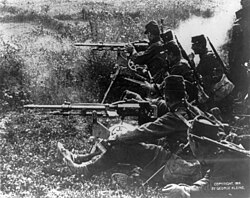
The military significance of these weapons became starkly apparent during World War I. For example, the United States Army increased its issuance from four machine guns per regiment in 1912 to 336 per regiment by 1919.
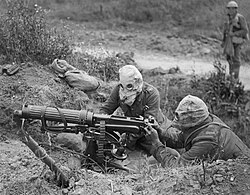
Modern Classifications and Cold War Development
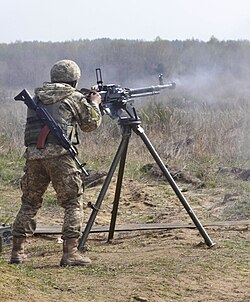
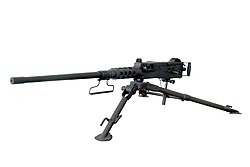
The term "heavy machine gun" evolved over time. Originally used in WWI to describe heavyweight medium guns, it now specifically refers to automatic weapons with a caliber between 12.7 mm (0.5 in) and 20 mm (0.8 in).
During the Cold War, the U.S. sought to replace the Browning Automatic Rifle (BAR) and the M1919 with a weapon that offered the power of the German MG 42 but could be fired from the hip or shoulder. This requirement led to the development of the M60 machine gun, which became a staple of the Vietnam War.
Technical Summary
| Category/Era | Defining Characteristic | Key Example/Inventor |
|---|---|---|
| Early Ancestors | Multi-shot organ guns / Revolvers | Nuremberg Revolvers (c. 1580) |
| Early Rapid Fire | Manually operated cylinders | Puckle Gun (1718) |
| Self-Powered | Recoil-operated / Water-cooled | Maxim Gun (1884) |
| Heavy Machine Gun | Caliber 12.7 mm to 20 mm | M2 Browning / DShK |
| Modern General Purpose | Versatile mounts / High mobility | M60 / FN MAG |
Frequently Asked Questions
What is the difference between a machine gun and an autocannon?
The primary distinction is the caliber of the ammunition. Firearms with a caliber of 20 mm (0.79 in) or larger are generally classified as autocannons, while those below this threshold are considered machine guns.
What is "open bolt operation"?
Open bolt operation is a design where the bolt remains held open until the trigger is pulled. This is common in machine guns to help prevent "cook-offs," where a round in a hot chamber fires spontaneously.
Why are bipods and tripods necessary for machine guns?
Because machine guns fire at a high rate of speed, they generate significant recoil. Bipods, tripods, and other fixed mounts provide the necessary stability to keep the weapon on target during sustained fire.
Who invented the first practical self-powered machine gun?
Sir Hiram Maxim invented the first practical self-powered machine gun in 1884, utilizing recoil energy to cycle the weapon and a water jacket to manage heat.
What defines a "heavy machine gun" today?
In modern military terms, a heavy machine gun is an automatic weapon with a caliber of at least 12.7 mm (0.5 in) but less than 20 mm (0.8 in).