M5 Motorway: Syria's Strategic North-South Backbone
The M5 motorway, recently redesignated as the M45 by the Ministry of Transport, serves as the primary north-south artery of Syria's transport network. Often referred to as the "International Road," this critical corridor facilitates the movement of goods and people across the country, linking the political capital of Damascus with the economic hub of Aleppo.
Spanning 450 kilometers (280 miles), the motorway connects the Jordanian border in the south to the Bab al-Hawa border crossing with Turkey in the north. Beyond the major cities, it provides essential access to Daraa, Al Nabk, Homs, and Hama. A key strategic point on this route is its intersection with the M4 motorway near Saraqib, which provides the primary link from Aleppo to the port of Latakia.
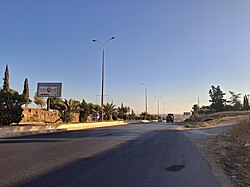
Key Facts
- Total Length: 450 km (280 mi).
- Primary Route: Connects the Jordan border to the Turkey border (Bab al-Hawa).
- Major Cities: Damascus, Aleppo, Homs, Hama, and Daraa.
- International Status: Part of the Arab Mashreq International Road Network (M45 corridor).
- Strategic Junction: Intersects with the M4 motorway near Saraqib.
The M5 vs. M45 Designation
There is often confusion regarding whether the road is the M5 or the M45. Historically, the route was part of a national system established in the 1950s where "Route 5" was the most important of nine national routes. As the road was upgraded to a dual carriageway (a highway with a dividing median), it became known as the M5.
However, under the Arab Mashreq International Road Network agreement, national numbering cannot overlap with international designations. To comply with these standards, the route is officially designated as the M45. This corridor is particularly significant as it connects Syrian cities with Mekkah and Madina, serving as a primary overland route for Muslim pilgrims.
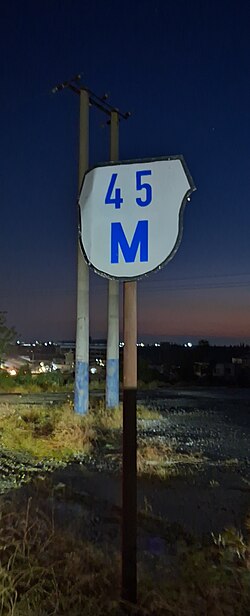
Technical Distinctions
While the M45 refers to the entire international corridor, the "M5" designation technically only applies to the sections that have been fully upgraded to motorway standards. For instance, the northern section between Aleppo and Bab al-Hawa was neglected and not fully upgraded, leading to frequent traffic congestion. Consequently, the true motorway standards begin at Aleppo city.
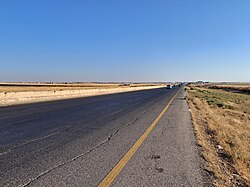
Infrastructure and Route Summary
The motorway varies in design across its length, ranging from dual carriageways separated by Jersey barriers (modular concrete barriers used to separate traffic) to sections with curbed medians and advanced lighting systems.
| Feature | Details |
|---|---|
| Southern Terminus | Jordan Border (Highway 15) |
| Northern Terminus | Bab al-Hawa Border Crossing (Turkey) |
| Total Distance | 450 km |
| Official Designation | M45 (Arab Mashreq Network) |
| Key Intersections | M4 Motorway at Saraqib |
![Al-Rastan bridge [ar] of M5 motorway](/images/c2/b4/c2b4ad2a74d41e9d4662eb1a2c089fb09ac1d93d2074324efc5c4d1019a96947.jpg)
Conflict and Recovery
Due to its strategic importance, the M5 has been a focal point of the Syrian Civil War since 2012. Control of the highway often signaled military dominance in the region. In October 2019, the northern section became a warzone during Turkey's Operation Peace Spring, as forces sought to reach the M4 junction.
The Syrian Army recaptured the full length of the motorway on February 14, 2020, though control of Saraqib fluctuated throughout February and March of that year. The highway was reopened for civilian use on March 8, 2020. More recently, the route was cut off again on November 28, 2024, during a Northwestern Syria offensive by opposition groups.
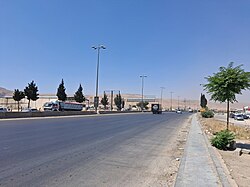
Future Rehabilitation
Looking toward recovery, the new Syrian government's Ministry of Transport has announced major tenders starting in 2026. The goal is to completely rehabilitate the M5 (M45) within a 500-day window to boost regional trade and restore the corridor's full functionality.
Frequently Asked Questions
What is the difference between the M5 and the M45?
The M5 is a common designation used by the public and map services, while M45 is the official designation under the Arab Mashreq International Road Network agreement to avoid overlapping with national numbering systems.
Which major cities does the motorway connect?
The motorway connects the Jordanian border to the Turkish border, passing through Daraa, Damascus, Al Nabk, Homs, Hama, and Aleppo.
Where does the M5 intersect with other major highways?
The M5 intersects with the M4 motorway near Saraqib; the M4 is the primary route connecting Aleppo to the port of Latakia.
Why is the M45 corridor important for international travel?
It serves as a vital overland corridor for Muslim passengers traveling for pilgrimage to Mekkah and Madina.
What is the current status of the road's infrastructure?
While much of the road is a dual carriageway, some northern sections have suffered from neglect. However, a comprehensive rehabilitation project is planned to be completed within 500 days starting from 2026.