Linnaean Insect Classification in Systema Naturae
In the 10th edition of Systema Naturae (1758–1759), the pioneering naturalist Carl Linnaeus established a foundational framework for classifying the animal kingdom. Among his most significant contributions was the class Insecta, a broad category that encompassed not only modern insects but also arachnids and crustaceans—collectively known today as arthropods.
Linnaeus described the Insecta as a diverse class of small animals characterized by their breathing through lateral spiracles (small openings on the abdomen) and their protection by a bony skin or hair. He noted their numerous feet and moveable antennae, which he identified as the likely instruments of sensation.
Key Facts
- Scope: The original class Insecta included insects, arachnids, and crustaceans.
- Primary Criteria: Classification into orders was based chiefly on wing form.
- Anatomy: Linnaeus identified a heart with one auricle and no ventricles, and a lack of a brain, ears, or nostrils.
- Diversity: The class was divided into seven distinct orders.
The Biological Characteristics of Insecta
Linnaeus detailed specific physiological traits to define the class. He described their blood as cold and "pus-like," and their external structure as a "bony coat of mail." In terms of sensory organs, he recognized the tongue, eyes, and antennae, while explicitly noting the absence of a brain, ears, and nostrils.
The physical supports for these creatures included feet and, for many, wings, which allowed them to buzz or skip across dry ground. Their respiratory system relied on lateral pores, and their jaws were positioned laterally.
The Seven Orders of Insects
Linnaeus organized the class Insecta into seven orders. While he primarily used a key based on the number and type of wings, he occasionally grouped organisms based on other shared affinities.
Four-Winged Insects
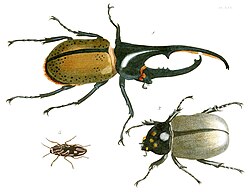
- Coleoptera: Forewings are fully hardened (e.g., scarab and ladybird beetles).
- Hemiptera: Forewings are partly hardened (e.g., cicadas and aphids).
- Lepidoptera: Wings are covered with flat scales (e.g., butterflies and moths).
- Neuroptera: Membranous wings with an unarmed tail (e.g., dragonflies and lacewings).
- Hymenoptera: Membranous wings with a tail bearing a sting (e.g., bees, ants, and wasps).
Two-Winged and Wingless Insects
- Diptera: Possessing only two wings (e.g., house flies and mosquitoes).
- Aptera: Lacking wings entirely (e.g., silverfish, spiders, and crabs).
Interestingly, Linnaeus sometimes prioritized biological affinity over his own wing-based key. For example, he placed the wingless female scale insects (genus Coccus) within the Hemiptera and correctly placed the wingless sheep ked (Hippobosca ovina) within the Diptera.
Summary of Linnaean Genera
| Order | Example Genera |
|---|---|
| Coleoptera | Scarabaeus, Coccinella, Cerambyx, Blatta, Gryllus |
| Hemiptera | Cicada, Cimex, Aphis, Coccus, Thrips |
| Lepidoptera | Papilio, Sphinx, Phalaena |
| Neuroptera | Libellula, Ephemera, Hemerobius, Panorpa |
| Hymenoptera | Apis, Formica, Vespa, Ichneumon |
| Diptera | Musca, Culex, Tabanus, Hippobosca |
| Aptera | Aranea, Scorpio, Cancer, Pediculus, Termes |
Frequently Asked Questions
How did Linnaeus define the class Insecta?
He defined them as numerous small animals with lateral spiracles for breathing, a bony skin or hair covering, many feet, and moveable antennae used for sensation.
What was the primary basis for dividing insects into orders?
The division was based chiefly on the form and number of the wings.
Did Linnaeus include non-insects in his Insecta class?
Yes, he included various arthropods that are now classified separately, such as spiders (Aranea), scorpions (Scorpio), and crabs (Cancer) within the order Aptera.
Which order contains the beetles?
Beetles are found in the order Coleoptera, characterized by forewings that are fully hardened.
How did Linnaeus handle wingless insects that shared traits with winged ones?
He grouped them by affinity; for instance, he placed the wingless sheep ked in Diptera and scale insects in Hemiptera despite their lack of wings.