LED Light Bulbs: Evolution, Technology, and Energy Efficiency
The transition to Light Emitting Diode (LED) lighting represents one of the most significant shifts in residential and industrial illumination. Unlike traditional bulbs, LEDs are a form of solid-state lighting that provide immediate full brightness without a warm-up period. Because frequent switching does not reduce their life expectancy, they offer a durable and highly efficient alternative to incandescent and fluorescent options.
The global LED lamp market is experiencing rapid growth, projected to increase from US$75.8 billion in 2020 to US$160 billion by 2026. This surge is driven by superior performance and a gradual decrease in light output over time, rather than the abrupt failure common in older technologies.
Key Facts
- Invention: Developed by Howard C. Borden and Gerald P. Pighini in 1968.
- Efficiency: Modern high-efficiency LEDs can reach at least 210 lm/W (lumens per watt).
- Lifespan: Typical domestic LED lamps have an average life of 15,000 hours.
- Instant On: LEDs reach full brightness immediately with no warm-up delay.
- Environmental Impact: Widespread adoption has contributed to a multi-year decrease in U.S. electricity usage.
The History of Solid-State Lighting
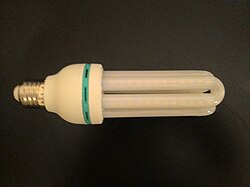
Before LEDs became mainstream, general white lighting relied on incandescent, halogen, and compact fluorescent lamps (CFLs). Early LED lamps struggled with chromaticity—the quality of a color regardless of its luminance—often differing significantly from the warm glow of incandescent bulbs.
To address this, standards such as ANSI C78.377-2008 were developed to specify recommended color ranges for solid-state lighting. In 2008, the National Institute of Standards and Technology (NIST) announced the first U.S. standards for performance specifications and test methods. Simultaneously, the Illuminating Engineering Society of North America (IESNA) published the LM-79 standard to measure light output (lumens), efficacy, and chromaticity.
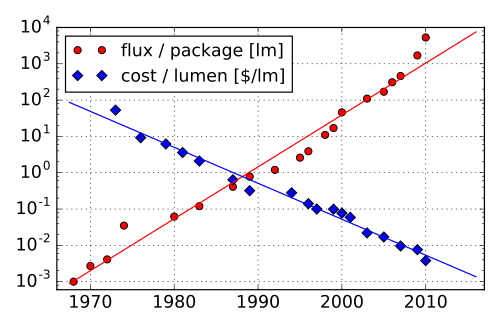
Commercial adoption accelerated in the late 2000s. Ushio released the first LED filament lamp in 2008, and Philips introduced its first LED lamp in 2009, followed by 60W and 75W equivalents in 2010 and 2011, respectively.
How LED Technology Works
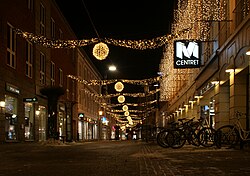
Generating White Light
General-purpose lighting requires white light that emulates a black body at specific temperatures, ranging from warm white (2700K) to daylight (6500K). Because LEDs naturally emit light in narrow wavelength bands, white light is achieved through two primary methods:
- Mixing light from multiple LEDs of different colors.
- Using a phosphor to convert some of the light into other colors.
The quality of this light is measured by the Color Rendering Index (CRI), where 100 is the ideal value. Most standard LED bulbs have a CRI of about 80, while high-end versions exceed 95.
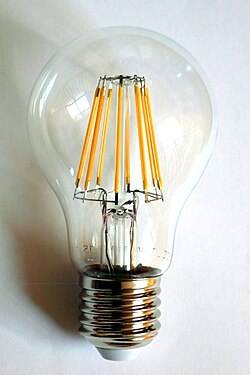
Technical Components and Challenges
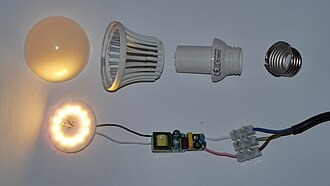
LEDs require LED drivers to manage power and thermal management systems to dissipate heat. One technical challenge is efficiency droop, where the efficiency of an InGaN (Indium Gallium Nitride) LED decreases as the input current increases.
![Efficiency droop in an InGaN LED as a function of its input current[56]](/images/8a/60/8a60f7509b433674aa4e6396831568782487967c25f222f59b1de8c5151a19c3.webp)
Practical Applications
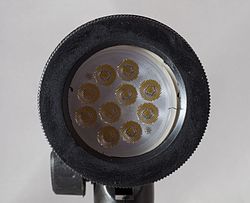
Household and Specialty Lighting
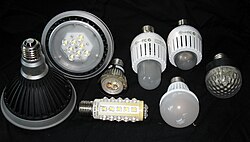
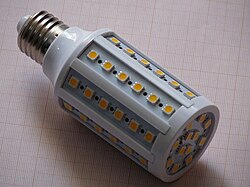
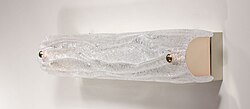
LEDs are now common drop-in replacements for incandescent bulbs using the standard Edison screw. Some high-power "corn cob" lamps and LED-wall lamps provide specialized illumination for various home needs.
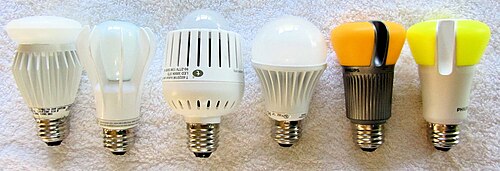
Beyond the home, LEDs have revolutionized other sectors:
- Automotive: Audi pioneered LED daytime running lights and directionals in the 2004 A8 W12.
- Medical: The first LED surgical goggles were demonstrated in 2003.
- Art: The National Museum in Warsaw uses computer-led LED lighting to enhance the unique qualities of paintings.
![Computer-led LED lighting allows enhancement of unique qualities of paintings in the National Museum in Warsaw.[66]](/images/b2/1e/b21e63b9f06c1a0c78fbfce69af1d97ef4c72819c4fe1154da02108cd6b87cd6.jpg)
LED Tube Lamps
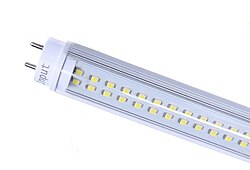
Designed to replace fluorescent tubes, LED tubes fit T5, T8, T10, or T12 designations. Unlike fluorescent tubes that emit light in all directions, LED tubes use Surface-Mounted LEDs (SMDs), which are directional and require specific orientation during installation.
Comparing Lighting Technologies
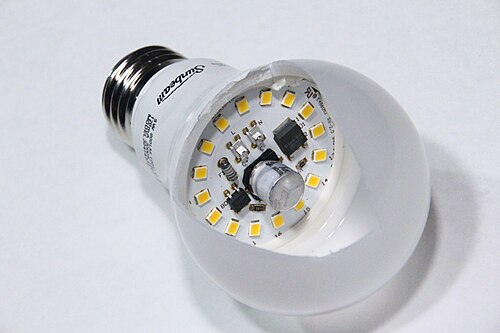
LEDs offer significant long-term savings compared to Halogen, Incandescent, and CFL lamps. While the initial purchase price may be higher, the drastically lower wattage and extended lifespan reduce the total cost of ownership over time.
| Lamp Type | Watts | Lumens/Watt | Lifespan (Hours) | Total 20-Year Cost |
|---|---|---|---|---|
| Philips Ultra Efficient (2023) | 4 | 210 | 50,000 | $35 |
| Cree (2019) | 9.5 | 85.8 | 25,000 | $75 |
| CFL (EcoSmart) | 6.5 | 123.1 | 15,000 | $56 |
| Halogen (V-TAC) | 9 | 89.6 | 20,000 | $69 |
| Incandescent | 60 | 14.3 | 1,000 | $441 |
Frequently Asked Questions
Do LED bulbs need a warm-up period?
No, LEDs come to full brightness immediately upon being switched on, unlike some fluorescent lights that require a warm-up delay.
How does the lifespan of an LED compare to an incandescent bulb?
LEDs are significantly more durable. While a typical incandescent bulb may last around 1,000 hours, a domestic LED lamp is often rated for an average life of 15,000 hours.
What is the Color Rendering Index (CRI)?
CRI is a measure of how accurately a light source reveals the colors of objects compared to a natural light source. A CRI of 100 is ideal; most LEDs range from 80 to over 95.
Can LED tubes be used in existing fluorescent fixtures?
Yes, many LED tube lamps are designed as drop-in replacements for T5, T8, T10, or T12 fixtures, though some may require the removal or replacement of the ballast.
What is efficiency droop in LEDs?
Efficiency droop refers to the phenomenon where the light-output efficiency of an LED decreases as the input current increases.