Lebanese Arabic: Linguistics, Dialects, and Cultural Identity
Lebanese Arabic (Arabic: عَرَبِيّ لُبْنَانِيّ ʿarabiyy lubnāniyy) is a vibrant variety of Levantine Arabic indigenous to Lebanon. Spoken by approximately 4.9 million native speakers as of 2024, it serves as a primary marker of national identity and a bridge to the wider Arab world. Because Lebanon is a hub of multilingualism, speakers frequently experience diglossia—a situation where two distinct varieties of a language are used by a single community—often code-switching between Lebanese Arabic, French, and English in daily conversation.
Historically, the language emerged from the Arabic dialects introduced to the Levant in the 7th century AD. Over centuries, these supplanted indigenous Northwest Semitic languages, resulting in a significant Aramaic substratum (a linguistic layer left by a previous language). It also features adstrate influences from Ottoman Turkish, French, and English, making it closely related to Syrian, Palestinian, and Jordanian Arabic.
Key Facts
- Native Speakers: 4.9 million (2024).
- Language Family: Afro-Asiatic > Semitic > West > Central > Arabic > Levantine.
- Core Feature: Significant Aramaic influence and frequent multilingual code-switching.
- Writing: Primarily uses the Arabic alphabet, though an informal "chat alphabet" using Latin letters and numbers is common.
- Phonology: Notable for the replacement of the voiceless uvular plosive /q/ with a glottal stop [ʔ].
Linguistic Differences from Standard Arabic
While Lebanese Arabic shares a root with Modern Standard Arabic (MSA), it diverges significantly in syllable structure and morphology. Unlike MSA, which typically allows only one consonant at the start of a syllable, Lebanese Arabic frequently employs two consonants in the onset. Furthermore, it lacks the mood and grammatical case markings found in the formal standard.
One of the most prominent phonetic shifts is the debuccalization of the letter qaf (/q/). In most Lebanese dialects, /q/ becomes a glottal stop [ʔ]. For example, the word for coffee, qahwa (/ˈqahwa/) in MSA, becomes [ˈʔahwe] in Lebanese. An exception to this rule is found among the Druze community, particularly in mountainous regions, who have retained the original /q/ pronunciation.
Another distinction is the treatment of diphthongs. While many Arabic varieties monophthongize /aj/ and /aw/, some Lebanese dialects retain them as [eɪ] and [eʊ]. In urban Beiruti dialects, however, these often shift to [eː] and [oː].

Regional Varieties and Dialects
Lebanese Arabic is not monolithic; it consists of several regional variations that differ in pronunciation and vocabulary. Historically, the geographer Yaqut al-Hamawi noted that the Lebanon district once contained as many as seventy dialects, some so distinct they required interpreters.
Modern regional varieties include:
- North Lebanese and North-Central Lebanese Arabic
- Beqaa Arabic
- South Lebanese and South-Central Lebanese Arabic
- Sunni Beiruti Arabic
- Saida Sunni Arabic
- Iqlim-Al-Kharrub Sunni Arabic
- Jdaideh Arabic
The Debate Over Linguistic Descent
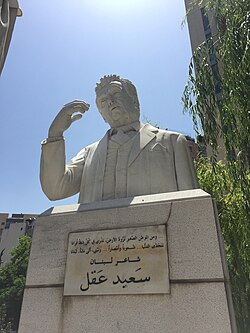
The classification of Lebanese Arabic has been a subject of intellectual debate. The literary figure Said Akl advocated for the recognition of Lebanese as a distinct, prestigious language, viewing Standard Arabic as a "dead language." This movement gained some traction among the Lebanese diaspora.
Similarly, statistician Nassim Nicholas Taleb has argued that the vernacular is a separate Central Semitic language descended from Aramaic and Canaanite, suggesting that its Arabic vocabulary consists largely of loanwords. He proposed terms like "Northwestern Levantine" or "neo-Canaanite."
However, the linguistic consensus, supported by scholars like Ahmad Al-Jallad, is that Lebanese is a variety of Arabic. While it contains "sedimentary structures" of older languages, its basic lexicon and morphology align with the Arabic branch of the Semitic family.
Writing Systems and Orthography
Lebanese Arabic is rarely used for formal writing, which is reserved for MSA, French, or English. However, it is the primary medium for songs, theater, and zajal (traditional oral poetry). In informal digital communication, Lebanese people use the Arabic chat alphabet, employing Latin letters and numbers to represent sounds that lack Latin equivalents:
- 2 for ء or ق (glottal stop)
- 3 for ع (ayn)
- 5 or kh for خ (kha)
- 7 for ح (ha)
- 8 or gh for غ (ghayn)
Said Akl attempted to formalize a Latin-based alphabet for Lebanese, using modified letters (such as ꞓ for the hamza) to better suit the local phonology. While not widely adopted for general use, this system influenced some lexicographical works, such as Roger Makhlouf's Lebanese-English Lexicon.
Summary of Linguistic Features
| Feature | Modern Standard Arabic (MSA) | Lebanese Arabic |
|---|---|---|
| Qaf (/q/) Pronunciation | Voiceless uvular plosive /q/ | Usually a glottal stop [ʔ] |
| Syllable Onset | Single consonant | Often two consonants |
| Grammar | Case and mood markings | No case or mood markings |
| Final Vowel (Tāʾ marbūṭah) | [a] | Raised to [e] (imāla) |
| Writing System | Arabic Alphabet | Arabic Alphabet / Latin Chat Alphabet |
Frequently Asked Questions
Is Lebanese Arabic a separate language or a dialect?
While some figures like Said Akl and Nassim Nicholas Taleb argue it is a separate language descended from Aramaic or Canaanite, the general linguistic consensus is that it is a variety (dialect) of Arabic with a strong Aramaic substratum.
Why do Lebanese people use numbers in their text messages?
They use numbers (like 3, 7, and 8) in the "Arabic chat alphabet" to represent specific Arabic sounds that do not have a direct equivalent in the Latin alphabet.
Who still pronounces the letter 'Qaf' in Lebanon?
The Druze community, particularly those living in the mountains, generally retain the classical /q/ pronunciation, whereas most other speakers use a glottal stop.
What is 'imāla' in the context of Lebanese Arabic?
Imāla refers to the raising of the word-final vowel of the tāʾ marbūṭah (ـة) from the MSA [a] sound to an [e] sound.
How does Lebanese Arabic differ from other Levantine dialects?
While closely related to Syrian, Palestinian, and Jordanian Arabic, Lebanese is distinguished by specific vowel shifts, unique regional dialects (like Beiruti), and a high frequency of French and English loanwords due to the country's history of multilingualism.