Le Cateau-Cambrésis: A Historic Commune in Northern France
Located in the heart of the Nord department within the Hauts-de-France region, Le Cateau-Cambrésis is a commune that blends deep historical significance with artistic prestige. Formerly known simply as Le Cateau until 1977, the town's name reflects its location in the Cambrésis, a county that historically fell under the jurisdiction of the Prince-Bishop of Cambrai.
Today, the commune serves as a vital link in northern France, with its railway station providing direct connections to major hubs including Paris, Maubeuge, and Saint-Quentin.
Key Facts
- Region: Hauts-de-France, Nord department.
- Population: 6,764 (as of 2023).
- Artistic Legacy: Home to the third largest collection of Henri Matisse's works in France.
- Historical Milestone: Site of the 1559 Peace of Cateau-Cambrésis.
- Geography: An area of 27.24 km² with an average elevation of 96 meters.
Historical Significance
Le Cateau-Cambrésis has long been a strategic point of interest in European geopolitics. One of its most enduring legacies is the Peace of Cateau-Cambrésis, agreed upon on April 2–3, 1559, which brought an end to the Italian Wars.
The town's sovereignty shifted over the centuries. Until 1678, it was part of the Spanish Netherlands before being officially conquered by France through the Treaty of Nijmegen. Its strategic position also made it a site of conflict during later eras; allied forces defeated French troops here on March 29, 1794.
In the 20th century, the commune played a role in World War I. On August 26, 1914, Le Cateau formed the right wing of the II Corps of the British Expeditionary Force during the Battle of Le Cateau, a critical engagement during their withdrawal from the Battle of Mons.
Art and Culture
The commune is a destination for art lovers, primarily due to its connection with the world-renowned artist Henri Matisse. The Musée Départemental Henri Matisse, housed in the historic Palais Fénelon in the town center, hosts the third largest collection of Matisse's works in France.
Beyond Matisse, the town has been the birthplace of several notable figures, including Marshal Mortier, artist Arthur Henri Lefort Des Ylouses, and Raymond Poïvet, a creator of the science fiction comics Les Pionniers de l'Espérance. Additionally, Pierre Nord was born here, and Pierre Mauroy, a prominent political figure, attended high school in the commune and later served as its representative at the general council for the Nord department.
Heraldry and Identity
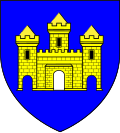
The identity of Le Cateau-Cambrésis is visually represented by its coat of arms. The heraldic blazon is described as Azure, a 3-towered castle or, featuring a gold castle with three towers set against a blue background.
Commune Overview
| Category | Detail |
|---|---|
| Department / Arrondissement | Nord / Cambrai |
| Intercommunality | CA Caudrésis–Catésis |
| Area | 27.24 km² |
| Population (2023) | 6,764 |
| Population Density | 248.3/km² |
| Elevation Range | 84–157 m |
| Postal Code | 59360 |
Population Trends
Since 1968, the population of Le Cateau-Cambrésis has seen a gradual decline. From a peak of 9,114 residents in 1968, the population decreased to 6,764 by 2023, reflecting a steady downward trend over the last several decades.
Frequently Asked Questions
What is the significance of the Peace of Cateau-Cambrésis?
The Peace of Cateau-Cambrésis was a major diplomatic agreement signed on April 2–3, 1559, which effectively ended the Italian Wars.
Which famous artist is associated with Le Cateau-Cambrésis?
Henri Matisse was born in Le Cateau-Cambrésis. The town's Musée Départemental Henri Matisse, located in the Palais Fénelon, holds the third largest collection of his works in France.
When did Le Cateau-Cambrésis become part of France?
The city belonged to the Spanish Netherlands until 1678, when it was officially conquered by France via the Treaty of Nijmegen.
What happened at Le Cateau during World War I?
On August 26, 1914, the Battle of Le Cateau took place, where the town formed the right wing of the British Expeditionary Force's II Corps during their withdrawal from the Battle of Mons.
How can visitors reach Le Cateau-Cambrésis?
The commune is accessible via the Le Cateau station, which provides rail connections to Paris, Maubeuge, and Saint-Quentin.