Laysan Albatross: The Remarkable Life of the North Pacific's Great Wanderer
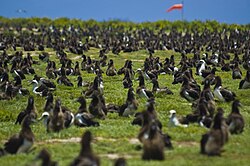
The Laysan albatross (Phoebastria immutabilis) is a majestic seabird that commands the vast expanses of the North Pacific. While these birds are known for their incredible endurance and wide-ranging flights, the vast majority of their population is concentrated in a very specific region: the Northwestern Hawaiian Islands, which host 99.7% of the species. With an estimated population of 1.18 million birds, this gull-like albatross is the second-most common seabird in the Hawaiian archipelago.
First described in 1893 by Lionel Walter Rothschild based on a specimen from Laysan Island, the Laysan albatross has become a symbol of both the fragility and the resilience of marine wildlife.
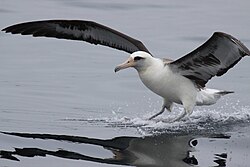
Key Facts
- Scientific Name: Phoebastria immutabilis
- Conservation Status: Near Threatened (IUCN 3.1)
- Primary Habitat: Northwestern Hawaiian Islands, specifically Midway and Laysan.
- Wingspan: 195 to 203 cm (77–80 in).
- Oldest Known Wild Bird: A female named Wisdom, estimated to be 74 years old as of 2024.
- Diet: Primarily squid and fish.
Physical Characteristics
The Laysan albatross is a medium-sized member of its family, averaging 81 cm (32 in) in length. There is a noticeable size difference between the sexes; males typically weigh between 2.4 and 4.1 kg (5.3–9.0 lb), while females are smaller, weighing between 1.9 and 3.6 kg (4.2–7.9 lb).
Their plumage is characterized by blackish-gray upperwings, mantle, back, and tail, contrasting sharply with a white head, lower rump, and underparts. A distinctive black smudge surrounds the eye, and they possess a pink bill with a dark tip. Juveniles can be distinguished by their gray bills and dark upper rumps. Unlike many other bird species, the Laysan albatross does not have a specific breeding plumage.
Distribution and Habitat
While the heart of the population resides in the Northwestern Hawaiian Islands, the Laysan albatross maintains 16 nesting sites across the North Pacific. Small populations exist on the Bonin Islands near Japan, and the species has begun colonizing islands off the coast of Mexico, including Guadalupe Island and the Revillagigedo Archipelago. In Mexico, they are protected within the Guadalupe Island Biosphere Reserve.
When not breeding, these birds are true nomads, ranging from the Bering Sea and Japan south to 15°N.
Reproduction and Life Cycle
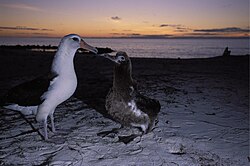
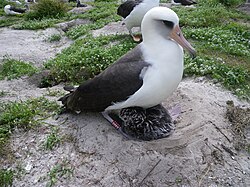
The reproductive process of the Laysan albatross is a long-term investment. Both parents share the responsibility of raising a single, buff-white egg, which measures approximately 10.7 cm by 6.8 cm. The male typically begins the incubation process, which lasts about 65 days. This is followed by several weeks of brooding.
Once the chick hatches, both parents spend significant time at sea gathering food. They feed their young a nutrient-dense mixture of partially digested squid, fish, and a rich "stomach oil." It takes approximately 160 days for a chick to fledge (acquire the feathers necessary for flight). Because of this immense time commitment, the birds engage in long courtships to ensure partner compatibility.
Wisdom: A Record-Breaking Life
The Laysan albatross is renowned for its longevity. The most famous example is a female named Wisdom, the oldest known wild bird in the world. First banded by a U.S. Geological Survey researcher in 1956, Wisdom was already rearing a chick at that time. Since albatrosses cannot breed until age five, she was estimated to be at least 66 in 2016. By 2024, her estimated age reached 74. In December 2024, she was observed laying her estimated 60th egg at the Midway Atoll National Wildlife Refuge.
Conservation and Environmental Challenges
The Laysan albatross is currently classified as Near Threatened. In the early 20th century, the species suffered devastating losses due to wide-scale hunting by feather hunters, which completely wiped out populations on Johnston Atoll and Wake Island.
The Lead Crisis at Midway Atoll
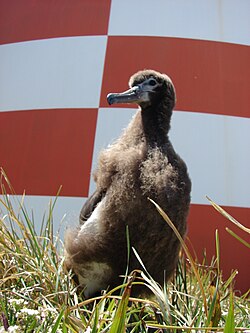
A more recent threat emerged at Midway Atoll, where approximately 70% of the global population nests. Abandoned Navy buildings coated in lead-based paint posed a lethal risk to chicks. Young birds would ingest paint chips, leading to severe neurological disorders and death. Some developed "droop wing," a condition where they cannot lift their wings, leaving them vulnerable to infection and starvation.
Following advocacy and legal action by groups like the American Bird Conservancy and the Center for Biological Diversity, a massive remediation project was launched. By August 2018, after treating over 20,000 cubic yards of contaminated soil and stripping paint from federal buildings, Midway Atoll was declared lead-free.
Population Summary
| Breeding Location | Breeding Pairs | Population Trend |
|---|---|---|
| Midway Atoll | 441,178 | Stable (1992-2005) |
| Laysan Island | 103,689 | Stable (1992-2005) |
| French Frigate Shoals | 7,073 | Stable (1992-2005) |
| Islas Guadalupe | 337 | Increasing |
| Other Mexican Islands | 63 | Increasing |
| Tori-shima (Izu Islands) | 1,218 | Unknown |
| Bonin Islands | 23 | Unknown |
Frequently Asked Questions
How long do Laysan albatrosses live?
They are very long-lived birds. The oldest confirmed wild bird, a female named Wisdom, is estimated to be 74 years old as of 2024.
What do Laysan albatrosses eat?
Their diet consists primarily of fish and squid, which they regurgitate as a rich "stomach oil" to feed their chicks.
Why is the population concentrated in Hawaii?
The Northwestern Hawaiian Islands provide critical nesting grounds, with 99.7% of the breeding population located there, particularly on Midway and Laysan islands.
What is "droop wing" in albatross chicks?
Droop wing is a neurological condition caused by lead poisoning from ingesting lead-based paint chips. It prevents chicks from raising their wings, making flight impossible and leading to eventual death.
Are Laysan albatrosses endangered?
They are currently classified as Near Threatened by the IUCN. While they suffered greatly from hunting in the 1900s, populations in some areas are now stabilizing or increasing.