Common Murre: The Master Diver of the Northern Seas
The Common Murre (Uria aalge) is a highly specialized seabird known for its remarkable ability to navigate both the air and the deep ocean. While they are fast in direct flight, their true mastery lies beneath the surface, where they utilize their wings to "fly" through the water column in search of prey.
These birds are essential components of marine ecosystems, serving as indicators of ocean health. However, they face significant challenges from environmental shifts, most notably extreme temperature changes in their northern habitats.
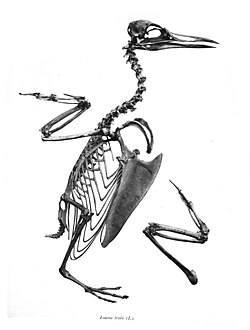
Key Facts
- Scientific Name: Uria aalge
- Diving Depth: Typically 30–60 m, with records reaching 180 m.
- Nesting Habit: Densely packed colonies called "loomeries" on bare rock.
- Diet: Primarily small schooling forage fish under 200 mm.
- Conservation Status: Least Concern (IUCN 3.1), though local populations face crises.
- Lifespan: Average of approximately 20 years.
Physical Characteristics and Taxonomy
The common murre typically measures between 38 and 46 cm in length, with a wingspan ranging from 61 to 73 cm. Males and females are indistinguishable in the field. Their weight varies by region, generally ranging from 945 g in southern areas to 1,044 g in the north, though some individuals have been recorded between 775 g and 1,250 g.
In breeding plumage, the nominate subspecies (U. a. aalge) features a black head, back, and wings contrasted by white underparts. After the post-breeding moult, they develop a white face with a dark spur behind the eye. Some subspecies, such as U. a. albionis found in southern Britain, appear dark brown rather than black. Their bills and legs are typically dark grey, though rare aberrations, including a bright yellow bill, have been documented.
Subspecies Distribution
Five subspecies are currently recognized, including:
- U. a. hyperborea: Found from coastal north Norway to Svalbard and Novaya Zemlya.
- U. a. californica: Located along the east North Pacific, from north Washington to south California.
Flight and Diving Capabilities
While the common murre is efficient in direct flight, it lacks agility in the air. Its evolutionary strengths are focused on pursuit-diving—a method of foraging where the bird swims underwater using its wings for propulsion.
Most dives last less than one minute and cover distances exceeding 30 m. While they typically forage at depths of 30–60 m (100–195 ft), they are capable of descending to 180 m (590 ft) and remaining submerged for several minutes.
Diet and Foraging Behavior
Common murres are opportunistic hunters that primarily target small schooling forage fish 200 mm (8 in) or shorter. Their preferred prey includes capelin and sand lances, though they also consume polar cod, sprats, sandeels, Atlantic cod, and Atlantic herring. To supplement their diet, they eat squid, marine worms, molluscs, and crustaceans like amphipods.
On average, an adult consumes 20–32 g of food daily. These birds are highly mobile, often traveling 100 km (60 mi) or more from their breeding grounds to find sufficient food sources.
Breeding and Life Cycle
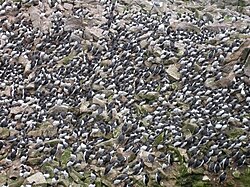
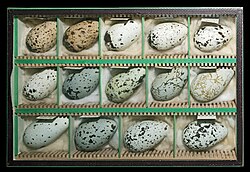
Common murres are famous for their loomeries—densely packed colonies where up to twenty pairs may occupy a single square metre during peak season. Unlike many birds, they do not build nests, instead laying their eggs directly on the ground, under rocks, or on bare rock ledges.
Birds typically begin breeding between four and nine years of age, with most recruiting into the population by age six or seven. Breeding success generally increases with age, peaking around 9–10 years at approximately 0.7 fledglings per pair, before declining due to reproductive senescence (the gradual deterioration of reproductive capacity with age).
From Fledge to Flight
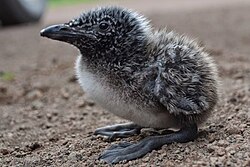
The transition from nest to ocean is a dramatic event. Chicks leave the nest after 16 to 30 days (averaging 20–22 days). Because they cannot yet fly, they glide down from cliffs—sometimes from heights as high as 457 m (1,499 ft)—fluttering their wings to slow their descent.
Following this "leap of faith," the male takes over primary care, feeding and attending to the chick at sea for up to two months. The chicks gain the ability to fly roughly two weeks after fledging and may swim up to 1,000 km (600 mi) during their southern migration.
Environmental Threats and Population Decline
Despite their overall status as a species of "Least Concern," common murres are highly susceptible to climate-driven events. A catastrophic marine heatwave between 2014 and 2016 devastated populations in Alaska.
A 2024 study published in Science revealed that this event caused a population plummet of 52% to 78% across 13 colonies, resulting in the loss of approximately 4 million birds. This is cited as the largest documented wildlife mortality event in the modern era, and as of 2024, there has been no evidence of recovery.
| Feature | Details |
|---|---|
| Average Length | 38–46 cm |
| Wingspan | 61–73 cm |
| Max Diving Depth | 180 m (590 ft) |
| Primary Diet | Schooling fish (Capelin, Sand lances) |
| Nesting Site | Bare rock ledges (Loomeries) |
| Chick Fledging Age | 16–30 days |
Frequently Asked Questions
What is a loomery?
A loomery is a densely packed breeding colony of common murres. In these colonies, birds nest in extremely close proximity, sometimes with twenty pairs sharing a single square metre of rock ledge.
How do common murre chicks reach the ocean?
Since they cannot fly immediately, chicks glide or flutter down from cliff edges—sometimes from heights up to 457 m—to reach the water below.
What is the primary cause of the recent mass mortality in Alaska?
An extreme marine heatwave between 2014 and 2016 is responsible for the death of approximately 4 million common murres in Alaska, marking one of the worst single-species mortality events in modern history.
How do common murres hunt for food?
They are pursuit-divers, meaning they use their wings to swim and "fly" underwater to chase small schooling fish, typically diving to depths between 30 and 60 meters.
Do common murres build nests?
No, common murres do not build traditional nests. They lay their eggs directly on bare rock ledges, the ground, or under existing rocks.