Lake Crescent Maritime History: From Early Steamers to Massive Ferries
The serene waters of Lake Crescent once served as a vital transportation corridor, hosting a diverse fleet of powered vessels that connected remote settlements and luxury resorts. From the first gasoline launches to massive side-wheel ferries, the lake's maritime evolution reflects the growth of regional tourism and infrastructure in the early 20th century.
The Dawn of Powered Navigation
The era of powered boating on Lake Crescent began in 1891 with the launch of the Lady of the Lake, built by Paul Barnes. This pioneering vessel established a key route between Fairholm and Piedmont. As demand for faster travel grew, the lake welcomed The Flyer in 1893, a steamer designed for increased speed.
Beyond these primary vessels, the lake supported a small fleet of steam and gasoline launches known for their evocative names, including the Olympus and the Greyhound.
The Rise of Luxury and Utility Transport
In 1913, Michael Earles, the proprietor of the Sol Duc Hot Springs Resort, introduced the Betty Earles. Named after his daughter, this gasoline-launch was designed to transport lodge guests from the head of the lake to Fairholm, where they would transfer to motor buses for the final leg of their journey to the resort.
The Betty Earles was a substantial vessel for its time, measuring 65 feet in length and 16.5 feet on the beam (the widest part of the ship). It was powered by a heavy-duty 80 horsepower (60 kW) Frisco Standard engine.
The Era of the Side-Wheel Ferries
As the need for vehicle transport grew, Clallam County commissioned Captain O.D. Treiber to design specialized ferries. In 1914, the Marjory entered service. A gasoline-powered side-wheel ferry—a vessel propelled by large wheels on either side of the hull—the Marjory measured 65 feet long and 27 feet on the beam. Powered by an 18 horsepower (13 kW) Field engine, it could carry 50 passengers and seven automobiles.
To meet increasing capacity needs, Treiber designed an even larger vessel: the Storm King, named after the mountain overlooking the lake. The Storm King was a massive side-wheeler, likely the largest vessel to ever navigate Lake Crescent. It featured a hull 90 feet long and 20.5 feet on the beam, while the deck extended to 112 feet in length and 31.5 feet across the wheels.
Powered by a 40 horsepower (30 kW) Fairbanks-Morse engine, the Storm King boasted a capacity of 150 passengers and 21 automobiles, exactly triple the capacity of the Marjory.
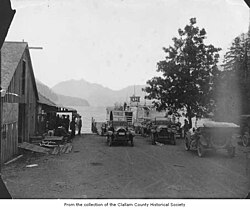
Key Facts
- First Powered Boat: The Lady of the Lake, launched in 1891.
- Largest Vessel: The Storm King, capable of carrying 150 passengers and 21 cars.
- Key Route: Fairholm served as a primary hub for passengers transferring to motor buses.
- Longevity: The Betty Earles remained in service as a tugboat until 1958.
Vessel Comparison Summary
| Vessel Name | Type | Length | Engine Power | Capacity |
|---|---|---|---|---|
| Betty Earles | Gasoline-launch | 65' | 80 hp | Guest transport |
| Marjory | Side-wheel ferry | 65' | 18 hp | 50 pax / 7 cars |
| Storm King | Side-wheel ferry | 112' (deck) | 40 hp | 150 pax / 21 cars |
The Legacy of the Betty Earles
The fate of the Betty Earles took a turn around 1918 when the Sol Duc lodge burned down. Michael Earles moved the boat off Lake Crescent to operate on Puget Sound under Captain O. G. Olson. In 1924, the vessel was sold to the Tacoma Tug & Barge Co. In a testament to its durable construction, the boat continued to operate as a tug under its original name as late as 1958.
Frequently Asked Questions
Which was the largest boat to operate on Lake Crescent?
The Storm King was likely the largest vessel, with a deck length of 112 feet and the ability to carry 150 passengers and 21 automobiles.
What was the purpose of the Betty Earles?
It was built to transport guests from the head of Lake Crescent to Fairholm, where they would then take motor buses to the Sol Duc Hot Springs Resort.
Who designed the lake's ferry system?
Captain O.D. Treiber designed both the Marjory and the Storm King for Clallam County.
When did powered boating begin on the lake?
Powered boating began in 1891 with the launch of the Lady of the Lake, built by Paul Barnes.
What happened to the Betty Earles after leaving the lake?
After the Sol Duc lodge burned down around 1918, it moved to Puget Sound and was eventually sold to the Tacoma Tug & Barge Co. in 1924, serving as a tug until 1958.